
Four ways for governments to balance data centre boom with a low-carbon future
At the Festival of Innovation (FOI), speakers highlighted the importance for policymakers to set common goals and accountability mechanisms to align diverse stakeholders to achieve a greener future for AI.
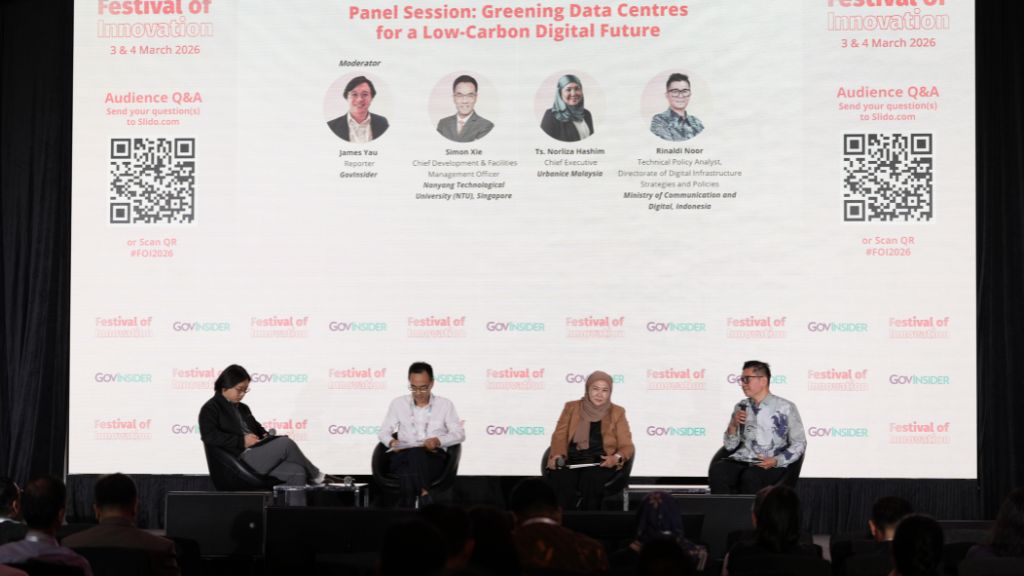
Speakers at the Festival of Innovation shared how to ensure that the expansion of data centres remains on track towards a low-carbon future. Image: GovInsider
Data centres have become the new critical infrastructure in Southeast Asia, driven by the rise of the digital economy and artificial intelligence (AI).
The e-Conomy SEA 2025 report shows that data centre development in Southeast Asia is the largest in the Asia-Pacific region, with an installed capacity of 4,620 MW.
More than 75 per cent of this capacity was concentrated in Malaysia (2,415 MW), Indonesia (825 MW), and Singapore (330 MW).
Yet, data centres were also among the largest consumers of energy and water.
In a panel titled Greening Data Centres for a Low‑Carbon Digital Future at the Festival of Innovation (FOI) 2026, leaders from government, academia, and urban planning discussed how to meet rapidly increasing digital demand without compromising sustainability targets.
Moderated by GovInsider’s Reporter James Yau, the panel featured perspectives from Urbanice Malaysia’s Chief Executive, Norliza Hashim; Nanyang Technological University (NTU)’s Chief Development and Facilities Management Officer, Simon Xie; and Indonesia’s Ministry of Communication and Digital (Komdigi)’s Technical Policy Analyst, Rinaldi Noor.
Here are the key takeaways from the session on how to balance the rise of data centres with the goal of a low‑carbon future.
1. Align digital growth with sustainability
For Noor, digital economy growth must go together with sustainability. Without green commitments, investor confidence could erode as countries could be seen as neglecting a sustainable future.
“Our digital economy [in Indonesia] is one of the largest in Southeast Asia. So, we cannot stop it … and carbon reduction must be aligned with it,” he said.
In this context, sustainability emerges not as an obstacle but as a prerequisite for competitiveness.
Echoing Noor’s perspective, Xie highlighted that regulatory certainty and policy clarity are key for investors and infrastructure operators, creating a win‑win situation for both economics and sustainability.
“Sustainability will not lose our competitiveness. Clear and stable sustainability requirements, in fact, can attract long‑term tech solutions,” he noted.
Hashim added that beyond clear policy, it was important to integrate policies across all supply chains and ensure that those who are involved have a common goal to work with.
2. Address the urban planning challenge
Hashim shared that the challenge in highly-intensive infrastructure development was that sustainability and local development considerations were often overlooked – and often forgone to top-down, investor-driven approaches.
-1775274517364.jpg)
As of 2026, Malaysia hosts more than 120 data centres – some still being developed – with concentrations in the Klang Valley and Johor.
From an urban planning perspective, Hashim said that a long-term vision that integrates data centres into spatial blueprints is essential.
She emphasised three key approaches: long‑term spatial‑based planning, strategic clustering to identify the most ideal locations, and infrastructure coordination through ministries and agencies.
“These approaches are not only to meet investor needs but also to ensure that it doesn’t affect the local area,” she said.
3. Anticipate AI power hunger
During the Q&A session, speakers shared on how to anticipate the immense energy demand driven by increased AI development.
According to Noor, next‑generation cooling technologies are already available to help address the energy needs of AI.
The main challenge lies in the pace of adaptation and ensuring that regulations and green industries can keep up with rapid AI advancements.
He shared an example from Indonesia where collaboration with the private sector is shifting towards clean energy.
One instance is the partnership between the state electricity company PLN and Microsoft to use renewable energy to support privately developed AI ecosystems in a sustainable way.
Xie highlighted a more fundamental issue: the exponential rise in energy and water demand creates challenges in securing cleaner, cheaper, and more convenient resources.
He emphasised that addressing this challenge depends heavily on research and development, as well as sustained investments to improve current technologies and unlock new energy resources.
“Governments and regulators play an important part in setting directions for the universities, institutes, and organisations to strengthen their R&D.”
4. Put people at the centre of the transition
Concluding the discussion, the moderator turned to the human dimension of sustainability, asking how citizens can contribute to more sustainable pathways.
Hashim emphasised that sustainability is a whole-of-society agenda and cannot be driven by the policy alone.
“Engaging with people is very crucial... How to localise this and make this personal agenda for everyone.”
Xie added that sustainability cannot come from silos but requires shared accountability and a common purpose.
“The policymakers have to set the common goals related to everybody and make sure it’s quite a long time stable,” he concluded.
Watch the full video here.