GovMesh Digest: Iceland shuns 'awkward silence' to build trust in the public sector among innovative companies
Icelandic Financial Management Authority’s Public Innovation Specialist Sveinbjorn Grimsson shares more about how and why the government can become a better customer to startups and scaleups.

Iceland’s story is one of those featured in the GovMesh Digest special report
Iceland’s story is one of those featured in the GovMesh Digest special report. You can find the other individual stories on the participating governments for GovMesh 3.0 here.
“Failures” and “mistakes” can sometimes be dirty words in government, associated with waste of taxpayer money that civil servants are accountable to.
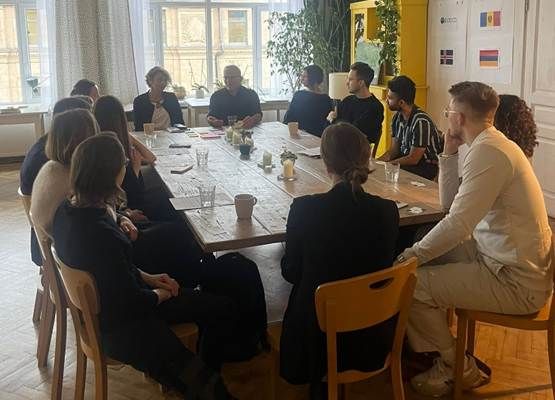
This was the theme with which Sveinbjorn Grimsson, Public Innovation Specialist at the Icelandic Financial Management Authority, started his GovMesh presentation at Vilnius.

The third edition of GovMesh, organised by interweave.gov, is a closed-door roundtable discussion that convenes a small group of governments to discuss selected topics around digital government.
The fear of failure is one of the main barriers to being a good customer, said Grimsson, and it is holding back innovation cultures.
He illustrated this with an example he called “the painful cost of awkward silence”, “a common scenario in the public sector and also a difficult one”.
He imagined a “manager of a public institution, a hospital for example, getting a pitch from a startup about a solution to help workflows in an ICU”. “Wow, it’s amazing”, says the hospital management, “we’ll get back to you”.
Then follows a process of internal dialogue and questions: how much will it cost? How will we implement it? What will it look like to pilot? How will we manage finance committees and budgets?
While these processes are ongoing, it looks like nothing is moving. “The startup doesn’t get a call, and we have some awkward silence”.
Even if the public sector is working hard on building the right conditions for the startup, poor communication can create distance: “it erodes trust and the startups don’t understand. They feel like the public sector is ghosting them”.
A second form of “awkward silence” comes in funding discussions.
Governments often provide support for co-creation opportunities with minor grants to startups but “as soon as the use case starts generating revenue, the company is at risk of being ineligible for R&D subsidies”, which startups are heavily reliant on in their growth process.
In the absence of real incentives to innovate for the public sector, companies and investors are left without motive and models to scale the relationship.
It is something that Hessel van Oorschot, programme manager at the Intergov Startup in Residence, also talked about at GovMesh.
The latter has produced a playbook to support public sector teams in scaling up partnerships with startups.
Grimsson continued, “This is happening in Iceland right now. We are tightening our budgets, to make sure that every Krone is being spent wisely.
“Unfortunately, we are seeing R&D as one of the first things to be cut, and it leads to more awkward silence”.
The erosion of trust, or sense of government as an unreliable customer, pushes startups to Silicon Valley or other innovation-friendly markets.
“When we actually cure cancer or solve ICU workflows, Icelanders will be the last to benefit from it if the government drops the ball”.
Being a better customer and supporting startups
Startups or scaleups and government aren’t the most natural match, Grimsson admitted.
“The public sector moves slowly, is risk averse, and cautious”, he said. “Startups need constant feedback and traction”. It’s a tale as old as time.
He said there are three things that governments could do to make government-startup relationships easier: be clearer on their needs and priorities; communicate better and more frequently; and derisk government-startup relationships by using procurement as a market-shaping tool.
The first is perhaps most important.
In another conversation this writer had with Grimsson, he talked about governments’ “hesitation to innovate because inherently, institutions aren’t motivated to exceed expectations, they are rather motivated to just be good enough.”, something that he called “the fundamental issue in public sector mentality and purpose”.
Grimsson is fond of quoting the Serenity prayer: “God, grant me the serenity to accept the things I cannot change, courage to change the things I can, and wisdom to know the difference”.
This can be a crucial mantra for governments in terms of knowing when to show courage and bring in startups when tradition fails.
“It is important for governments to actively participate in the innovation conversation: attend startup conferences, begin conversations, and be present.
In a call-to-action for the other governments present at GovMesh, he said: “we need to disperse, get involved with startups, and share what we learn to spot scalability opportunities” and adds “but most importantly we have to take a leap of faith and change the things we can.
Finally, governments need to use procurement as a market-shaping tool. This meant working together between countries on joint problems, “creating multiple buyer panels, coming up with the problem together and taking it to the market”.
It can mean running startup programmes like the Netherlands’ Startup in Residence – offering support which means the government can say “it’s okay to start without worrying about procurement pathways and regulatory environments”.
The key is understanding where collaboration should and can transition into co-creation. Working together with startups to co-create solutions ensures that governments can move from passive buyers to priority customers.
Governments could shift from late majority adopters – the last recipients of Grimsson’s imagined ICU solution – to early adopters, giving startups the perspective that they are easy to do business with and real target customers.
While governments cannot control a whole tech ecosystem on their own, they are able to create the conditions for those who can partner with them to build and develop that ecosystem.
In a year of conversations about sovereignty and about security, as well as those budget cuts that Grimsson mentions, it can be easy to overcorrect in screening out potential partners. Governments must keep, said Grimsson, returning to the Serenity, “the wisdom to tell the difference”.