
GovMesh Digest: South Korea boosts public-private synergy using Open Digital Services
The government has opened up APIs of registered public services, thus offering citizens access to these services through private apps and websites, said National Information Society Agency (NIA)’s Yoo Jae-sin.
-1746113479139-1754369329522.jpg)
South Korea’s story is one of those featured in the GovMesh Digest special report. Image: GovInsider
South Korea's story is one of those featured in the GovMesh Digest special report. You can find the individual stories on the other participating governments at GovMesh 2.0 here.
With a strong card payment culture and high smartphone adoption rate, the South Korean government planned to leverage the private sector’s strengths to boost adoption of its national digital ID cards.
The National Information Society Agency (NIA) would tap on its Open Digital Service to integrate digital IDs with the mobile wallets of Samsung, Apple and other private providers.
During GovMesh 2.0, NIA’s former Executive Principal, Yoo Jae-sin, pointed out that governments were best positioned to develop secure digital foundations and open up services, while letting the private sector excel at what they do best – managing services more efficiently and creating better user interfaces.
GovMesh, co-organised by GovInsider and interweave.gov, is a closed-door roundtable discussion that convenes a small group of governments to discuss selected topics around digital government. The event took place in Berlin, Germany, in early June.
Yoo noted that South Korea’s rapid adoption of mobile wallets and IDs was due to people’s high trust in private sector technology like Samsung’s, and they found these solutions efficient and convenient.
Public-private interoperability
In 2023, the South Korean government introduced the first phase of the Any-ID policy, which allowed users to use their preferred authentication method to log onto public services.
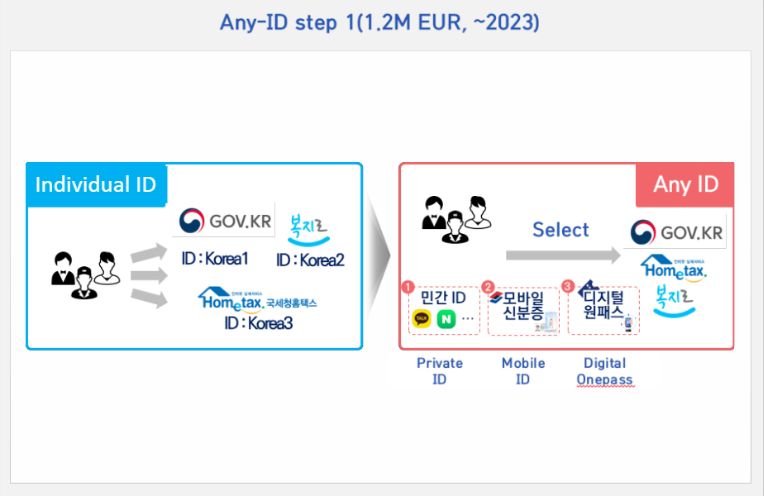
Instead of being the sole government authentication method, Digital OnePass was "opened to the market”.
By doing so, the government allowed private companies to offer their authentication methods for users to access government services, Yoo said.
As a result, Digital OnePass became just one option among many for users to authenticate themselves, rather than just the government mandated one.
The second phase of the Any-ID Policy has been currently underway from 2024, with an aim to implement a single sign-on concept.
If users have already authenticated themselves (that is log into a government service using their preferred method), they would automatically be able to access other government services without needing to log in again, Yoo added.
This has created a more unified, seamless and user-friendly digital experience across different government platforms, further building on the multi-authentication approach from phase 1, said Yoo.

Open digital services
The South Korean government’s focus on integration with private sector offerings, rather than building more, was evident in its Open Digital Service policy.
Thanks to the use of application programming interfaces (APIs), the national digital ID could now be connected with popular apps and services, Yoo noted.
He added that this integration made it easier for consumers to adopt and access digital IDs through the websites and apps they use frequently, Yoo explained.
This not only offered citizens more convenient access to government services - but also created a powerful synergy between businesses and the public sector, boosting public-private cooperation and trust, he added.
The public-private partnership was illustrated in an example he shared around high-speed KTX (public corporation) train reservations.
Initially, KTX high-speed train tickets could only be booked via a dedicated app.

However, by integrating this service with private providers, KTX now allowed users to reserve tickets through more familiar and popular apps like Naver Map, which was similar to Google Maps, said Yoo.
This has also fostered business synergy, benefiting Naver Map with an added feature and KTX with broader booking reach, he explained.
Yoo also provided an example of how the national digital ID was integrated with Samsung Wallet.
Last year, Samsung Pay, which previously only allowed users to store credit card information and make payments, was upgraded to Samsung Wallet. This new version incorporated both mobile ID cards and digital payment functionalities.
Users no longer need to carry a physical ID card or even a wallet, as both credit cards and IDs were now integrated into their phones.
These two examples illustrated how South Korea's strategy of opening up digital services and promoting public-private partnerships achieved several key benefits, including citizen convenience, economic advantages and greater public trust.
At its core, this strategy involves leveraging the private sector's expertise to create user-friendly and efficient technologies, Yoo noted.
For more stories about South Korea's National Information Society Agency (NIA), you can click here.