
GovMesh Digest: Ukraine’s digital success story has been shaped by transforming its government structures
Setting up structurally well to deliver digital transformation is not the be all and end all, but it’s a helpful start, says GGTC Kyiv’s Head of Innovation Piloting Kateryna Frolova.

Ukraine's story is one of those featured in the GovMesh Digest special report. Image: Canva
Ukraine's story is one of those featured in the GovMesh Digest special report. You can find the other individual stories on the participating governments for GovMesh 3.0 here.
By now, much of the digital government world is familiar with Ukraine’s success story – its mission to become “the most convenient digital state in the world for citizens and businesses” has been much lauded with its successes well-documented.
The country was the first in the world to make digital passports equivalent to paper ones and the first to have fully online marriage services; 91 per cent of newborns now register with the national Diia superapp; and it has the fastest automated business registration in the world.
It is also the home of the Global Government Technology Centre Kyiv, established jointly by the World Economic Forum (WEF) and the Ukrainian Ministry of Digital Transformation as a strategic global hub for advancing GovTech, including through public private partnerships.
When GGTC’s Head of Innovation Piloting Kateryna Frolova presents at GovMesh, she began by emphasising the role of the innovative structures of the Ukrainian government in informing its success.
Central to this has been the network of Chief Digital Transformation Officers (CDTOs) that stretch across government, from the national through to the local level.
The third edition of GovMesh, organised by interweave.gov, is a closed-door roundtable discussion that convenes a small group of governments to discuss selected topics around digital government.
“Since First Deputy Prime Minister Mykhailo Fedorov came into office”, said Frolova, he has “focused on the idea of creating a powerful team of Deputy Ministers of Digital Transformation in each government entity”.
The idea, she continued, is that “each entity has someone responsible for digital and open innovation”.
“Picture a typical ministry: it juggles hundreds of tasks and faces constant demands. In that environment there’s often little time – or political will – to identify what could be automated or improved”.
The CDTO’s role is closing that gap by recognising and driving those changes – identifying synergies between services, streamlining public access, reducing corruption risks and driving digital innovation.
To manage this, each CDTO has a double-reporting line – to its ministry and agency head, and to the Minister of Digital Transformation.
Across the country, there are 17 CDTOs in ministries; 28 in central executive bodies like national agencies and inspections; and 16 in regional military administrations (not to mention the CDTOs in civilian subnational bodies).
Frolova herself worked as a CDTO in the Reform Office for Child Protection before moving to the GGTC Kyiv, working on the digitalisation of adoption processes and foster care closely with the Ministry of Social Policy.
CDTO Campus: Building digital capacity throughout the CDTO community
She is also one of the people to have taken part in Ukraine’s CDTO Campus, the education project that allows CDTOs to be successful by building their capacity and equipping them with the necessary skills to innovate within government.
The Ukrainian digital ecosystem is a complex one – encompassing everything from the Diia Engine which powers services’ backends to the Ukraine startup funds, which work on civilian and defence procurement.
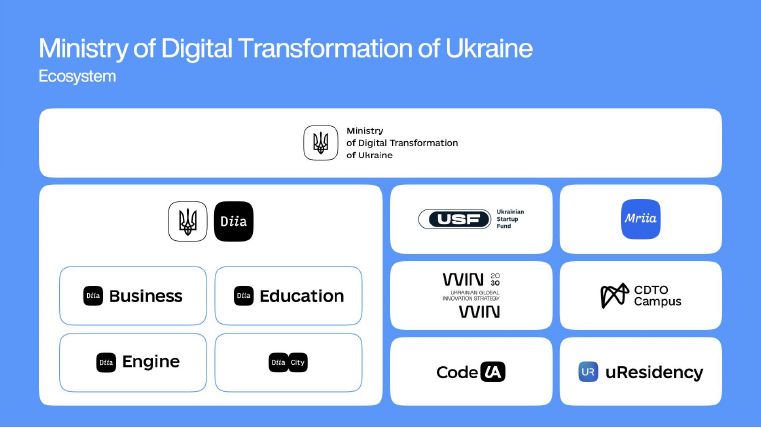
CDTO campus works across this ecosystem to train its digital leaders.
In 2025, it delivered 40 iterations of educational programmes, including custom programs including Digital Transformation in Public Administration at both a national and local level.
The WEF describes it as the “first national GovTech educational project dedicated to developing digital leaders and their teams who drive digital transformation in the public sector”.
It was set up to tackle an acute need, as the government faced a shortage of people with the combination of technical skills and strategic vision needed to drive through their CDTO vision.
As Frolova told the GovMesh audience, just “16 per cent of CDTOs have prior innovation experience [… the CDTO campus is] a framework for them to test out these skills”.
The campus delivers its courses with an ecosystem of its own, adopting a strategic partnership model. While core programme management remains in house, their partner list is extensive – from Google and Microsoft to aPolitical and the UNDP.
These partners provide financial support and specialised knowledge, with guest lecturers including other top government CDTOs to deliver much of the teaching.
Setting up structurally well to deliver digital transformation is not the be all and end all, but it’s a helpful start.
Through its CDTOs, Ukraine has an in-built network to transfer learnings from a national to local level and back again, as well as to get a headstart on change management initiatives.
For other countries, struggling with silos and building communities of digital leaders, Ukraine and its CDTO campus can provide a model for signalling the place of digital transformation at the heart of their governments’ agendas.
Disclaimer: The views expressed in this op-ed do not reflect or channel the official position of the Ukraine’s Government on digital transformation.