
How EU integrates Intergenerational Fairness Strategy into policymaking
The European Commission will work with Directorates-General to implement pilot projects that incorporate the interests of future generations into present-day strategies.
-1754360783371.jpg)
EU Policy Lab brought together foresight, design and behavioural insights to design an inclusive and cross-cutting process for a comprehensive EU strategy on Intergenerational Fairness in one year. Image: European Commission
The impact of climate change is no longer just news headlines from other parts of the world, but tangible disruptions that affect our daily lives.
We are experiencing it firsthand through things like bumpier air travel, dangerous heat waves and unpredictable weather events, making the “long term” consequences of climate change feel more urgent and personal.
A spokesperson from the EU Policy Lab, who is part of the team managing the European Union (EU)’s Intergenerational Fairness Strategy, shares with GovInsider that it is misleading to draw a clear distinction between short term and long term challenges around supposedly “future problems” like climate change.
The two are deeply intertwined and often overlap – as what is considered a future problem is already showing symptoms today, she explains.
Recognising that people are more likely to act on immediate concerns than distant ones, she highlights this interconnectedness to build public support for creating policies that consider future generations.
This approach is central to the Intergenerational Fairness Strategy, a one-year project launched this year as part of the new European Commission's mandate. The strategy is managed by both the EU Policy Lab and the Directorate-General for Education, Youth, Sport and Culture (EAC).
Beyond climate change, the spokesperson notes the current generation is already feeling the effects of an ageing population on the pension and healthcare systems and the impact of artificial intelligence (AI) on the job market.
"While it's tempting to focus on the most immediate problems, these long-term challenges are just as urgent because they will only get worse if we don't act now,” she says.
Policies must go beyond short-term fixes to address the consequences that policy decisions have on future generations, including those who are not yet born, she says.
To subscribe to the GovInsider bulletin, click here.
What kickstarted a systemic approach
What started as a general legal commitment to intergenerational fairness is now becoming a more concrete and institutionalised part of policymaking.
The first explicit mention of intergenerational solidarity was weaved into the Treaty of EU back in 2012, which provided a legal basis for EU to act on this issue.

To put this long-held principle into practice, the first-ever Commissioner dedicated to Intergenerational Fairness Glenn Micallef was just appointed this year, tasked to prepare the strategy that “takes fully into consideration the impact of today’s decisions on future generations”.
The goal is to create more than a temporary project, the spokesperson says, much like sustainable policies have become part of policymaking that do not depend on the current mandate.
The idea is to make intergenerational fairness the "DNA of policymaking", ensuring it continues even after the current commissioner's term ends.
The spokesperson adds that her team draws inspiration from countries like Wales and Finland, studying their established practices in future thinking and intergenerational fairness to inform EU's approach.
“While some regions have a more advanced approach to this type of governance, many countries are already working to implement it.
“This can take different forms like nominating a Minister for the Future or a spokesperson to represent the long-term interests of future generations,” she adds.
Piloting an abstract concept
The spokesperson emphasised that the strategy does not merely serve as a theoretical document, but a list of concrete actions for the Directorates-General (DGs) to implement.
DGs are the main administrative departments of the European Commission tasked to carry out the Commissioner’s mandate.
Across the year, the European Commission would implement the strategy in five phases: Scoping, visioning, ideation, designing the strategy and adoption process.
The strategy is now in the ideation phase, having just concluded a collective visioning meeting and its scoping phase.
“It’s not enough to conclude this with the message of ‘be more inclusive’,” she adds, highlighting that she looks forward to the fourth phase of implementing pilot projects with concrete interventions.
Since intergenerational fairness affects many policy areas such as climate change and healthcare, she expects multiple DGs to be involved in these pilots.
“That’s why we involve them from the very beginning because if they’re not part of the process and can’t see how they can contribute to it, they obviously won’t be convinced to implement it,” she says.
The spokesperson adds that the strategy is also in the process of developing a way to measure intergenerational fairness.
This involves creating a scoring system or a set of indicators to track how well policies across member states are implementing this concept.
To avoid creating a system that is too complex and has too many metrics, the EU Policy Lab has based their indicators on existing well-being indicators.
She highlights the major challenge being the lack of a single timeline for these issues, as each problem to tackle would have a different time horizon.
For example, nuclear waste disposal requires a very long-term perspective (e.g. 100 years or more), while other areas may only need a shorter and more practical horizon.
User design puts foresight into action
“I saw foresight projects ending at the point where I see my user design work should start,” she says.
While foresight is the process of looking ahead and thinking about the future, design then becomes the process of creating concrete interventions and solutions.
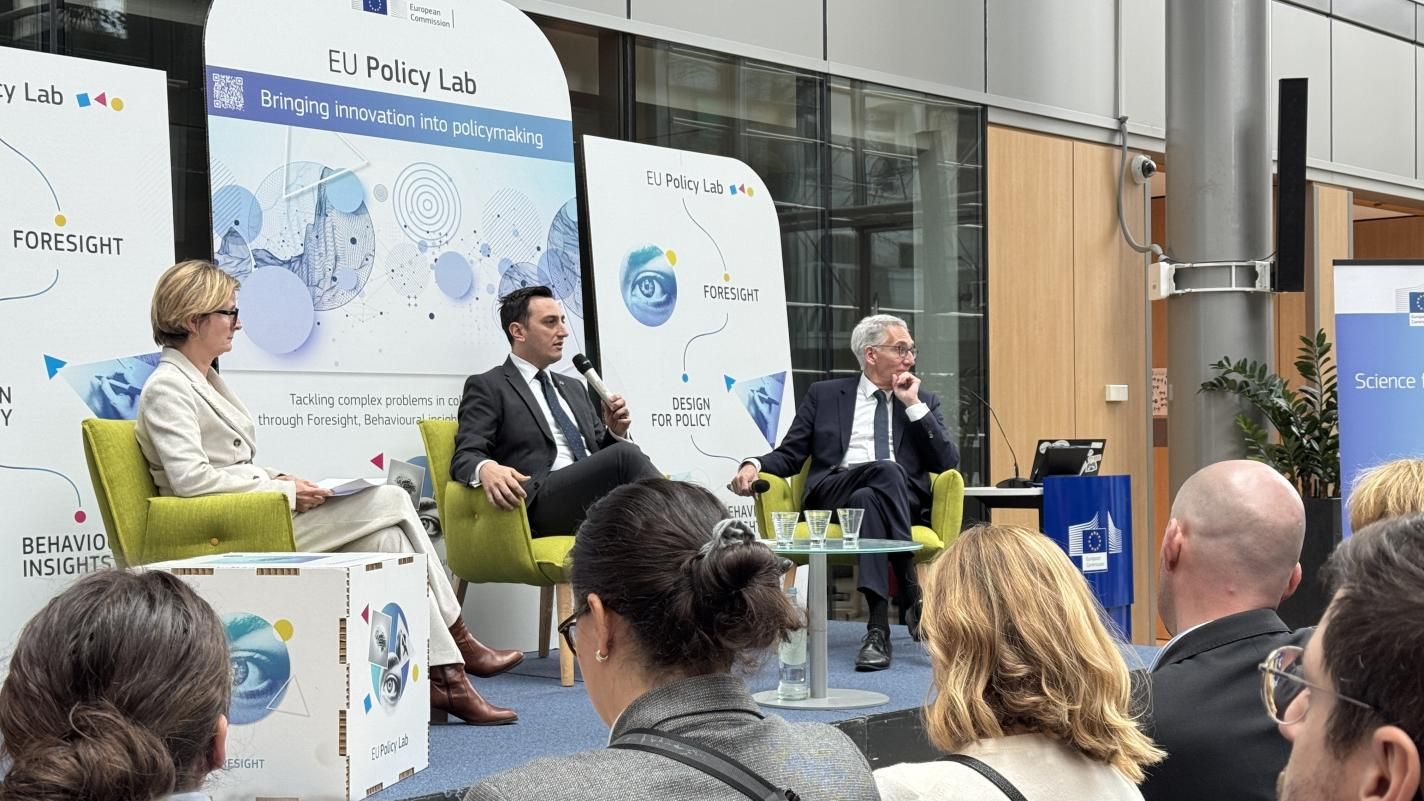
Highlighting that foresight should inform the design process, the spokesperson adds how taking an integrated approach ensures that intergenerational fairness does not just describe a desired future but creates a clear plan for how to get there.
She further explains how principles of design are being applied to bring the intergenerational fairness strategy to life.
The first of which is to include the lived experiences of real people and communities.
This is why the team will organise Citizens’ Panel between September and November this year to bring together 150 randomly selected citizens from all 27 member states to discuss what an intergenerationally fair EU should look like and what actions could be taken to achieve it.
The second principle is to embrace complexity, which involves gathering as many diverse perspectives as possible, even if they conflict.
Particularly around topics like fairness and solidarity, she emphasises the need for policymakers to be comfortable with a wide range of views.
The third principle is to engage in collaborative sense-making. It is not enough to simply collect a large amount of data from various stakeholders, she says.
The process of interpreting the data, also known as “sense making”, needs to be collaborative as well to avoid being influenced by the biases of a selected group of people.
Most importantly, she believes in prototyping and piloting policies before a full-scale launch.
This approach allows policymakers to test interventions on a small scale, identify potential issues, and refine the policies before they are widely implemented.