
How low-code sets the foundation for the world’s first government AI agent in Ukraine
A standardised and consistent environment allowed the government to leverage AI to act on their behalf and deliver services across different branches, says Oleksandr Iefremov from Kitsoft Ukraine.

Kitsoft team at the Global DPI Summit 2025 in South Africa. Image: Kitsoft
Low-code isn’t just a software development tool, but an architectural foundation that allows artificial intelligence (AI) to transition from a chatbot to an agent.
This was the key takeaway from my conversation with Kitsoft Ukraine’s CEO, Oleksandr Iefremov.
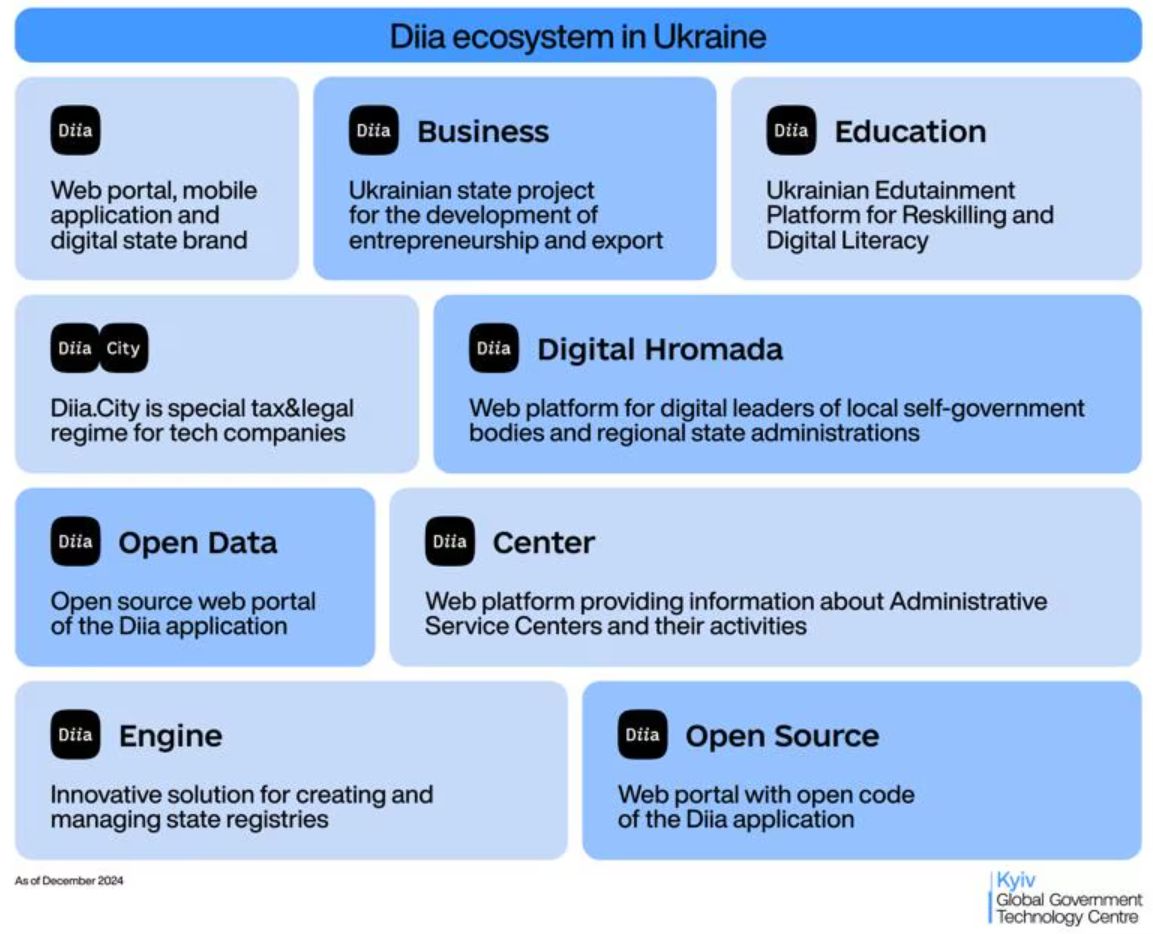
Kitsoft is the Ukrainian govtech company behind the open-source, low-code platform, Liquio, which is the backbone of the country’s Diia ecosystem of public services.
While the Ukraine’s Ministry of Digital Transformation hosts Diia, the private company Kitsoft was the one to build its technical foundation.
Ukraine’s Diia has distinguished itself from other government apps by providing a wartime lifeline for public services, and even evolving to launch the world’s first government AI agent (known as Diia.AI) amid the conflict with Russia.
“Because each of our services in Liquio is low code and stored in a standardised way, it’s clear what is the input of the service,” he explains.
Diia.AI was developed and scaled on a low code platform, with a Model Context Protocol (MCP) and a controlled service layer built in to ensure safety and predictability.
According to him, the MCP defines the interface through which the AI agent can initiate a limited set of pre-approved actions.
The controlled service layer, on the other hand, prevents the AI agent direct access to state registries or service business logic.
The Ministry, he notes, was responsible for adjusting the AI agent.
To subscribe to the GovInsider bulletin, click here.
Low-code by chance
Iefremov shares that while Kitsoft has been involved in Ukraine’s digital transformation for more than 10 years now, it was only around six years ago that the firm decided to adopt a low code approach with digital government services.
The approach in the government was “really broken” back then, he says, highlighting its tendency to adopt a waterfall approach with new innovations. This approach led to systems becoming outdated with evolving citizen needs and new requirements when they are rolled out.

The government then shifted to a modular, standardised and open-source approach that would allow low-code developers, instead of heavy software engineers, to build, launch and update services within four to six weeks.
“We started from form builder, [by taking a] low-code approach for validations and integrations ... Then, continued with adding BPM [business process management] to cover the business process logic and to cover all the execution of business processes,” he says.
Utilising Trembita, Ukraine’s data exchange layer which is one of the key pillars of digital public infrastructure (DPI), has also simplified the integration process between government services and ministry data.
To improve the accuracy of outcomes generated by Diia.AI, Kitsoft also developed a knowledge management tool to simplify the user’s information inputs into structured data.
“It’s always a problem for governments to manage and store all the necessary information up to date. And now, it’s also a problem in the context of AI,” he explains, adding that the tool will serve as a standardised knowledge base for the AI agent.
Culture and mindset to evolve with tech approach
A low-code platform isn’t the be all and end all for successful digital transformation.
Design thinking, rapid iteration, component reuse and agility are important skills that need to accompany this low-code approach, says Iefremov.
“It's super important not just to work on the theoretical part, but also to be involved in some real-world projects,” he notes.
Within Ukraine, Kitsoft partnered with the Ministry of Digital Transformation to conduct short three-day workshops for government teams, highlighting what constitutes good services, having them use the platform to build forms and launch services, and get user feedback to improve their services.
Today, the ministry remains the main entity to implement digital government services.
“They have a lot of their personnel trained to create digital services. So right now, they are creating new services and supporting existing services.
“On the low-code platform, it’s very easy to manage the execution process. The analytics and monitoring can also be easily done on the platform,” he explains.
Scaling the ‘Ukraine model’ globally
Liquio was listed as a digital public good in the GovStack catalog of DPI solutions, which requires Kitsoft to be able to integrate effectively with the three key pillars of DPI (digital ID, payments, data exchange).
Iefremov realises that the problems Kitsoft has solved in Ukraine, like slow bureaucracy, siloed data and complex coding, are universal.
“Our plan is to create a community and movement of reusing these components in different parts of the world,” he says, emphasising Kitsoft’s role as an open-source and low-code platform provider key for governments to build their DPI.

The firm recently started operating out of Ukraine in Brussels, Belgium as well as Berlin, Germany, with ongoing projects in Africa.
Unlike traditional govtech procurement, Kitsoft operates with a Services-as-Software model to stay financially feasible.
While it does not charge licensing (for example, a yearly subscription fee), it sells its implementation and expertise.
He shares that while the platform is free, the implementation (such as customising it for local laws, connecting it to old databases, and training staff) is a professional service that requires their unique expertise.
Given the collaborative nature of digital government projects, Kitsoft also joins consortiums with public and private partners to apply for these contracts.
You can click here to read other stories about Ukraine's Ministry of Digital Transformation.