
How Singapore turned declassified history into a public exhibition that people engage with
By Hanna Kum
The National Library Board (NLB)'s Chief Librarian and Albatross File Exhibition’s Executive Creative Director, Gene Tan, shares how the exhibition provided multiple points of entry for visitors to choose their preferred forms of engagement.
-1781771810702.jpg)
Quote by Dr Goh Keng Swee at the entrance to the Exhibition, first publicly revealed in Dr Melanie Chew's book, "Leaders Of Singapore" (1996). Image: Hanna Kum
Upon entering the Albatross File Exhibition in Singapore’s National Library Building, you are presented with five entry points to engage with the nation’s recently declassified history.
That is through the Atlas Wall, Spacetime Clock, Room, Records, and ChatBook.
What’s interesting is that these sections are not designed to be experienced in sequence.
Each one stands alone, where visitors can engage with just one and still walk away with a full picture of the historical event.
“There are different people, age groups, or different backgrounds who respond to things very differently,” explains Gene Tan, Chief Librarian at the National Library Board (NLB) and Executive Creative Director of the exhibition, to GovInsider.
Tan shared that the team thus planned something that museums and exhibitions “almost never do”, which was telling the story several times and in different ways.
Opened in December 2025, The Albatross File: Singapore's Independence Declassified is a permanent exhibition curated by NLB and Singapore's Ministry of Digital Development and Information (MDDI).
The exhibition addresses Singapore’s 1965 separation from Malaysia through a collection of once-secret documents, confidential Cabinet memos, and handwritten notes compiled by one of Singapore's founding fathers and former Finance Minister, Dr Goh Keng Swee.
The responsibility of telling the story
When Tan received the brief, one big challenge was how to process the massive amount of information in an accessible, yet nuanced manner that did justice to the separation as it happened.
“I could feel the hair of my arms standing, because it was so riveting, and I felt that, wow, I cannot mess with this,” Tan recalls.
-1781754355077.jpg)
In addition to the responsibility of telling the story, there was also the problem of how to engage the general public, given that most visitors might not have an inherent interest in history.
The team thus decided to use the voices of the prominent historical figures, to “help the visitor be as close as possible” to the first-hand accounts of the separation.
That manifested in Records, a section of the exhibition where one can listen to oral history recordings of several founding fathers’ reflections, arranged in a podcast-like manner.
Along with that were four other ways of telling the story, with the intention to cater to as many diverse preferences as possible.
-1781754037228.jpg)
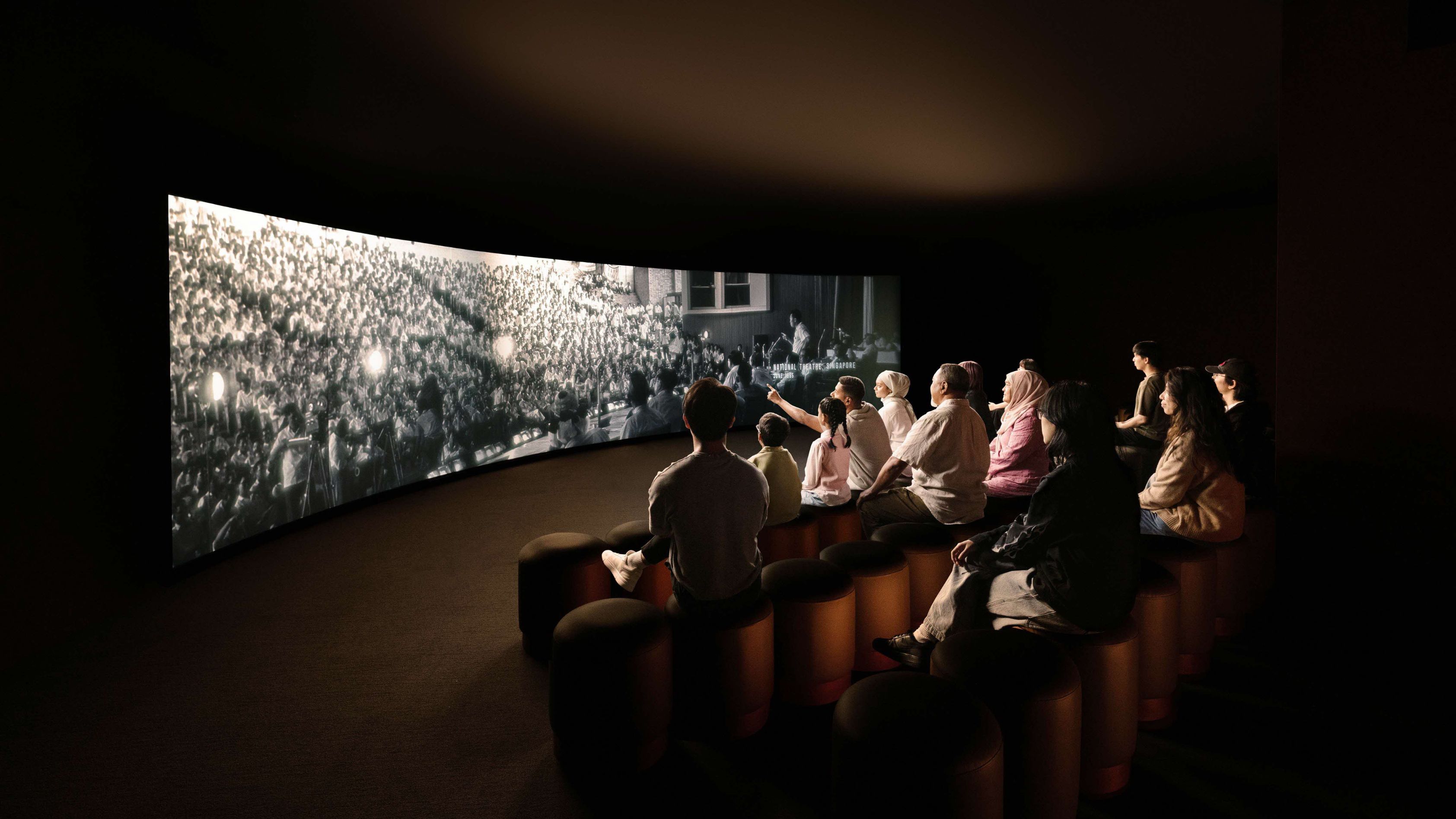
For those who are “Netflix in nature” — referring to visitors who enjoy visuals — there is the Room which screens a reenactment of the events leading up to separation.
For Harry Potter fans, they might be interested in the Atlas, featuring a big Spacetime Clock in which the story unfolds over time and space, which was inspired by the Marauders Map.
And for those who are more comfortable with text, there is the second part of the Atlas, which is a comprehensive timeline that covers the walls of the exhibition’s main room.
Last but not least, there is the ChatBook, where one can ask their questions and receive answers from a generative artificial intelligence (GenAI)-powered system.
Technology allowing visitors to get a personal, bespoke experience
ChatBook came about partially to bridge the gap between what the team had to share, and the limits within which they had to operate.
“I figured it’s still an exhibition, and I cannot put everything inside. I still have to make a choice, because otherwise it’ll be a very, very endless exhibition,” Tan shares.
Sources inputted into Chatbook included the publication The Albatross File: Inside Separation, 1,400 articles verified by NLB’s librarians, and Seven Hundred Years: A History of Singapore, a book co-written by four historians covering 700 years of Singapore's history.
Answers to questions asked on ChatBook would prioritise resources from the Albatross File publication, but also drew on the Seven Hundred Years book, oral recordings and other accounts.
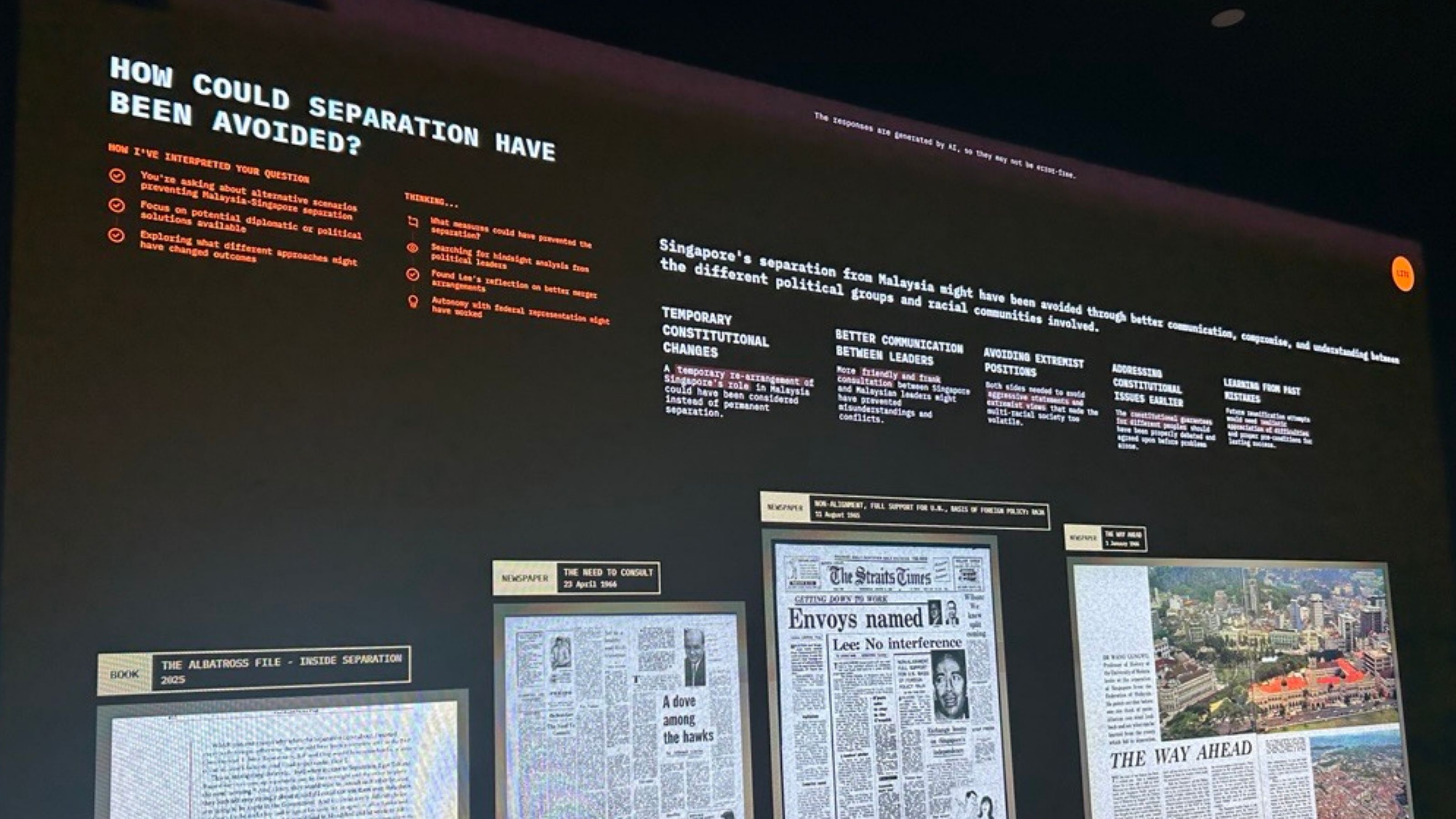
One of the guardrails included the team’s decision to drop the large language model’s (LLM) creativity level to 0.5, instead of the usual 1.0 — so that it retained its conversational elements but also relied, as much as possible, on the content data set from verified sources.
“We still put a disclaimer to let people know very evidently that this is done by GenAI. It is not a search engine,” Tan adds.
Therefore, ChatBook provides the opportunity for curious visitors to ask lingering questions which the exhibition may not have answered, adding yet another layer of accessibility, while still sticking to the facts.
Notably, Tan highlights that the team got human actors to reenact the scenes shown in the Room screening, and did not use AI to generate video footage of the founding fathers.
“I wanted people to know what's real and what's not, so in cases where I did not have footage or I did not have the original voices, I make it very, very clear,” Tan emphasises.
Don’t get fancy so fast, Tan says
When asked for any advice to other agencies looking to start a project of similar scale, there was a ready answer: “Don’t get fancy so fast.”
“Pull together your content brief. Try to figure out where the story is, visualise it as much as you can in your head. Then the ideas will come,” Tan advises.
Tan also pays tribute to the creative team that pulled together the exhibition, including creative director Beatrice Chia-Richmond, playwright Michael Chiang, filmmaker Brian Gothong Tan, and composer Don Richmond.
A total of 220,000 people had come since the exhibition opened in December 2025 — a surprisingly high number, considering that it was a permanent fixture at the NLB. And the majority of feedback rated it a maximum five stars.
“I’m very moved that both Singaporeans and our foreign friends have taken to it a lot,” Tan says.