
How Ukraine’s open legislative data powered a free civic legal assistant
A Kyiv company manager on keeping up with wartime military-registration rules, building on Ukraine's open legal data, and why an AI helper still needs a lawyer at the end.
-1793890080565.jpg)
Ukraine's open legislative data is what made it possible for one person to build this project, and it is what lets anyone verify every line. Image: Canva
I run a company in Kyiv. Like every Ukrainian employer, we keep military-registration records for our staff.
We track who is liable for service and whose details have changed, and we report what we must, on time.
Since the full-scale invasion, this has become one of the most demanding parts of running a business. The duty itself is not new. The rules, however, keep moving.
The numbers are easy to check:
- Military registration. The Cabinet of Ministers' procedure for military registration was adopted in December 2022. It has been amended 14 times since.
- Reserving employees from mobilisation. The resolution on this was adopted in January 2023 and has been amended 39 times, almost once a month.
- Military service. The Law on Military Duty and Military Service has changed more than 35 times since February 2022.
A country defending itself has to adjust its rules quickly, and that is understandable.
But every change has to reach millions of citizens and every employer in the country, and each of us has to work out what it means for us.
As a citizen, I faced the same questions from the other side: which details to update, where to apply, which deadline applies. The official texts were always available.
What was missing was the step between the text and the action.
The gap is not access, but translation
Ukraine publishes its legislation openly. Parliament runs an open-data service with every act and every one of its editions. The State Judicial Administration publishes court decisions.
What people lack are answers to three practical questions:
- Which of several overlapping documents applies to me?
- Which version was in force on the date that matters?
- Where exactly do I go, by when, and with what?
Without those answers, people turn to messenger chats and social media, where advice is often out of date.
Families of prisoners of war and missing service members are targeted by scammers. They are offered paid "search" services that the law does not provide for.
Building on what the state already does well
A lot already works:
- Employers submit their lists for reserving staff electronically through the Diia portal.
- Reserve+, the Ministry of Defence app, lets people check and update their registration data online.
- There is a state free legal aid system.
- There is a Coordination Headquarters for the Treatment of Prisoners of War.
These are the foundations.
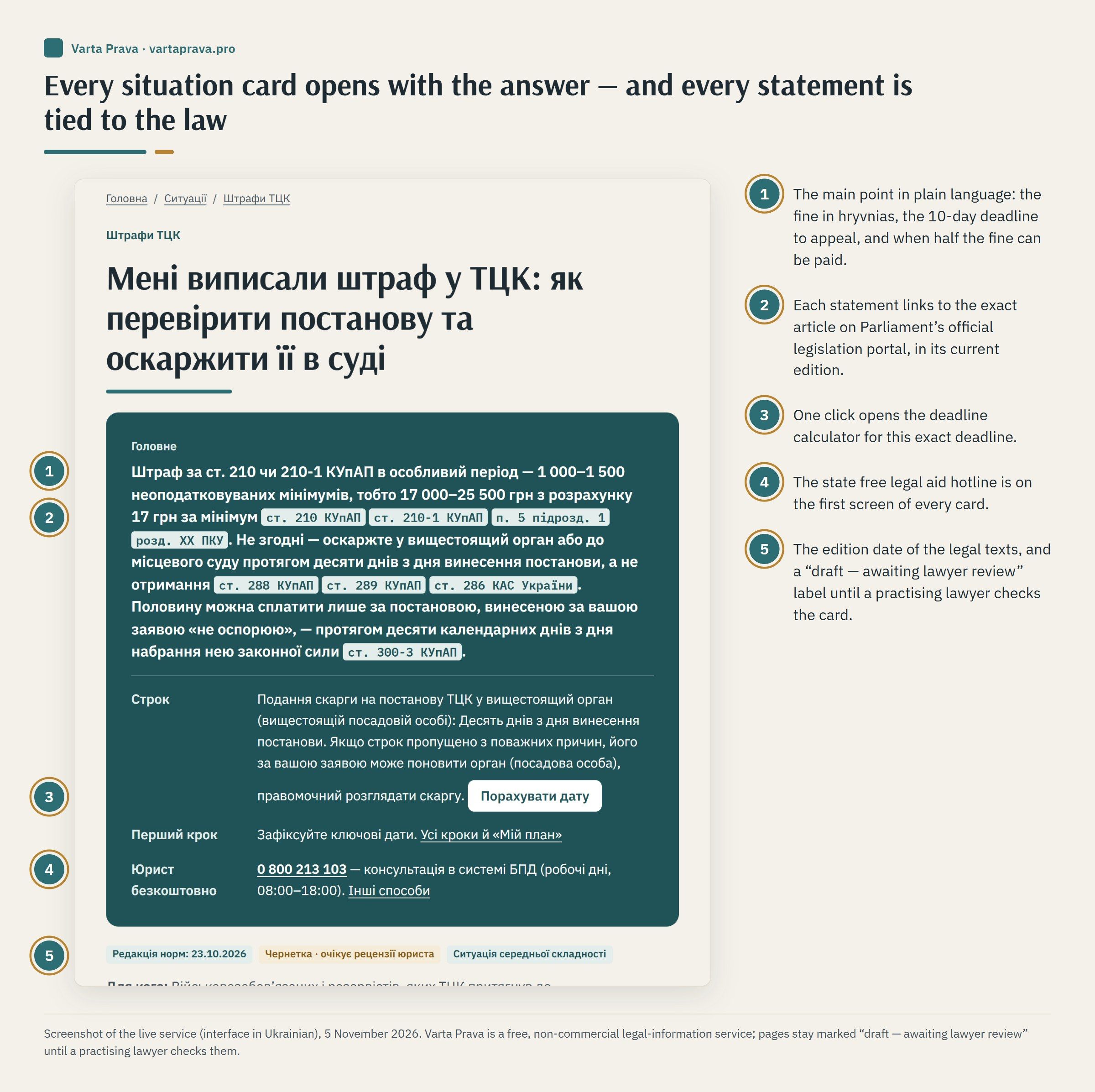
Varta Prava launched in October 2026. It is a free, non-commercial civic layer on top of that foundation.
It does not connect to any state database and does not ask for personal data.
It explains in plain Ukrainian what the law says, what to do, and by when, and it links every statement to the exact provision in its current edition.
Where a procedure runs through Diia or Reserve+, the card says so and explains the conditions behind it.
Today the service covers:
- 104 life situations for people liable for service, service members, veterans and families;
- 34 document templates;
- a deadline calculator for 24 procedures;
- a 42-point military-registration checklist for employers, with a verbatim quote from the law for each point. My own starting point was the employer's side.
The aim is to help people meet their obligations correctly and use their rights lawfully.
The service does not advise avoiding obligations, and it takes no cases.
What the AI knows, and what it doesn't
The site also has an AI assistant, and this is where credibility matters most.
The model works only from a library I assembled from official sources:
- Laws and government resolutions: 7,217 articles and clauses from 88 acts, taken from Parliament's open-data API with their edition dates.
- Court practice: 574 Supreme Court rulings and 27,469 court decisions from 2025–2026, from the State Judicial Administration's open data.
- Situation cards: the 104 cards prepared from those texts.

For each question, the model receives only the relevant extracts and is instructed to answer only from them.
Under every answer, the person sees the provisions it relied on, with their dates, so anyone can check.
Several safeguards sit around this:
- Personal data. Before a question reaches the model, phone numbers, ID numbers and military-unit numbers are masked automatically. Questions are not stored.
- Quotations. When the site is built, every quotation is checked against the source text. If a quote no longer matches the law word for word, the build fails.
- Changes in the law. A script checks Parliament's data every day. When an act changes, the cards it affects are flagged. Minor updates go live only after automated checks. Significant changes wait for a person to approve them.
An AI can be wrong, so a lawyer has the final word
An AI can make mistakes. Our automated tests on 312 questions showed that:
- 97 per cent of answers stay within the provisions given to the model;
- every one of 41 attempts to get advice on avoiding service was refused;
- an answer can be accurate yet incomplete, or miss an exception that matters in a particular case.
So the AI is a first step, not the last word:
- Every answer carries a note: it is legal information generated by AI, not legal advice. The note points to a lawyer or the state free legal aid bureau.
- Every page stays marked "draft — awaiting lawyer review" until a practising lawyer checks it. The reviewer's name and the date then appear on the page. We are inviting lawyers to do this pro bono.
- For any decision in a person's own case, a lawyer must be involved at the final stage
One thing to try tomorrow
If you write or publish rules, do two things:
- With each amendment, publish a short note on who is affected and what changes for them.
- Keep every article and clause available as open, versioned data with a stable identifier.
Ukraine's open legislative data is what made it possible for one person to build this project, and it is what lets anyone verify every line.
Public institutions cannot write a plain-language guide for every combination of wartime circumstances.
Civic projects can take on part of that explaining, as long as they stay tied to the official text, are open about their limits, and leave the final word to people qualified to give it.
-------------------------------------------------------
The author is the country manager of an international manufacturer in Kyiv, a developer, and the founder of Varta Prava (vartaprava.pro), a free, non-commercial legal-information service on Ukrainian military law.