
How Uzbekistan’s geospatial platform has helped to build a data-first government
The Agency for Strategic Development and Reforms’ Aziza Umarova shares more about her team’s work on an open-source geospatial platform to drive data-driven policymaking and citizen participation.
-1778547056991.jpg)
Uzbekistan's story is one of those featured in the GovMesh Digest special report
Uzbekistan's story is one of those featured in the GovMesh Digest special report. You can find the individual stories on the other participating governments at GovMesh 4.0 here.
When it comes to digital transformation, Uzbekistan has a bold vision.
A “1 million AI prompters programme”, run in partnership with the UAE government, is looking to train one million people in artificial intelligence (AI) prompting skills.
The country has also set the target of US$1.5 billion in AI software products and services by 2030, with 10 per cent of e-services based on AI.
Technology has become a key enabler of effective public service delivery and sits at the heart of the work led by Aziza Umarova and her team at the Agency for Strategic Development and Reforms under the President of the Republic of Uzbekistan.
The team initially developed an open-source geoportal to track the delivery of critical cross-government priorities in areas such as water management, education, and healthcare.
They help policymakers visualise disparities, monitor progress, and enhance data-driven policy making across institutions.
Through the platform, Umarova told participants gathered for GovMesh 4.0, the government can monitor the development of priorities across the country and improve public investment management – by connecting strategic metrics to budgets in one holistic view.
“It is a major shift across government towards data-driven decision-making”, she said.
Building the fundamentals for data-driven government
“For years, a lack of reliable data had been a major barrier in Uzbekistan” Umarova told GovInsider during an interview in December, “[with the geospatial platform], we decided to turn the table”.
The result is an open-source platform developed around location intelligence. Its design is supported by good legislation and citizen collaboration.
A new draft data law clarifies ownership and stewardship, mandates inter-agency sharing, protects privacy without blocking use, and enables official statistics and admin integration.
“We needed a new legal framework to prevent excuses for ministries not to share”, she shared.
Inspired by a Dubai law that says data belongs to a state, not a minister, this legislation mandates sharing of data across government.
“People cannot just not share because they are doing badly,” she said.
The draft law also introduces a data council reporting directly to the President, with data stewards at the Deputy Minister level in every single ministry, similar to Ukraine’s CDTOs.
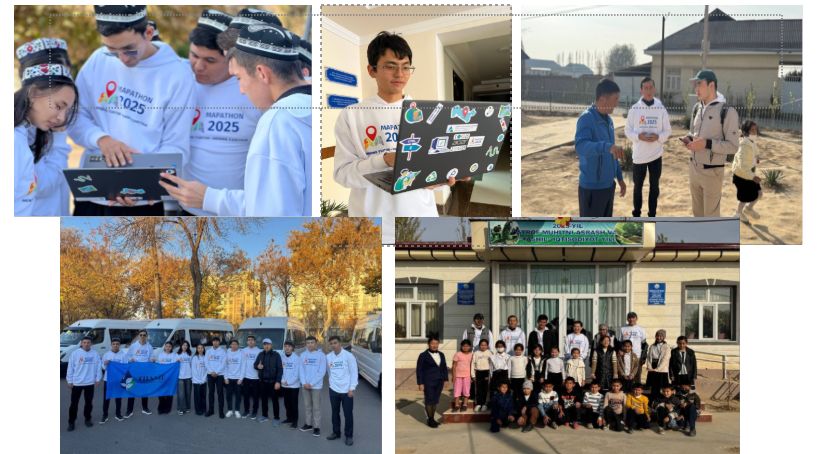
But perhaps more important, and impressive, has been the mobilisation of young people to support the platform’s development, a so-called “mapathon”.
It is visible to citizens through mapping, generating a collective buy-in which enables a bottom-up gathering and validation of data.
“This was first tested with water-access mapping”, Umarova said, “where 120 students produced a full household-level dataset for an 8,000-household district”.
Through the students’ mapping, the government was able to show areas of lower water access and poorer water quality, all without any formal infrastructure.
These young people are a valuable resource.
“In a country of 38 million people, 60 per cent are below 30”, she reminded the participants.
“With a slogan of ‘my country, my map’, we have been able to work with university students to collect data on schools and public institutions”.
This “participatory sensing” collects micro-data that is then fed back into national data systems.
Not only does this improve data quality, but it builds a data consciousness throughout the population.
Turning data into policy results
Good data is a tool for good policy, but not an end point on its own.
Uzbekistan has also been working to shift the way the government thinks and operates. “We have begun to use evidence instead of anecdotes”, she said.
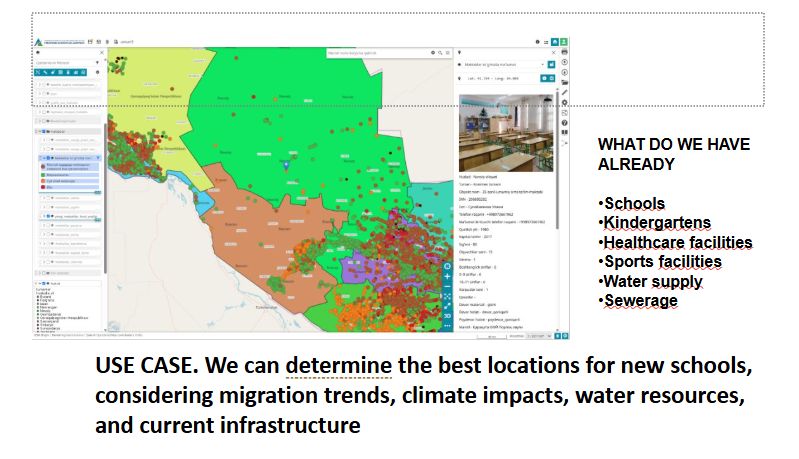
As she told GovInsider previously, “success for us means when a policymaker stops saying ‘I think’ and starts saying ‘the data shows’”.
Collecting data on social facilities has allowed the government to better determine approaches for planning based on changes in demographic data.
Knowing how many children are approaching the age of educational enrolment, or migration patterns in a given region, allows the government to make better calls on where to open a school or a sports club.
Elsewhere, Land Use Land Cover demonstrates changes in pastures and forestry on a map are demonstrating the effects of climate change over time.
A further byproduct of the geospatial platform has been creating a cross-government view by gathering indicators around health, development and education all in one place.
“Ministers are required to place themselves in each other’s shoes”, Umarova said, “it doesn’t matter if your portfolio is construction, education or healthcare. You see everything, not only yourself, on the platform”.
It is a model of government that requires a whole-of-government approach and ability to mandate government bodies to share data.
But with data formats like satellites becoming increasingly accessible (as Japan’s Dr Naoko Sugita shows elsewhere in GovMesh) – it is a model that holds potential for many others to learn from.
“Everything is possible”, Umarova closed with, “but the oil for this, the fuel for this, is a good quality of disaggregated, structured and cleaned data sets”.
By prioritising open-source technologies, strengthening local capacity in data analytics, and embedding citizen-centric design across government systems, Uzbekistan’s reforms aim to place people - rather than bureaucracy - at the center of governance.