
HSEU and GovInsider sign MoU to champion healthcare workers learning
By James Yau
The agreement will see Healthcare Service Employees Union (HSEU) providing its members access to GovInsider’s published content and events around global public sector innovation.
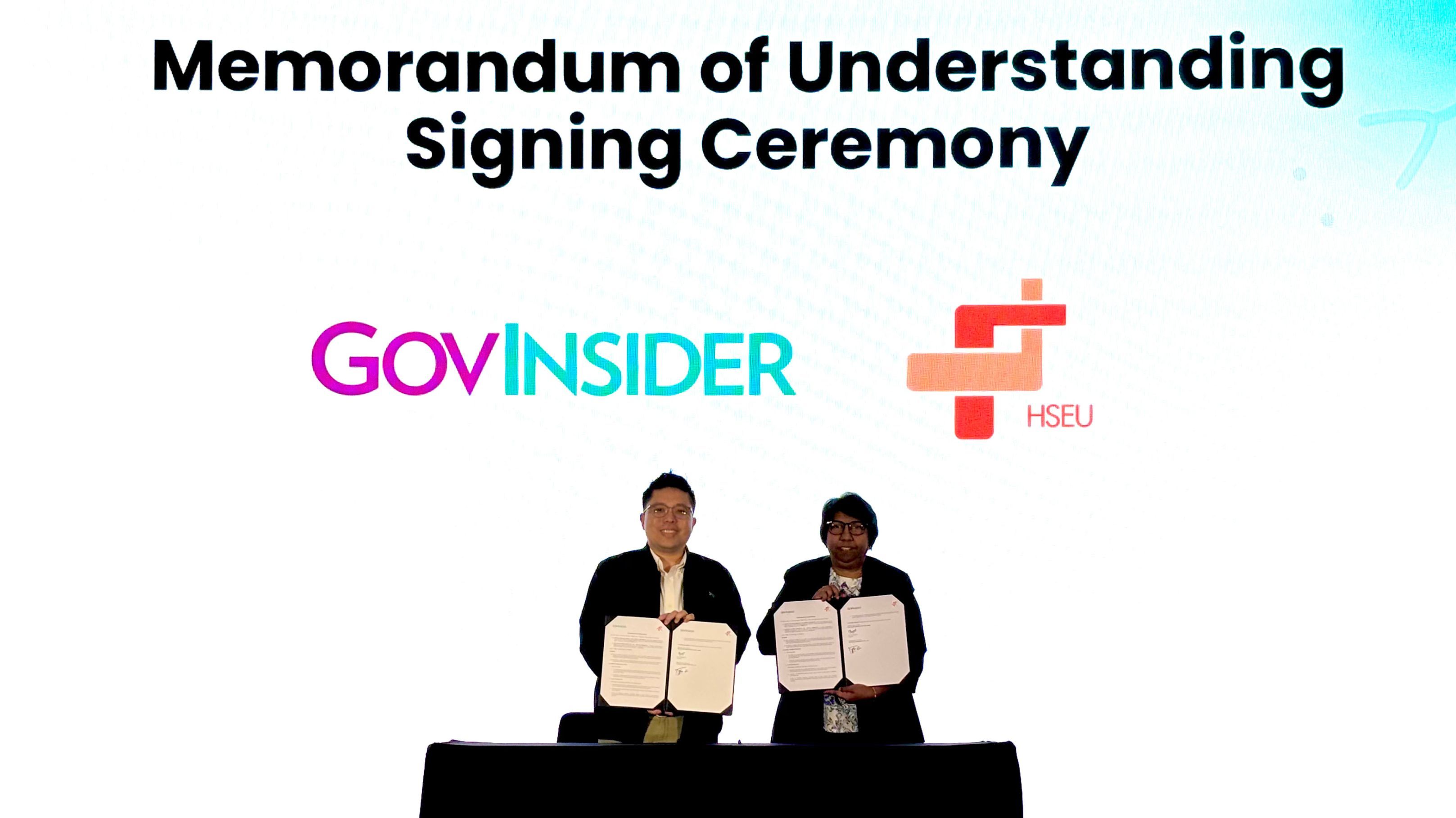
Healthcare Service Employees Union President, K. Thanaletchimi (right) and GovInsider Director, Tyler Lim. Image: GovInsider
The Healthcare Service Employees Union (HSEU) and GovInsider have signed a memorandum of understanding (MoU) to promote content and event access between their respective communities.
The MoU was signed by HSEU President, K. Thanaletchimi and GovInsider Director, Tyler Lim, on Tuesday as part of GovInsider’s Healthcare Day 2025 event.
Both HSEU’s and GovInsider’s work involve healthcare workers and has synergy and optimisation of resources across both parties.
Over the past 10 years, GovInsider’s stories on public sector innovation have reached over 10 million readers and a unique audience of ministers, governors and government C-level executives.
It also runs curated online and in-person events to enable the exchange of ideas, learnings and best practices between government agencies across the region.
Building on the success of the inaugural Healthcare Day in 2024, over 550 delegates were present on September 16 to witness the signing of the MoU and to share learnings on Singapore’s Healthier SG at Healthcare Day 2025.
“Thematic events like the Healthcare Day allow us to explore sectoral innovation and transformation more deeply as well as to address challenges head-on so that we can learn from each other. Technology, however, is just an enabler. The people who wield it are the ones that are key.
“This is why we will be signing an MOU today with the Healthcare Services Employees Union to bring greater access to learning content and events to its members to build deeper expertise and adoption of technologies, supporting the work of the Company Training Committees (CTCs) and implementation of the Ops & Techonolgy Roadmaps,” said Lim.
Formed in 1989, HSEU represents a 50,000-strong membership base comprising employees in the public and private healthcare sector.
It is committed to safeguarding the well-being and protection of its members and bringing about sustainable improvements to their careers and lives.
Healthcare workers united
Under the MoU, HSEU and GovInsider will collaborate to promote HSEU membership.
HSEU members in the public healthcare and community care sectors will be granted marketing material and complimentary access to GovInsider’s suite of events.
GovInsider will also provide HSEU a complimentary booth at the annual Healthcare Day and other events organised by GovInsider, as well as jointly work on the co-location of the Healthcare Day and any other GovInsider events.
On content, GovInsider will support media coverage on announcements, features and releases made by HSEU.
Coverage will be published on GovInsider’s website with permission granted for further distribution by HSEU.
HSEU will share GovInsider’s articles, deemed informational to its members, in its newsletters, website and social media.
To subscribe to the GovInsider bulletin, click here.
Healthcare system needs to evolve
Giving a presentation at the Healthcare Day event, Thanaletchimi emphasised the need for Singapore's healthcare system to evolve in response to demographic shifts, technological advancements, and rising healthcare demands.
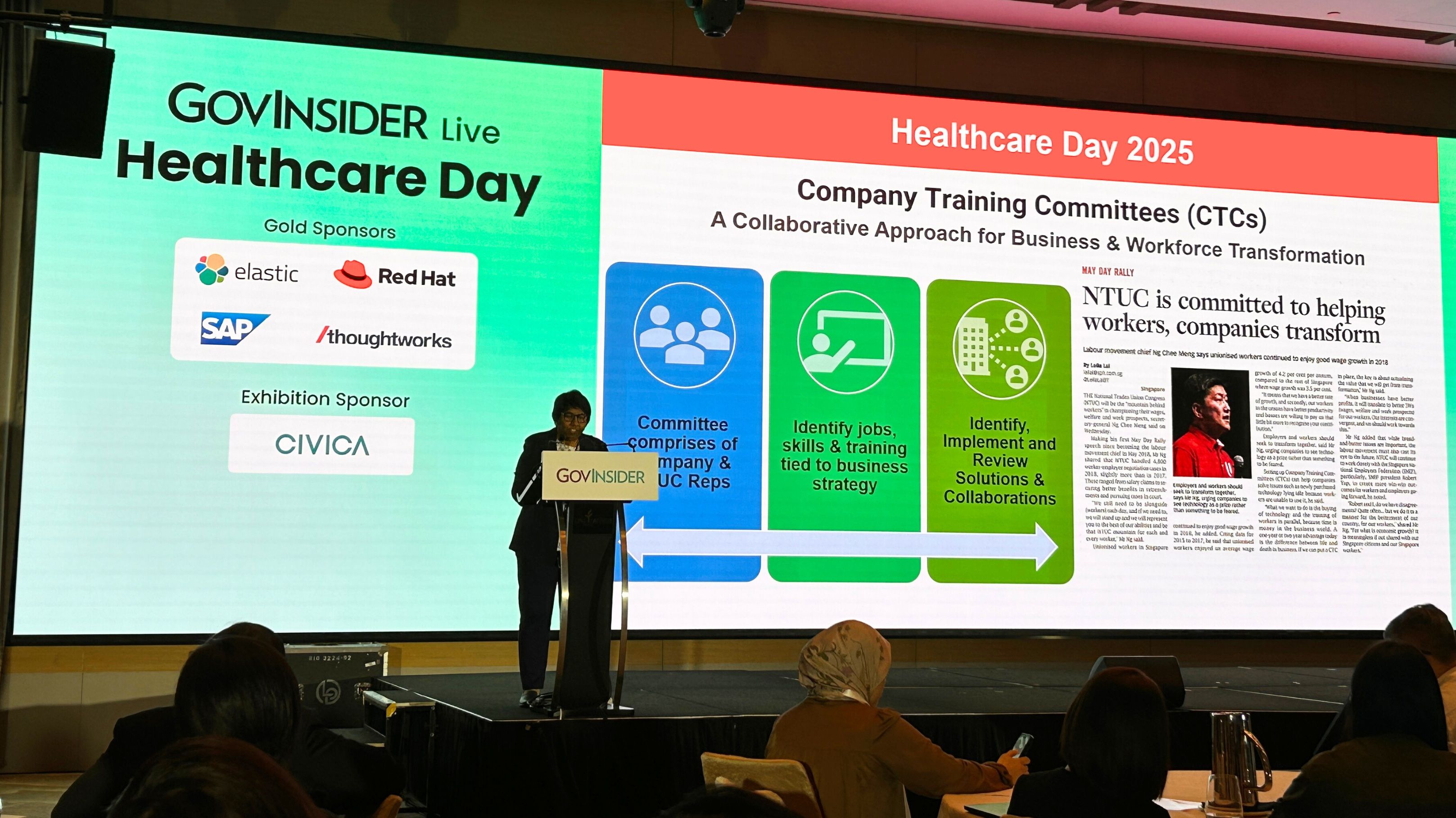
She noted that the National Trades Union Congress (NTUC) played a pivotal role in driving the adoption of technology within Singapore’s healthcare sector.
Thanaletchimi added that using established CTCs, NTUC partners with public and private healthcare institutions, as well as unions, “to co-create transformation journeys that embrace digital innovation”.
Contrasting the stance with that of unions of other countries, she said the HSEU/NTUC advocated for upskilling and reskilling workers to ensure they remain at the forefront of technological change, rather than being displaced by it.
Unlike other countries where the fear was that innovation would lead to job losses; “in Singapore, the focus is on embracing technology to enhance, not replace, the human element in healthcare,” she said.
Thanaletchimi noted that digital disruption and the adoption of artificial intelligence (AI) were not threats to healthcare professionals’ employment, but rather tools to empower and complement the existing workforce.
“By automating repetitive and time-consuming tasks, technology enables healthcare workers to focus on delivering compassionate, high-quality care,” she said.
Sharing innovation
Thanaletchimi added that healthcare institutions could effectively share successful innovation projects and enable easier implementation across the sector by actively sharing case studies and best practices with other institutions, so that proven solutions can be adopted without duplicating effort.
They should also collaborate across clusters, disciplines, and sectors to harness collective wisdom and accelerate learning.
This could be done, she said, by leveraging platforms such as seminars, workshops, and innovation committees (like the company training committee) to present and discuss successful projects.
Thanaletchimi added that leading institutions (Queen Bees as she called them) could mentor and support others in rolling out innovations, making implementation smoother for everyone.
They could also engage with union leaders and partners to facilitate knowledge transfer and support through grants like the CTC and also foster a culture of open communication, where insights and lessons learned are shared transparently to benefit the wider healthcare ecosystem.
In this context, Thanaletchimi noted that the Healthcare Academy, established in 2018, focused on training and upskilling healthcare professionals.
NTUC successfully lobbied for a S$200 million top-up to the CTC grant, supporting more transformation projects, she added.
Stay tuned for more stories about healthcare transformation thanks to our collaboration with HSEU.