
IMDA’s new initiatives to build SME capacities to be tech-savvy and green
By James Yau
Launched at the Singapore Computer Society’s Sustainable Tech Forum, the initiatives are part of IMDA’s ongoing efforts to help businesses become greener while adopting digital solutions.
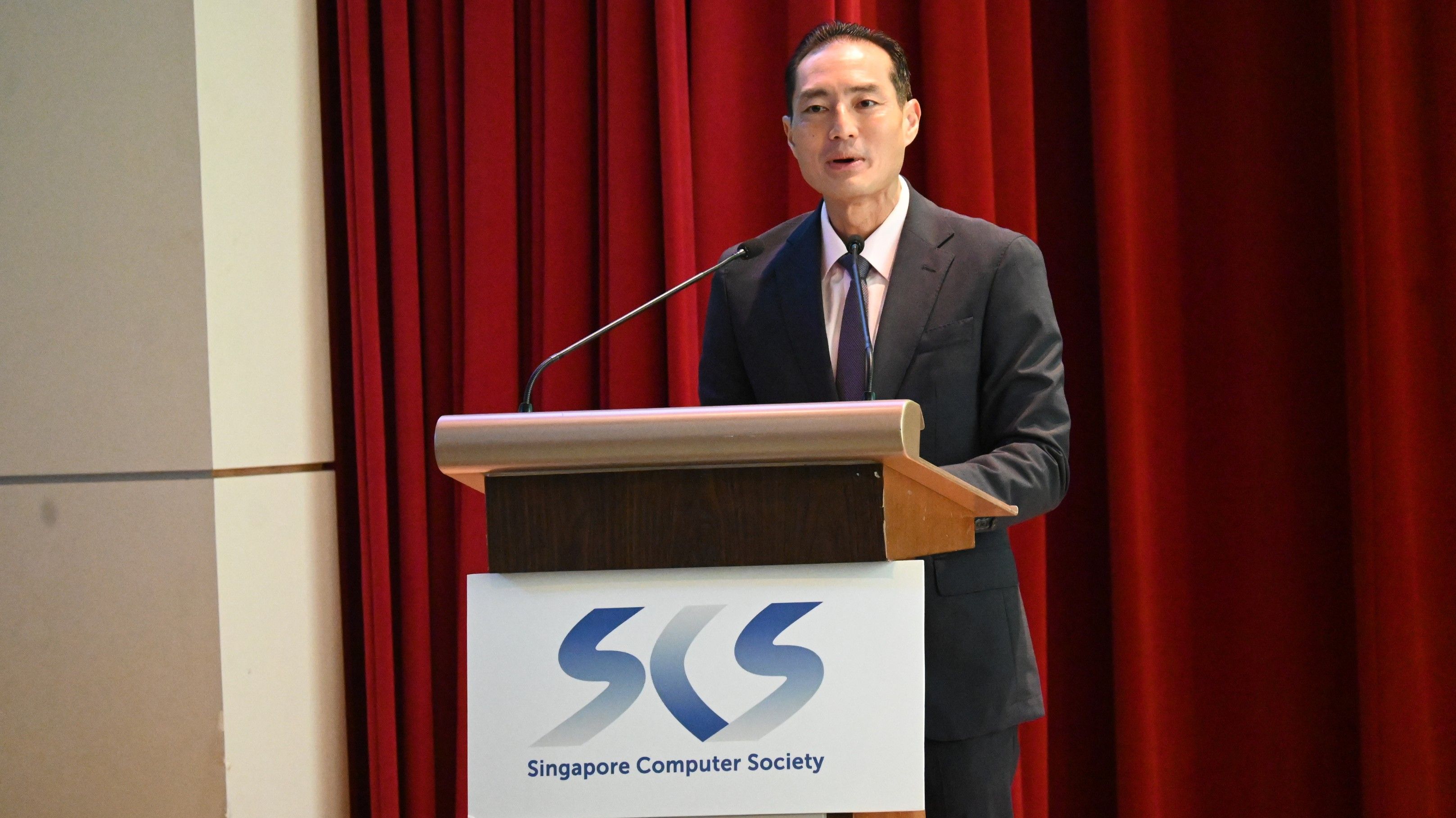
Senior Minister of State for Digital Development Tan Kiat How launching the new resources from IMDA at the Singapore Computer Society Sustainable Tech Forum 2026. Image: GovInsider.
Singapore businesses could now take practical steps outlined by the government to drive the adoption of digital sustainability solutions.
The resources released by the Infocomm Media Development Authority (IMDA) included the Digital Technologies for Sustainability Playbook, Practical Green Software Guide for Enterprises and Information, and Communications Technology (ICT) Emission Factors, as well as the Carbon Calculator for Cloud Services.
Senior Minister of State for Digital Development Tan Kiat How launched these initiatives at the Singapore Computer Society (SCS)’s annual Sustainable Tech Forum today.
Delivering the keynote at the forum, Minister Tan explained the unrelenting pace of digital innovation and transformation, driven by artificial intelligence (AI) and cloud computing.
“These trends significantly increase the world's carbon footprint through energy intensive data centres, significant electronic waste and a constant demand for newer and more powerful software and devices,” said Minister Tan.
Especially for energy scarce and open economies like Singapore, this has created tighter and more binding constraints for countries around the world.
With necessity as the mother of invention, Minister Tan added that digitalisation has provided an opportunity for the country to optimise resource usage and create more energy efficient systems.
IMDA said that it aims to support companies to go greener while remaining competitive.
The authority highlighted its survey findings where 81 per cent of non-SMEs (small and medium enterprises) and 27 per cent of SMEs have adopted at least one digital sustainability solution.
Their sustainability efforts were largely driven by regulatory requirements, and meeting customer expectations.
To subscribe to the GovInsider bulletin, click here.
Leveraging digital technologies for sustainability
IMDA also found that while businesses recognise the value of adopting digital sustainability solutions, they lack the expertise and know-how to do so.
The authority has surveyed about 500 local companies to better understand their readiness, barriers they face, and the outcomes from adopting digital sustainability solutions.
Thirty-eight per cent of enterprises that have not adopted sustainability solutions identified "limited knowledge about sustainability practices" as a key challenge.
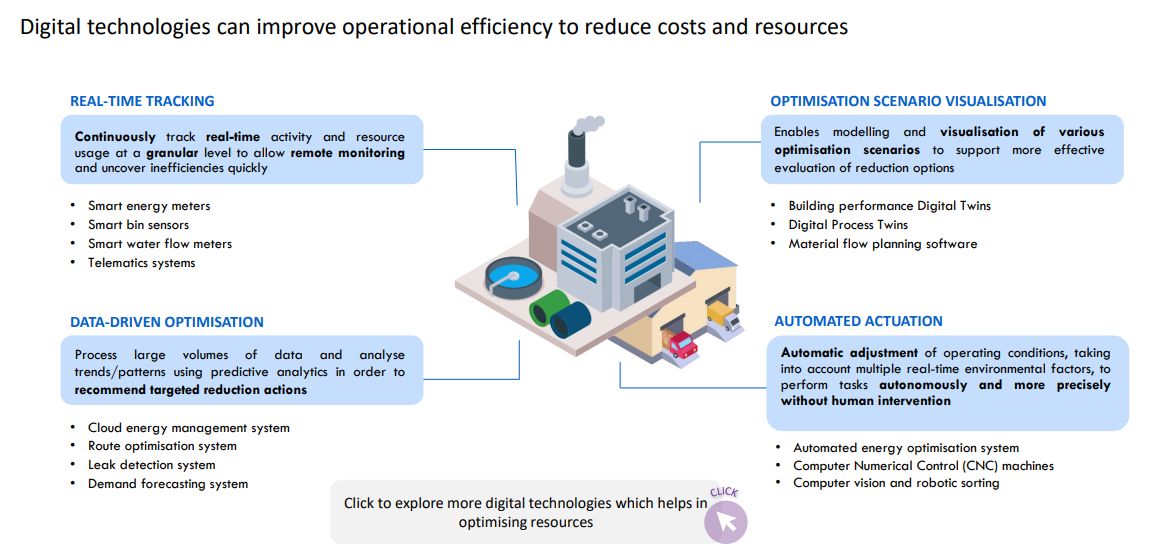
The Digital Technologies for Sustainability Playbook aims to bridge this gap.
The playbook covers technologies ranging from automation and Internet of Things (IoT) to big data analytics and AI, and how they can be leveraged to reduce emissions and resource use.
The document also includes in-depth case studies with enterprises that achieved desirable results after adopting digital sustainability solutions.
New carbon calculator specific to Singapore
IMDA and the National University of Singapore Energy Studies Institute (NUS ESI) have jointly developed a new carbon calculator for Singapore-specific emission factors (EFs) for ICT services.
EFs are representative values to calculating greenhouse gas emissions associated with a unit of activity.
This helps businesses track and better manage emissions from their cloud usage.
IMDA says that the new Singapore-specific EFs for cloud services is among the first few globally that estimate emissions using a “bottom-up” approach based on actual cloud usage.
Speaking to GovInsider, NUS ESI’s Research Fellow Alvin Ee explained the need for the change.
“Traditionally people use a top-down approach which is a sectoral average.
“You can use it for reporting, but you can't use it to identify where potential emissions hotspots are and how a company can use to streamline their processes to reduce emissions,” he explained.
EFs for cloud services provide a more accurate way to measure emissions by considering local operating conditions and specific usage of cloud resources, he said.
This also makes emissions tracking and reporting easier for enterprises in Singapore without the need for extensive data collection, he notes.
The new carbon calculator allows users to track emissions by service types, configurations of the cloud service, as well as the service duration.
This information empowers businesses to develop mitigation strategies and better plan for their digital infrastructure. For example, choosing between on-premises and cloud deployments, or comparing emissions across different vendors and service types.
Both the EFs and the calculator are available online at the Singapore Emission Factors Registry (SEFR) website.
Practical green software guide for enterprises
IMDA has developed the Practical Green Software Guide for Enterprises to equip more businesses with the knowledge of green software practices.
The guide notes that if energy supply cannot keep pace with increasing energy demand, plans to scale AI and other technologies for innovation could stall, escalate costs, and compromise sustainability goals.
One practical lever is green software that is designed and operated to minimise energy and compute, cutting emissions across its lifecycle.
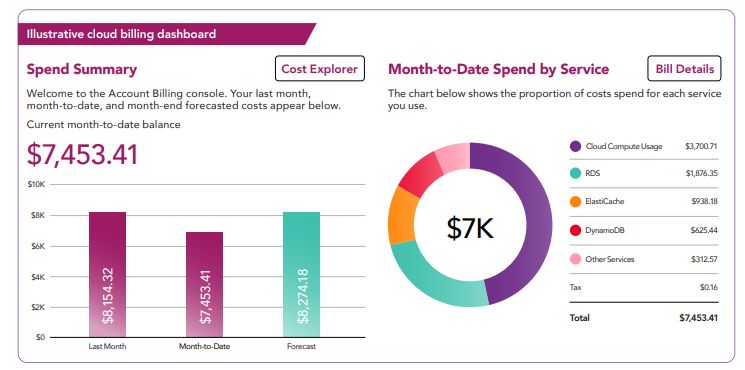
Businesses can achieve early cost and carbon reductions by focusing on practical steps: right-sizing AI models, designing leaner software, and tracking and monitoring energy usage and costs.
IMDA said it has worked with 13 companies to trial the effectiveness of carbon reduction techniques on software application since May 2024.
To date, the green software trials saw businesses achieving at least 20 per cent reductions in carbon emissions, costs and energy usage by adopting green software practices.