
Indonesia cuts red tape on investments to accelerate clean energy transition
At the Electricity Connect 2026 event, the Indonesian government outlined new measures to make it easier for investors to enter Indonesia's clean energy market.
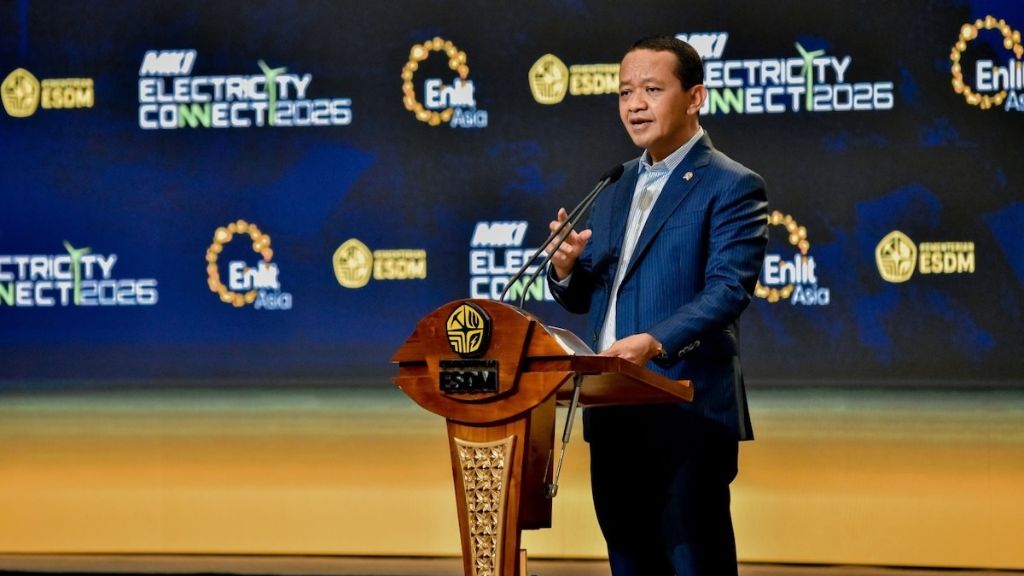
Minister of Energy and Mineral Resources Bahlil Lahadalia was opening up investment opportunities in Indonesia’s energy sector, including the development of renewable energy-based power plants. Image: Ministry of Energy and Mineral Resources
Getting a clean energy project off the ground in Indonesia is about to get simpler.
The government is streamlining key stages of the investment process through new policies and stronger coordination among agencies, with the aim of cutting red tape that could delay projects.
The goal is to attract more investments into the energy sector, while accelerating Indonesia’s transition towards cleaner energy with its 2060 net-zero target.
The commitment was discussed by the Indonesian government leaders at a panel discussion titled “New Players, Onboard: Corporate Entry and Project Execution Pathways in Indonesia” held at the Electricity Connect 2026 event on September 23 in Bumi Serpong Damai (BSD) City, Indonesia.
Bringing together government and industry leaders from the energy and electricity sectors across ASEAN, the event was organised by the Indonesian Electric Power Society (MKI) and Enlit Asia.
Lower capital requirements, easier licensing
Ministry of Investment and Downstreaming's Director of Licensing and Business Services for Non-Industrial Sectors, Raharjo Siswohartono, said that the government had issued Government Regulation Number 28 of 2025 to make it easier for foreign investors to enter the market.
The minimum paid-up capital requirement for foreign-owned companies was reduced from IDR10 billion (S$713,000) to IDR2.5 billion (S$178,230), while 100 per cent of foreign ownership is now permitted for power plants above 1MW, down from the previous threshold of 10MW.
“The government will also provide tax remedies for investors in the electricity sector located in Special Economic Zones (SEZs), subject to a minimum investment requirement,” he said.
The government has also changed the order of procedures that had been seen as a major obstacle to power project construction, added the Ministry of Energy and Mineral Resources' Coordinator for Electricity Business, David Firnando Silalahi.
The Ministry’s Regulation No. 7 of 2026, the government has moved the issuance of the Electricity Supply Business Licence (IUPTL) for independent power producers (IPPs) to after project completion when the plant is ready to operate.
“A licence that was previously required upfront is now moved to the back end,” David explained.
This means developers with projects in PT PLN's Electricity Supply Business Plan (RUPTL) and a power purchase agreement in hand can begin construction right away.
The licence is issued once the operational feasibility test is completed.
However, further coordination across ministries is still needed, as some other processes like permit applications for using forest areas, may still require a license at an earlier stage, David acknowledged.
He noted the internal government discussions are underway to close these gaps.
Clearer maps, smoother tenders
Ministry of Agrarian Affairs and Spatial Planning's Head of Subdirectorate of Spatial Utilisation and Synchronisation, Corry Agustina, said how long site licensing takes depends on whether the project area has a Detailed Spatial Plan (RDTR).
“Projects in areas with an RDTR that has been integrated with the Online Single Submission (OSS) system can obtain confirmation in real-time,” she said.
For sites outside the RDTR, the ministry has to assess the application manually, which takes longer.
Document verification takes seven working days, followed by an assessment stage of around 20 working days, she added.
Companies seeking to work with the state-owned electricity company must first register on its vendor management system platform, the single, free entry point for prospective partners, said the PT PLN's Vice-President of Vendor Management, Kusnadi Agus Nugroho.
After obtaining the “Verified” status, companies can register on PLN’s e-Procurement system to join the official list of partners eligible to participate in PLN’s project tenders.
“Requirements include positive net equity over the past three years and financial capacity of at least 10 per cent of the project value, which can be met through a consortium scheme,” he said.
Minister’s call to investors
In his opening speech at the event, Minister of Energy and Mineral Resources, Bahlil Lahadalia, said Indonesia was opening up major investment opportunities in the energy sector amid continued geopolitical uncertainty.
According to him, the 2025-2030 Electricity Supply Business Plan (RUPTL) has programmed 69.5 GW of new generation capacity, with 70 per cent expected to come from a mix of renewable energy sources.
Total investment is estimated at IDR2,700 trillion (S$192 billion).
The minister invited investors to explore opportunities across Indonesia, including hydropower potential in Papua, which he said could reach 23GW along the Mamberamo River, as well as around 12GW in Kayan, Kalimantan.
“This is the right timing for those of you who are serious about taking part,” he said, adding that production costs in Indonesia were competitive relative to other countries.
He also highlighted opportunities in data centres, pointing to Indonesia’s geographic position as Southeast Asia’s largest country and its diverse energy resources, including solar, hydropower, geothermal and wind.
At the same time, the minister outlined the government’s position on cross-border energy cooperation, including requests from neighbouring countries for Indonesia to export electricity under the the ASEAN Power Grid initiative.
He said Indonesia was open to such options, provided that the arrangements delivered mutually beneficial outcomes.