
Indonesia seeks control over global AI supply chain through critical minerals
The country must not just be a mere a user of artificial intelligence (AI), but also secure a strategic position within the global supply chain that underpins the industry, says Deputy-Minister of Communication and Digital Affairs Nezar Patria.
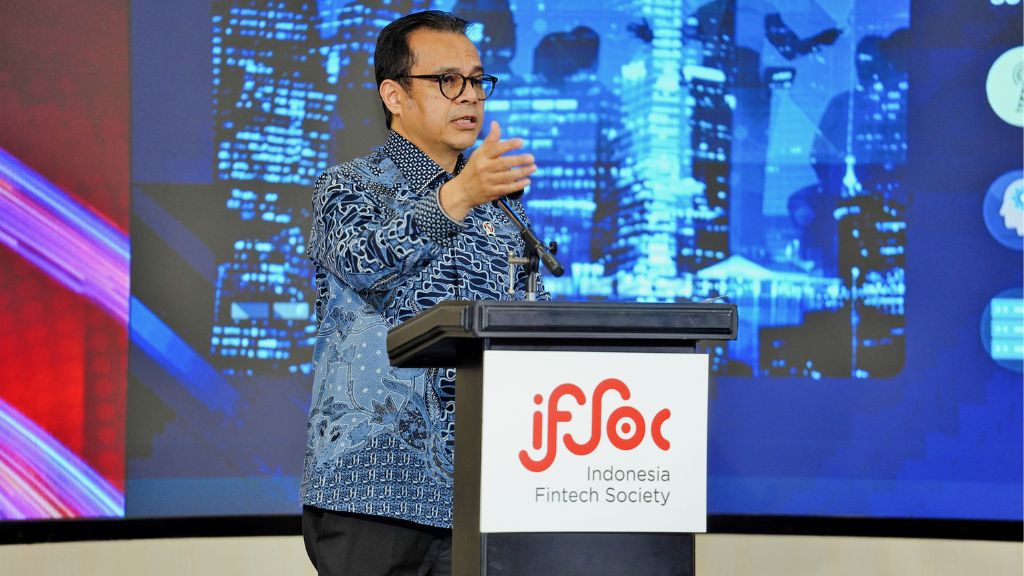
Deputy-Minister of Communication and Digital Affairs stressed the need for Indonesia to strengthen its domestic mineral processing industry in order to become part of the global AI infrastructure supply chain. Image: CSIS
Amid growing geopolitical and economic competition over artificial intelligence (AI), the Indonesian government is actively seeking to integrate into the global supply chain and cultivate the talent needed to build AI infrastructure.
This was the message shared by Indonesia’s Deputy Minister of Communication and Digital Affairs, Nezar Patria, during his opening remarks at the AI Infrastructure Readiness, Regulation and Socio-Economic Impact event organised by the Centre for Strategic and International Studies (CSIS) and Indonesia FinTech Society (IFSoc) in Jakarta on July 14.
"The issue of AI is not purely technological anymore, but has developed into an economic and even geopolitical issue... We need to collaborate with many parties so as not to be left behind," he said.
According to Patria, Indonesia has been adopting AI across various sectors like healthcare, education, transport, and financial services.
He cited data from his ministry showing that more than 90 per cent of internet users in Indonesia had adopted AI, making the country the second-largest user of AI in the world after India.
Yet widespread AI adoption is not enough on its own.
As Patria noted, Indonesia must transition from a consumer of AI services to a key player in building and supporting global AI infrastructure.
What was required, Patria said, was to look for an opportunity bring Indonesia into the global AI industry as a key contributor to the infrastructure behind AI.
The real battle lies in infrastructure
As Patria pointed out, the real AI race is happening behind the scenes in core infrastructure. These ranged from semiconductors and data centers to energy grids, water supply, telecom networks, and the skilled talent driving this.
"Discussions about AI in the past focused mostly on applications and platforms, but we overlooked one very strategic element. It was infrastructure that made AI possible," he said.
Indonesia, he argued, could not compete directly with the US and China, which had already come to dominate everything; from computing capacity to the best Frontier AI models.
The country's opportunity instead lays in a less well-known part of the AI supply chain: control over critical minerals.
Indonesia held substantial reserves of silica sand, the key raw material used to produce the silicon wafers that form the foundation of the semiconductor industry.
The country is also the world's largest producer of nickel.
"We tend to think nickel is only for batteries. But it turns out that in the AI industry, particularly for building supercomputers and AI infrastructure, there are strategic minerals that are needed."
One example was indium, a material important for the semiconductor industry, and high-speed optical connectivity, which was a by-product of nickel processing.
However, the real challenge was not merely possessing these natural resources but processing them into the high value-added products required by the global industry, he added.
Lessons from Batam
Patria assessed that Indonesia's capacity to build high-tech manufacturing industries capable of generating added value still fell well short of what was required.
He recounted his experience visiting a semiconductor factory in Batam, Riau Islands, which supplied components to the global automotive industry.
Although the production process took place in Indonesia, almost all of the high-value components were still imported from abroad.
"I asked one of the workers whether the gold wire came from Indonesia. He replied: 'Sorry, sir, no.'"
Even a simple material such as the microscopic gold wire used to connect chips was still produced in Japan using foreign technology and licences.
"I asked again, so which parts are made in Indonesia? 'None, sir’."
For Patria, that experience reminded Indonesia that it had for too long focused on downstream economic activities that generated little added value, leaving the higher-value work to other countries.
"That was a moment of truth. Perhaps we have all this time been busy playing downstream, while forgetting upstream," he said.
Searching for Indonesia's "choke point"
According to him, the country that held control in the global technology industry was not always the largest country, but rather the one that possessed a choke point.
Taiwan, for instance, has become the centre of the world's most advanced chip manufacturing. The Netherlands controlled lithography technology through Advanced Semiconductor Materials Lithography (ASML).
"Whoever controls this supply chain will be the countries that can create a choke point," said Patria.
Indonesia needed to find its own strategic point, particularly through downstream processing of the critical minerals needed by the semiconductor and AI industries.
Only in this way could Indonesia become an irreplaceable part of the global supply chain, rather than merely a user of technology.
The quality of AI talent
Beyond infrastructure and industry, Patria highlighted that the quality of talent would be decisive for a country's competitiveness in the global AI race.
He cited how talent in China had managed to overcome GPU export restrictions through algorithmic innovation and extreme computational efficiency, producing AI capabilities able to rival US tech giants despite far more limited resources.
"This is proof that the battle lies not only in infrastructure, but also on the talent side," Patria noted.
He emphasised that the future focus of Indonesia's talent development should no longer be on basic programming skills, which AI could already perform.
Indonesia needed to develop talent capable of developing AI models, optimising algorithms, and creating innovations that could compete globally, he added.
Nezar said the government was currently drafting a Presidential Regulation on the National AI Roadmap and a Presidential Regulation on AI Ethics, to ensure Indonesia did not miss out on the opportunity to take part in the strategic global AI ecosystem.
These regulations, aim to anticipate the various new risks arising from AI development, ranging from fraud and automated cyberattacks to quantum computing.