
Indonesian Air Force strengthens officers’ capacity to fight cyber warfare
Indonesian Air Force is strengthening its readiness through cyber warfare exercises, personnel development, security by design approach, and technologies such as artificial intelligence (AI), says Air Force Information Office's Col Ahmad Irvan.
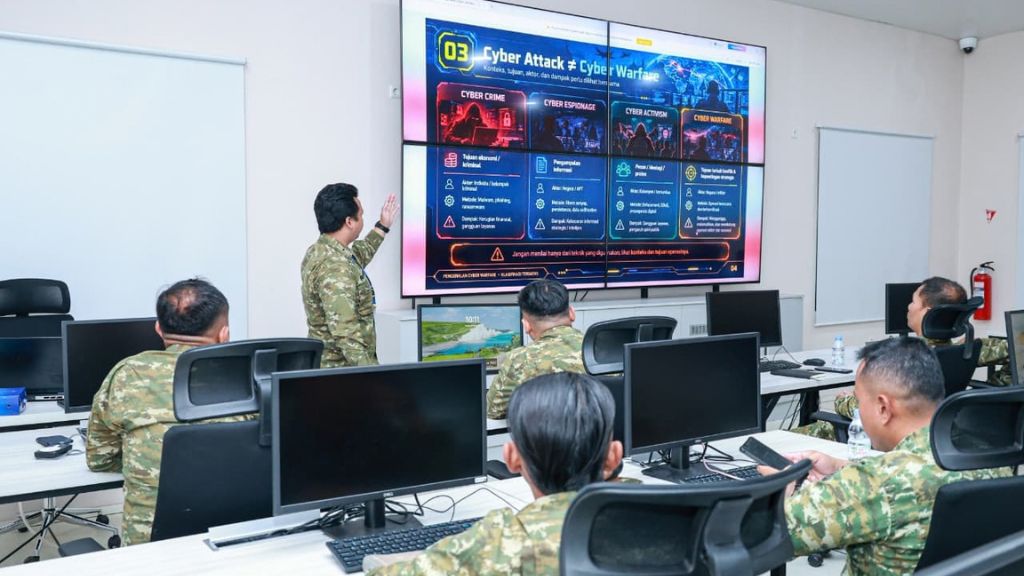
The Indonesian Air Force is strengthening its cyber warfare capabilities by improving the quality of its officers through cross-unit training and certification programmes. Image: Indonesian Air Force
This story is part of GovInsider's Digital Trust & Cybersecurity Champions 2026 Special Report.
As defence systems become increasingly connected, the Indonesian Air Force (TNI AU) must now protect more than just its airspace.
Communication networks linking navigation systems, command and control centres, and various platforms are not only used to support defence operations, but can also become targets for attack.
“In the past, we talked about network-centric warfare, where all forces were brought together on a single network.
"Now, the network itself can even become a point of attack,” says Col Ahmad Irvan, Head of the Information and Internet Subdirectorate at the Indonesian Air Force Information Bureau.
The Force therefore considers cyber capabilities part of defence across all three services – the Army, Navy and Air Force – rather than simply a matter of network security, he adds.
The challenge is that systems considered adequate today may not be able to withstand the attacks that emerge in the coming years.
“No technology will always remain strong, so we have to keep updating it,” he says to GovInsider.
Exercises cyber-attack's test responses
The Force has incorporated the development of cyber capabilities into its Swa Bhuwana Paksa (translated from Sanskrit as the "Wings of the Motherland") doctrine.
These capabilities are needed to help the organisation and its personnel adapt to the changing nature of threats, says Col Irvan.
One way of measuring personnel readiness is through cyber warfare exercises.
These are conducted internally and incorporated into major exercises such as the Angkasa Yudha 2026 Air Exercise.
The Force also participates in multilateral exercises including Cobra Gold and Super Garuda Shield.
In these exercises, the Red Team acts as the attacking side, while the Blue Team defends the system through detection, analysis, mitigation, and recovery.
The exercises assess more than whether personnel can follow technical procedures.
The Force also looks at how they make decisions under pressure, how quickly systems can be restored, and how effectively teams communicate during an incident.
This is important because performance under normal conditions does not necessarily translate into an effective response when an attack is simulated.
“In theory, they are capable, but once an attack happens, they panic. That readiness to deal with an attack is what we look at,” he notes.
The exercises are then used to identify gaps and improve subsequent scenarios.
If network recovery takes too long or a procedure proves insufficiently flexible, the findings are used for further improvement before being tested again under a different scenario.
Building air defence's cyber talent
To increase the number of personnel with relevant expertise, the Force conducts specialist recruitment in information technology and provides cyber training for new personnel through the regular recruitment pathway, Col Irvan says.
Development takes place through education, training, courses, and certification. Formal education is also available at a master's degree level in cyber-related fields.
He cites Indonesian Air Force's Cyber and IT Education Centre (Skadik 506) in Bogor, West Java, as a dedicated education and training centre for developing the personnel's cyber competencies.
“These competencies are not only needed by units specifically responsible for cyber operations, but also by other organisations operating network-based systems,” he adds.
International cooperation is another way to strengthen these capabilities. Joint exercises are used to exchange knowledge, build personnel capacity, conduct research, and strengthen interoperability.
Putting security into systems from the start
As defence and security equipment become increasingly dependent on networks, cybersecurity needs to be considered from the procurement and integration stages.
“With the new defence and security equipment, we hope to have security by design. So, the security is prepared from the outset,” Col Irvan says.
The security-by-design approach applies both when new systems are integrated and when legacy systems, such as radar and aircraft, connect with other systems.
However, security by design does not mean that risks end once a system is deployed.
Changes in technology and attack methods mean that security measures must continue to evolve throughout the system's lifecycle, he adds.
Anticipating AI and future threats
Col Irvan describes artificial intelligence (AI) as “a double-edged sword, with the potential to accelerate decision-making while also giving attackers more effective tools."
The Force therefore sees opportunities to use AI for early warning and threat intelligence, allowing information about potential threats to be processed more quickly.
To ensure these benefits do not create new vulnerabilities, technology development should also involve Indonesia's domestic defence industry.
Indonesian talent can contribute to developing the technology, while helping ensure security is considered from the development stage.
He highligths that over the next five to ten years, the Force plans to strengthen capabilities in areas including data analytics, cryptography, weapons systems and network security, digital forensics and incident response.
It also needs to anticipate developments such as quantum computing, which could change the approach to cybersecurity in the future.
Despite these technological changes, Col Irvan emphasises that air force personnel remain a critical part of the equation.
“What matters most is that our personnel need to strengthen their critical thinking skills,” he concludes.