
Indonesian experts discuss best practices in public sector digitalisation
By Yuniar A.
Experimentation, business process transformation, and adoption of the latest technologies, were the way forward according to public sector leaders who were speaking at the Digital Transformation Indonesia Conference and Expo (DTI-CX) 2025.
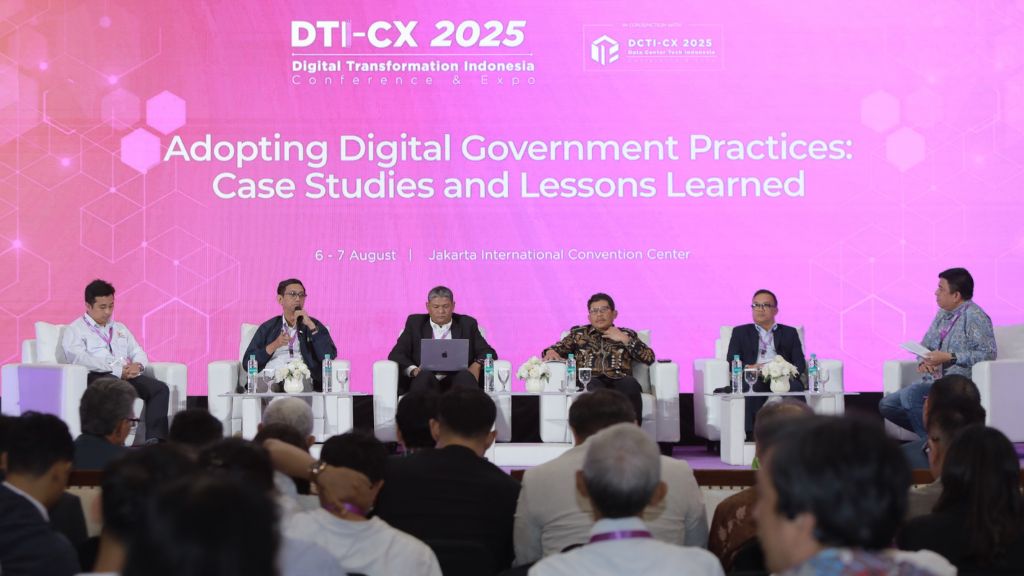
Public sector and industry leaders share best practices in public service delivery at the DTI-CX 2025. Image: Adhouse Clarion Events
Highlighting the bottlenecks to innovation for the healthcare sector, Indonesia’s Ministry of Health’s Expert Staff for Health Technology, Setiaji said that while innovation promises efficiency and effectiveness, “the main challenge was that existing regulations which were often not ready to keep up with changes”.
Setiaji was speaking at panel discussion, Adopting digital government practices: Case studies and lessons learned at the Digital Transformation Indonesia Conference and Expo (DTI-CX) 2025 event in Jakarta recenty.
He noted that in order to bridge the gap between innovation and regulation, the Ministry of Health has launched a regulatory sandbox inspired by the financial sector, which had previously implemented a similar concept.
“The sandbox allowed for the testing of digital health innovations in a controlled environment while ensuring that safety, service standards, and regulatory compliance are maintained,” he said.
One example included in the sandbox was telemedicine services. During the pandemic, telemedicine proved beneficial as it allowed patients to consult with doctors without having to meet face-to-face.
With this approach, healthcare innovations can continue to grow without compromising public safety.
“We want to ensure that innovation continues to develop, that the public can use services safely and reliably, while ensuring that this is supported by regulations,” he said.
Apart from Setiaji, the panel discussion included BPJS Health’s President Director, Ali Ghufron, State Civil Service Agency’s (BKN) Deputy for Information Systems and Digitalisation, Suharmen, Indonesian Chambers of Commerce and Industry’s (KADIN) Deputy Chairman, Eryk Budi Pratama, and Interbio Technologies’ Director, Feri Risnandar.
The panel was moderated by Indonesian Internet Service Providers Association’s (APJII) Deputy Chairman, Hernan Ramadhan.
Accelerating service delivery
BPJS' Ghufron shared how his organisation was implementing digitalisation to ensure public access to healthcare facilities through the National Health Insurance (JKN) programme. BPJS Kesehatan, also known as JKN (Jaminan Kesehatan Nasional) is Indonesia’s national health insurance programme.
“In the past, patients could wait up to six hours to receive services at the hospital. Now, the average wait time is less than two hours, and patients can even queue from home through the Mobile JKN app,” said Ghufron.
According to Ghufron, improvements to the healthcare queueing system were made possible through data interoperability with hospitals and the Directorate General of Civil Registration at the Ministry of Home Affairs.
This interoperability enables faster registration of JKN participants and healthcare facilities, he added.
To subscribe to the GovInsider bulletin, click here.
Additionally, the Mobile JKN app now features an AI-based virtual assistant named Vira, capable of answering various questions from participants such as information needed for the registration process, outpatient or inpatient facility applications, and JKN premium payments.
Currently, BPJS Health manages data for over 275 million users, 3,000 hospitals, and a total of 23,000 healthcare facilities, including clinics and community health centres. Over two million service transactions are recorded daily, and health claims exceed one million per day.
“No other health insurance in Indonesia, or even in the world, manages huge claims like that. And we couldn’t do it without digitalisation,” Ghufron noted.
Transforming business processes
BKN’s Suharmen shared his experience in driving digital transformation in civil service management to create efficiency, transparency, and convenience.
Through the BKN digitalisation roadmap, developed in 2019, Suharmen explained that the core of his efforts was “simplifying complex business processes.”
One example was the civil servant promotion process. Previously, this process could take six to eight months with 14 steps and a pile of documents.
“Through digital reform, those steps were reduced to just three without compromising service quality. Now, the promotion process can be completed in less than a day,” he said.
According to Suharmen, this roadmap also mandates data interoperability with other institutions, such as PT Taspen – the state-owned company that manages civil servant pension funds.
Previously, civil servants entering retirement age had to re-submit documents to PT Taspen, but now data automatically flows from the BKN to Taspen’s system, enabling pension payments to be processed more quickly, he added.
Interbio Technologies’ Risnandar added that digital transformation was not just about technology. The most important aspect lay in how change management could be implemented, including changes in business models and work processes.
“The point was, technology should be used to support and strengthen good business processes, not to cover up the weaknesses of poor business processes.”
Based on his experience as a strategic partner to government agencies, he believes that the private sector could contribute to government business processes and develop data interoperability.
Building public trust
At the end of the session, the moderator asked how digitalisation could build public trust and transparency.
Risnandar said the main foundation of trust was cybersecurity, so investing in developing a security posture was a must.
“No matter how good the system is, if there is a hack or compromise, public trust can collapse instantly.”
Suharmen highlighted the importance of transparency. For example, in the BKN civil servants' recruitment, the results of participants' exams were immediately published online so that there was no room for intervention.
Setiaji added that every digital service must be designed to be citizen-oriented, not just bureaucratic. Therefore, applications need to be continuously updated based on citizen feedback.
Ghufron emphasised the importance of the impact of digitalisation programme. If the impact is felt by the public, trust will follow.
KADIN’s Pratama reminded that no matter how advanced the technology is, it will be meaningless if the policies implemented end up complicating matters for the public.
“The best service a public official can provide is to create policies that simplify matters and maintain consistency in upholding policies that are pro-people,” he said.