
Indonesian ministries and private sector innovators team up to build AI solutions
An experimental space of this kind is important for giving governments the confidence to try new approaches without overlooking security and regulatory considerations.
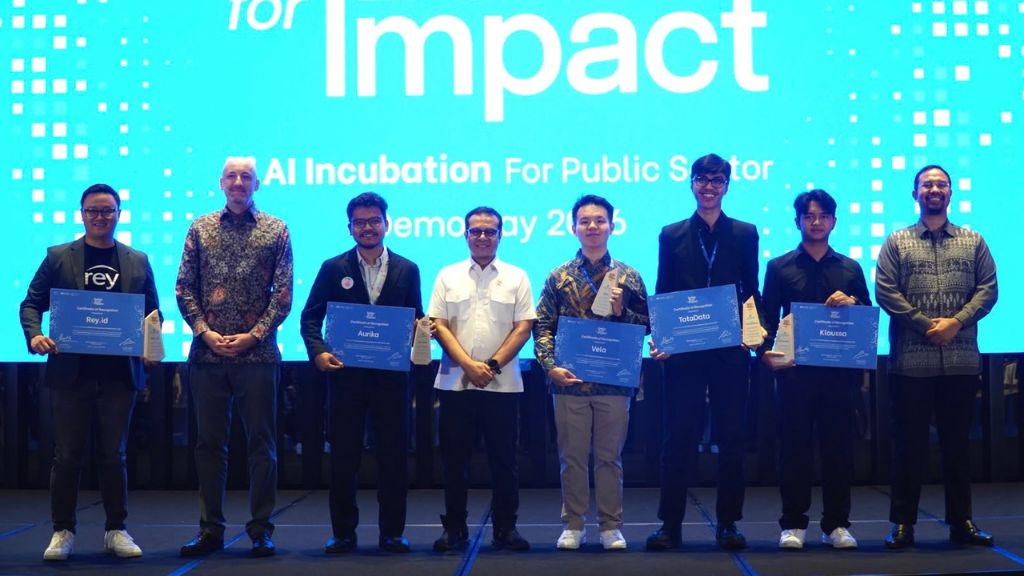
Five innovators are working with the ministries to develop AI solutions to address government's real-world problem. Image: AMANA Solutions
Indonesian ministries and private sector innovators are co-creating artificial intelligence (AI) solutions to be implemented within government workflows.
The AI Incubation for Public Sector (AIPS) Demo Day 2026, jointly organised by the British Embassy in Jakarta and public sector advisory services firm AMANA Solutions, is designed to do just that.
It’s an experimental space for governments and innovators to test AI against real-world problems before scaling the technology.
Five selected innovators – Klaussa, AURIKA, TataData, Vela and Rey – presented solutions they developed through a six-month incubation process, with ministries acting as problem owners.
Accelerating data analysis
FiskalLink, developed by Klaussa for the Ministry of Finance, used AI to tackle a key challenge in budget governance by aligning between central and local government financial systems.
This allows the Ministry to quickly determine whether budgets allocated to a programme are being used as intended.
According to Klaussa, previously manual processes also make information gathering, research, validation and report preparation time-consuming.
FiskalLink automates this process based on three principles: explainability, human-in-the-loop, and traceability.
“Every AI decision must be explainable, while officials must retain the authority to validate or correct the AI’s recommendations,” said Klaussa's Eriawan.
He claimed that FiskalLink can carry out the process more than 2,000 times faster and at 208 times lower cost than manual processes.
He said the system could help the government identify where budgets are being allocated, while reducing the process to around 15 minutes.
While Klaussa focuses on accelerating human work, TataData ensures that the data used by decision-makers can be trusted.
Working with the Ministry of National Development Planning (Bappenas)' Satu Data Indonesia Secretariat, TataData has developed a workspace to help government data managers ensure data quality from the planning stage.
TataData's Product and Institutional Lead, Surya Dharma, said the system helps reviewers check metadata, data categories, and reference codes.
When errors or potential duplicates are identified, the system provides recommendations and a confidence level.
“However, the decision to accept or reject the recommendation remains with the reviewer,” he said.
From thinking partner to AI agent
Another innovator, AURIKA, worked with the Ministry of Primary and Secondary Education on an AI assistant for the Rapor Pendidikan (Education Report) used by teachers and school principals.
Rather than immediately providing recommendations, AURIKA asks questions like: why numeracy has become a problem, how teaching practices are being carried out, and what interventions have already been attempted.
The resulting conversation is then used to help schools develop possible courses of action.
Vela demonstrates how AI agents can help local governments and investment promotion agencies present projects to investors.
After studying 176 government investment promotion projects, the team identified three key challenges: the lack of common standards and language, the absence of a consistent measure for assessing bankability, and the continued reliance on manual communication processes.
Working with the Ministry of Investment and Hilirisation (BKPM), the developers have built several AI agents to help local governments prepare investment presentations and materials.
Other agents produce materials tailored to investors in English, Mandarin, Arabic and Japanese.
Once an investor shows interest, another agent works around the clock to answer questions about the investment opportunity.
While Vela uses AI to accelerate investment promotion, Rey applies a similar approach to healthcare claim verification through Olvo AI.
The team said BPJS Kesehatan processes around two million claims each day. This leaves verifiers with limited time to compare claim codes against supporting medical documents.
Olvo AI seeks to automate this process by reconstructing evidence from medical documents and comparing it with the case mix submitted by hospitals to detect discrepancies between procedure codes and medical evidence.
Rey claimed that the system can identify payment differences of around IDR5 million (S$356) on a single claim.
Building trusted AI for public sector
In his opening remarks, Samuel Hayes, Head of Social and Economic Affairs at the British Embassy in Jakarta, said the success of the programme should not be measured simply by the quality of the demonstrations, but by whether government institutions can take tested solutions to the next stage.
“The important next step is to strengthen safeguards, test them further with users, and build sufficient evidence to scale up,” said Hayes.
Vice-Minister of Communication and Digital, Nezar Patria, praised the collaboration between the development teams and five ministries in building AI solutions capable of helping government address real-world problems.
He told the innovators that AI solutions must be adapted to local languages, norms and needs, given Indonesia’s diversity of ethnic groups and languages.
“We cannot stop at adoption. Adaptation is the important next step,” he said.
He also urged innovators to prioritise security from the earliest stages of development and throughout incubation and scale-up. Without security and ethics, trust cannot be built regardless of how advanced technology is.
“This is not about slowing innovation down. It is about making innovation last,” Patria added.
AMANA Solutions' Managing Partner, Prasetya Dwicahya, said an experimental space of this kind is important for giving governments the confidence to try new approaches without overlooking security and regulatory considerations.
“Demo Day is only a milestone, not the finish line. What we are celebrating today is the process through which five groups of innovators and five government institutions have learned together to build safe and responsible AI.”
He hopes the approach can be extended to other government units and ministries.