
Indonesia's ambition to achieve space sovereignty and become a global space player
National Research and Innovation Agency (BRIN)'s Chair Arif Satria outlined Indonesia's ambitions for space sovereignty, including developing earth observation satellites, a national spaceport, and efforts to strengthen the country's space ecosystem.
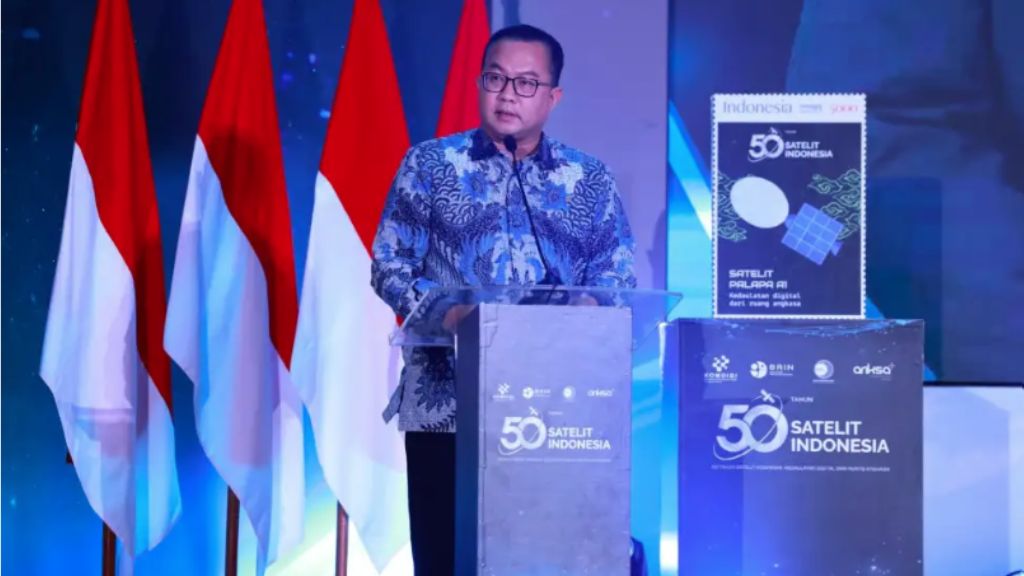
BRIN Chair Arif Satria emphasised the importance of achieving self-reliance in satellite technology. Image: BRIN
For Indonesians who grew up during the 1980s and 1990s, the phrase "This broadcast is made possible by the Palapa Satellite" was a familiar aspect of watching national television programmes on the state's official broadcaster, TVRI.
"When we think back to the FIFA World Cup decades ago, we miss hearing those words," said National Research and Innovation Agency (BRIN)’s Chair, Arif Satria, who delivered the opening remarks at the 50 Years of Indonesian Satellites commemoration event organised by BRIN and the Ministry of Communication and Digital Affairs in Jakarta, July 8.
The event reflected on Indonesia's half-century journey in satellite development while charting the direction of the country's space future.
With an economic zone spanning eight million square kilometres, Indonesia can only effectively monitor and manage its vast territory with the help of satellite technology, explained Satria.
Developing satellite technology is no longer merely a matter of national prestige, but an effort to build space sovereignty and lay the foundations for Indonesia's future economy, he added.
For Satria, space sovereignty means having control over the technologies, infrastructure and capabilities required to design, build, integrate, test, launch, operate and utilise satellites on Indonesia's own terms.
The nation's first homegrown satellite
Indonesia's ambitions for space sovereignty would be demonstrated through the launch of the Nusantara Earth Observation-1 (NEO-1) satellite in January 2027.
NEO-1 is Indonesia's first earth observation (EO) satellite fully developed by the country.
"The launch of NEO-1 will mark an important milestone, demonstrating Indonesia's growing capability to master the entire satellite technology supply chain," said Satria.
The NEO-1 will carry high- and medium-resolution imaging sensors, thermal infrared capabilities, and an Automatic Identification System (AIS) receiver for vessel monitoring, allowing Indonesia to generate its own strategic spatial data for agriculture, maritime surveillance, disaster management, and evidence-based policymaking.
Satria stressed that the launch of NEO-1 is not the destination, but rather the beginning of Indonesia's long journey towards space sovereignty.
Indonesia's next step is to develop its own telecommunications satellites to meet the connectivity needs of the world's largest archipelagic nation while supporting the country's digital economy backbone, he added.
Realising the dream of a national spaceport
Indonesia aims to position itself as a global space player by incorporating space economy, space sustainability and space defence into its national space development blueprint, Satria said.
One of BRIN's strategic priorities to realise this vision is to develop a national spaceport as Indonesia's gateway to outer space.
According to him, Indonesia's geographical position along the equator provides greater launch efficiency, giving the country a unique competitive advantage.
BRIN hopes Indonesia will no longer rely entirely on foreign launch service providers and may eventually become a launch service provider for other countries in the region.
Satria underlined that Indonesia's ambitions for space sovereignty cannot be achieved without close collaboration between the government, BRIN, the private sector, international partners, and other stakeholders in the space sector.
Space sovereignty begins with data
BRIN's Aerospace Research Organisation’s Head, Heru Triharjanto, highlighted that space sovereignty cannot be achieved without ensuring Indonesia has control over the data generated from space, particularly spatial data.
Although satellite data processing is already carried out domestically, Indonesia still relies heavily on satellites owned by foreign governments and vendors as its primary data source.
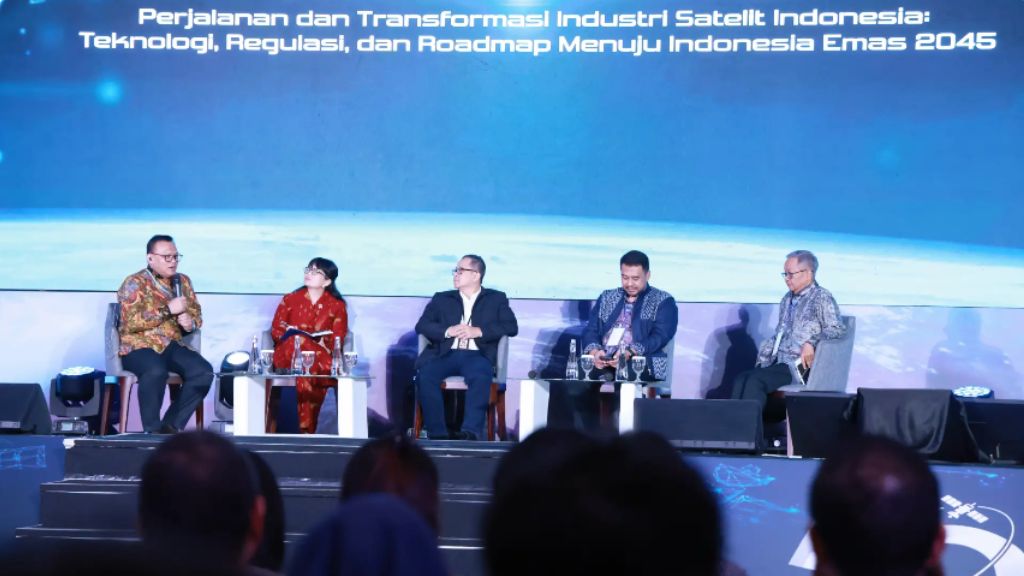
This dependency limits access to timely, sustainable, and nationally relevant data.
"The mindset that we should simply buy satellites from the United States or rely on technologies from overseas needs to change," he said.
With the launch of NEO-1, Indonesia will gain full authority over its own spatial data, enabling the government to make faster and more informed decisions on issues ranging from food security and disaster management to maritime security and territorial sovereignty.
"One thing is certain: illegal fishing will no longer go undetected because every vessel entering our territorial waters can be identified immediately and authorities can act straight away," he added.
The ability to generate and control strategic data from space is increasingly becoming a prerequisite for digital sovereignty and evidence-based policymaking.
In that sense, Indonesia's pursuit of space sovereignty begins not with rockets or launchpads, but with data.
Industry and talent: which should come first?
Another challenge lies in resolving the long-standing dilemma between the space talent supply and growing the domestic space industry.
Indonesia Space Association's Chairman, Adi Rahman Adiwoso, pointed out that Indonesia's satellite ecosystem has long faced a classic chicken-and-egg problem: there are too few space professionals, while the industry itself remains underdeveloped.
"But industry cannot wait for the perfect solution before getting started. I would rather crack the egg first and figure it out later on," he said.
Higher Education, Science and Technology’s Vice-Minister, Stella Christie, proposed a short-term solution by establishing a dedicated space centre of excellence within a university or polytechnic institution.
"Starting entirely from scratch would be difficult. We should first identify which areas of the space sector offer the greatest opportunities for prioritisation."
She added that her ministry plans to send lecturers overseas for training through a train-the-trainer approach.
Triharjanto added that Indonesia could learn from countries such as the US, China and India, which successfully built their space ecosystems through close collaboration between government, industry and academia.