
Indonesia’s citizen health app gets a boost with an AI-powered personal health assistant
Starting next year, the SATUSEHAT Mobile app will include an artificial intelligence (AI)-powered personal health assistant for its users.
The Indonesian Ministry of Health is strengthening the SATUSEHAT ecosystem as the backbone of national health digital transformation. Image: Ministry of Health
Indonesia’s Ministry of Health is incorporating artificial intelligence (AI) into SATUSEHAT Mobile to encourage healthier behaviors among users through more personalised recommendations and guided self-monitoring.
With AI integration, the citizen health app is no longer merely as a place to store health data, but as a platform that prompts user’s action.
The Ministry of Health’s Expert Staff for Health Technology, Setiaji, said that the enhanced feature is aimed at helping people build healthy daily habits.
“Imagine new features that operate 24 hours a day, delivering notifications, reminders, and recommendations for healthy lifestyles. SATUSEHAT Mobile becomes our personal health assistant,” he said.
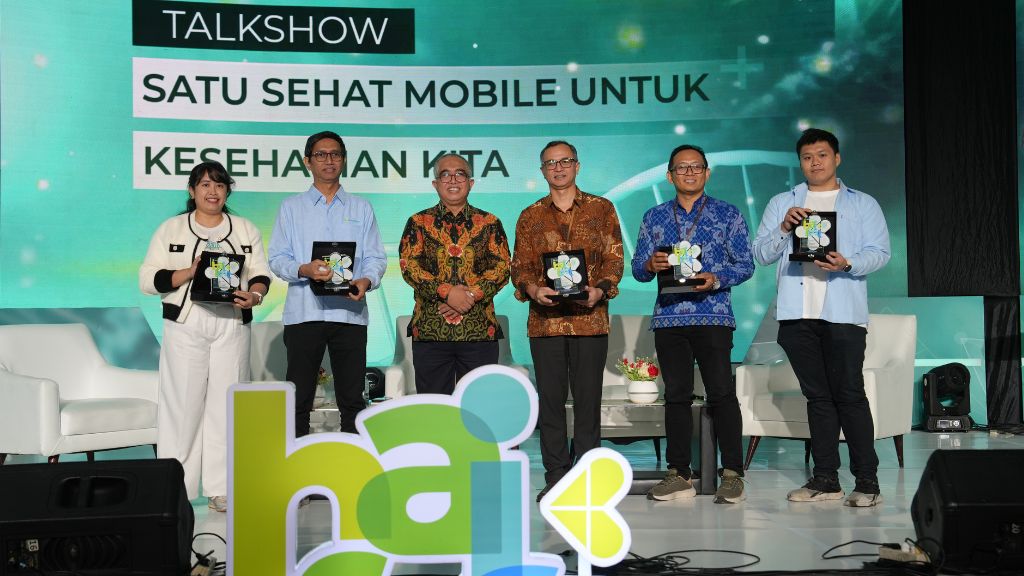
Setiaji was speaking in a panel discussion titled SATUSEHAT Mobile for Our Daily Lives at the Health Innovation Festival (HAI-Fest 2025) event organised by the Ministry of Health on December 8 in Jakarta.
Ministry’s Head of Centre for Data and Information Technology, Eko Sulistijo; Badung Regency’s Health Officer, Dr Komang Arya; and SATUSEHAT Mobile user, Kevin Pratama, were among the other speakers, with the session moderated by Ministry’s Head of Brand, Marketing and Communication, Technology Transformation and Digitalization Team, Karina Kusumawardani.
From curative to preventive healthcare
Setiaji added that SATUSEHAT is expected to drive the shift from curative to preventive healthcare.
“Many patients still come to health facilities only after experiencing severe symptoms. With personalised reminders and recommendations, the risks of non-communicable diseases can be reduced much earlier,” he said.
Among the planned features is the app’s ability to analyse the meal’s nutrient count from photos. Users could simply take a photograph of their food, and the app would instantly provide estimated count of calories, protein, and other nutrients.
The AI will also monitor daily activity and send activity reminders, a behaviour-based method that Setiaji expected to help users become more disciplined about healthy lifestyle practices.
Throughout 2025, the Ministry of Health has strengthened the app’s user input capabilities, laying the technological groundwork for AI. This allows users to record blood pressure, weight, and various other health indicators into the app.
To subscribe to the GovInsider bulletin, click here.
Data ecosystem as the key
Setiaji emphasised that AI technology cannot run optimally without an integrated, high-quality national health data ecosystem.
Until now, health data is scattered across many institutions, from hospitals and primary care facilities to pharmacies and health tech providers.
“This is why we developed the SATUSEHAT ecosystem: to integrate these various data sources so they can be connected and secure,” he added.
He noted that setting standards help make interoperability possible, likening the SATUSEHAT ecosystem to Indonesia’s shared ATM network where each bank has its own internal system but follows the same standards.
The Ministry has also developed the Health Sandbox to test emerging technologies like AI and robotics, ensuring their safety and suitability before widespread use.
This builds on the Ministry’s existing efforts to stimulate innovation, as it recently organised an AI Hackathon to seek technological solutions for national health priorities.
This competition serves as a platform to expand the innovation ecosystem, with the goal that successful solutions will eventually be integrated into SATUSEHAT.
A showcase of digital health services
The Ministry’s Head of Data and Information Technology, Eko Sulistijo, added that SATUSEHAT Mobile has now become the national showcase for digital health services.
While it looks simple from the user’s point of view, the app is actually connected to hundreds of health systems behind the screen.
Its core feature is allowing users to view their outpatient medical records from various healthcare facilities, provided that the facilities have completed their digital reporting obligations.
Another key feature is enabling medication search and reminder service, which is directly integrated with Indonesia’s national master drug data.
Meanwhile, the free health screening programme (CKG) offers the public an initial opportunity to onboard the app and monitor basic health indicators, such as blood pressure or blood sugar, at no cost.
“The ticket to access this service is also available through SATUSEHAT Mobile,” Sulistijo said.
Local-level adoption of SATUSEHAT
The panel highlighted a success story of SATUSEHAT Mobile adoption at the local level, particularly its integration with emergency services.
Badung Health Office’s Dr Komang Arya shared that with a population of 520,000 and an annual tourist arrival of 5.3 million, his district required faster emergency response services.
“When we talk about emergencies, this is a right for all of us,” he said.
To meet this demand, Badung established a 24-hour safety centre involving doctors, nurses, and health analysts, connected directly to the emergency hotline and the regent’s public complaint channel.
Komang claimed the response time was only 14 minutes.
This response system is also linked to SATUSEHAT Mobile via the location-based emergency feature.
“When users press the emergency button within Badung, the call is automatically redirected to our regional crisis centre or safety centre,” he said.
At the user level, SATUSEHAT Mobile is increasingly being used to meet practical health needs and has become the first option for many people.
Pratama, an active user of SATUSEHAT Mobile, found the app particularly helpful when he needed a medical examination for his Working Holiday Visa.
“Rather than paying for expensive services, it’s better to try the free one.”
For Kevin, the medication reminders and health indicator tracking features are the two most useful services.
He hopes SATUSEHAT Mobile could further develop into a comprehensive health service hub that enables teleconsultations and provides recommendations on vaccinations for citizens travelling abroad.