
Indonesia’s Ministry of Education looks to consolidate its edutech teams and initiatives
Indonesian Ministry of Primary and Secondary Education’s Head of the Centre for Data and Information Technology, Yudhistira Nugraha, shares how he navigates bureaucracy to keep education GovTech running and sustainable.
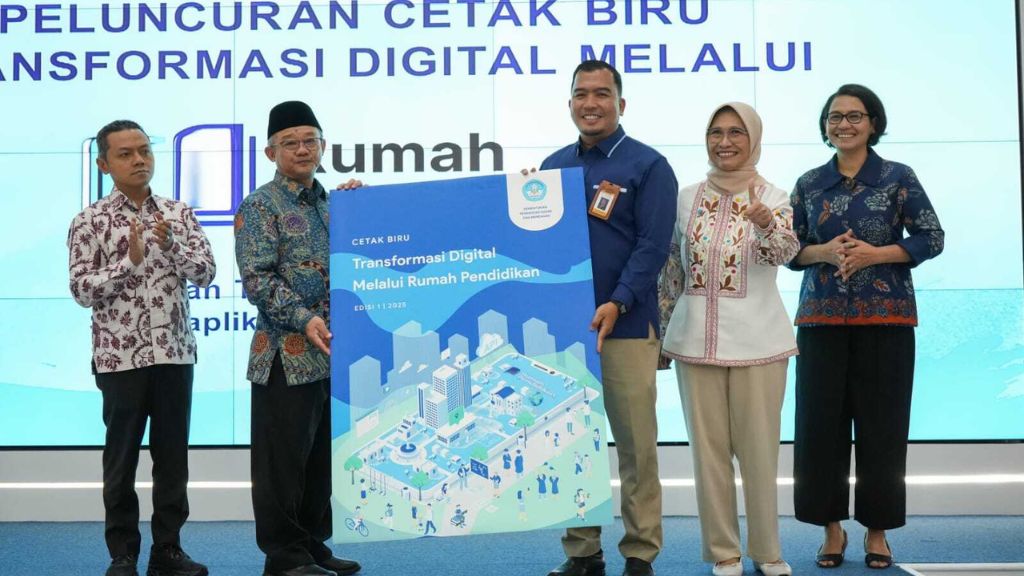
Indonesia’s Minister of Primary and Secondary Education, Abdul Mu’ti (left), and Head of the Centre for Data and Information Technology (Pusdatin), Yudhistira Nugraha (right), launched the Rumah Pendidikan app in 2025. This marks the continued advancement of government digital services in the education sector. Image: Ministry of Primary and Secondary Education
As Indonesia advances its digital government agenda through Presidential Regulation (Perpres) 82 on Accelerating Digital Transformation and the Integration of Digital Government Services, many GovTech initiatives have entered a challenging adjustment phase.
Changes in national leadership, updates to procurement frameworks, and institutional restructuring have required public agencies to adapt to new regulations while ensuring that digital services continue to operate without disruption.
Since the announcement in 2023, several government agencies have been unable to adapt to the new regulations ended up having to do major restructuring and, in some cases, ended up dissolving their GovTech units.
In contrast to this, there have been success stories.
The Ministry of Primary and Secondary Education has used this period to strengthen its GovTech infrastructure. Through the Centre for Data and Information Technology (Pusdatin), the ministry has ensured that digital transformation journey continues and becomes more sustainable.
Speaking to GovInsider, the Ministry of Primary and Secondary Education’s Head of the Centre for Data and Information Technology, Yudhistira Nugraha, says the government’s ability to continue serving users over the long term is the true measure of GovTech’s success, and “not merely how quickly or how well an app is built”.
Adjusting to the new scheme through interagency collaboration
According to him, maintaining digital transformation within the education ministry depends on close integration with other digital teams across the education sector and public agencies.

Before the new regulation, the foundations were laid by GovTech Edu, a private tech partner to the education ministry.
GovTech Edu had previously developed the teacher platform called Merdeka Mengajar (PMM), School Budget System (ARKAS), and the Students Education Report (Rapor Pendidikan).
“Institutionally, this model requires further consolidation, as the administrative umbrella for the technology team has not yet been fully established because of changing leadership,” he explains.
To ensure continuity in development, the ministry has been using a framework of contract scheme with a state-owned enterprise (SOE) subsidiary, allowing technology talent to work in a focused manner without having to become full-time civil servants.
Challenges have emerged with Perpres 82 coming into effect. New regulations mandate that all GovTech initiatives must involve Peruri, a digital security focused SOE, but GovTech Edu was not a unit under Peruri.
After coordinating with the National Public Procurement Agency (LKPP) and internal oversight bodies, the ministry completed its transition period in 2025 and fully implemented the Perpres 82 scheme with Peruri as its partner.
“Under this new scheme, Peruri’s role is limited to managing and providing technology talent. The team works within the ministry, with product needs and direction fully under the ministry’s authority,” Nugraha explains.
GovTech Edu has transformed into INA Digital Edu, fully embedded within Pusdatin as the Pusdatin Technology Team.
Technology that supports education policy
Nugraha underlines that this model allows the ministry to retain control over product development while aligning with national policy.
“By positioning digital transformation as an integral part of the national education system, digital services must follow policy cycles and operational needs in schools, rather than operating separately as standalone technology initiatives,” he notes.
This shift has also changed the role of Pusdatin, from merely developing digital products for the ministry to acting as a bridge connecting education policy with on-the-ground implementation, he adds.
The institutional adjustment process has been accompanied by reorganised team capacity and resource allocation. The number of tech talents has been recalibrated to better match long-term needs, alongside budget adjustments.
According to Nugraha, the main challenge during this phase has been maintaining knowledge continuity and service quality.
“The most important thing is retaining the core team and product knowledge, because that is where the understanding of the education context and service sustainability lies,” he adds.
Learning from this success, the Ministry of Administrative and Bureaucratic Reform (PANRB) and Peruri initiated a study to understand how the Ministry of Primary and Secondary Education’s Pusdatin manages a technology team embedded within the organisation.
Building a "home” for education services
For Nugraha, over three million users of government-owned education apps represent a crucial asset for driving innovation.
The next challenge is how to integrate various apps into a single shared platform without adding to the burden on users, particularly teachers and schools.
Pusdatin has consolidated its services through the “Rumah Pendidikan” (Education Home), a digital ecosystem that brings together education services within a single-integrated framework.
The ecosystem includes the following:
The Teachers Space (GTK) - previously known as the Merdeka Mengajar Platform, serves as a hub for teachers’ professional development. It offers teaching materials, self-paced training, and official channels for communicating learning policies, as well as a data-driven space for reflecting teaching practice.
The School Space supports the governance of education units, covering planning, administration, and school operations management. It is designed to help principals and education administrators make decisions aligned with policy and learning priorities.
The Student Space provides digital services focused on the student learning experience. Learning content, assessments, and personalisation features are designed to encourage active engagement and deeper understanding.
The Government Space enables central and local governments to access data, monitor policy implementation, and use data-driven insights in the formulation and evaluation of education policies.
The Parents’ Space facilitates family involvement in children’s education. Through this space, parents can access learning information and students’ progress more transparently.
The Language Space functions as a platform for language development and preservation, while also supporting digital language learning for various user groups.
The Public Space provides open access to selected education information and services, as part of efforts to enhance transparency and public literacy in education.
The Partners’ Space is designed to facilitate collaboration with external partners and support the innovation ecosystem, including the private sector, civil society organisations, and other stakeholders.
The “home” metaphor, according to Nugraha, has been chosen because a home is a place where all its occupants feel comfortable and well served.
“In the same way, digital education services must embrace all stakeholders and be built around users’ needs.”