
Inside Sri Lanka’s efforts to leverage digital public infrastructure (DPI) for economic recovery
DPI advisor Dasun Hegoda shares how the Sri Lankan government is coordinating nationwide DPI development to support the country’s digital economy goals.
-1778030602458.jpg)
Sri Lanka's story is one of those featured in the GovMesh Digest special report
Sri Lanka's story is one of those featured in the GovMesh Digest special report. You can find the individual stories on the other participating governments at GovMesh 4.0 here.
From 2022 to 2023, Sri Lanka experienced a severe macroeconomic crisis, marked by record levels of inflation, the collapse of its currency, and a severe shortage of essentials.
Structural reforms have stabilised the situation today, but the path to long-term growth remains uncertain and fragile.
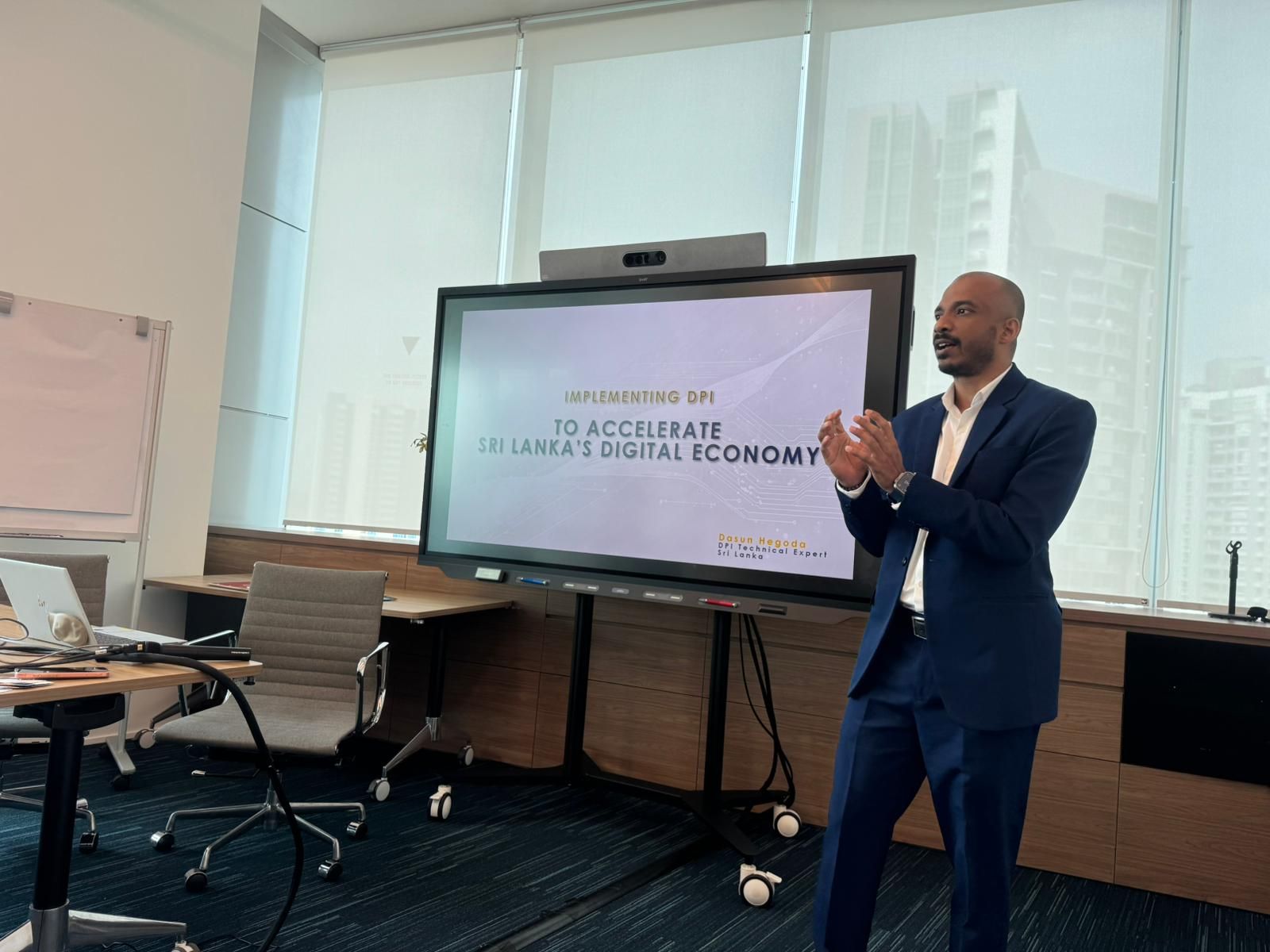
Within this context of broader turmoil, the current government has identified the digital economy as a key component of economic recovery – what Dasun Hegoda, Sri Lanka’s Technical Advisor for Digital Public Infrastructure (DPI), called “an opportunity to reimagine where we want to be in five years”.
In particular, the National Digital Economy Strategy has earmarked DPI as the foundational layer for realising Sri Lanka’s vision of a robust, export-oriented digital economy that can sustain economic growth, create new employment opportunities, and deliver trusted public services.
At GovMesh 4.0 event held in Singapore by interweave and GovInsider, Hegoda shared more about how Sri Lanka is tapping on DPI - defined by the World Bank as “foundational, digital building blocks designed for the public benefit” - to meet its digital economy goals.
From silos to horizontals: how DPI powers the digital economy
The South Asian country has set an ambitious target: for the digital economy to comprise 12 per cent of its total economy by 2030, from 3 – 4 per cent (US$15 billion) currently.
One third of that (US$ 5 billion) would come from digital exports.
This reflects the government’s confidence in its strong domestic IT industry, which saw nearly 30 percent growth from 2023 to 2024.
“The whole idea is not only to be digitally ready within the country, but also to compete regionally within Asia and beyond as well,” said Hegoda.
This is where the DPI approach comes in.
A traditional approach to the digital economy would entail each sector developing its own digital platforms, such as digital identity, digital payments, and data exchange systems – a repetitive and costly approach.
In contrast, introducing secure and interoperable foundational systems can enable use within both government and industry.
This horizontal approach to digital infrastructure means that individual sectors, such as healthcare, need not re-invent the wheel or develop their own methods for interacting with users.
Businesses tapping on these common systems can onboard new customers more quickly and securely, while benefitting from lower costs and compliance burdens.
The reusability of DPI across sectors makes it a cost-effective method for achieving whole-of-society digital transformation, which is particularly helpful when working with financing constraints, noted Hegoda.
By coordinating the development of nationwide DPI, the Sri Lankan government aims to support the private sector in building meaningful products and services, in turn contributing to the country’s digital economy goals.
Adopting open-source solutions
Currently, the Sri Lankan government’s strategy for implementing DPI is through the adoption of open-source digital public goods (DPGs).
This is in part to avoid the vendor lock-in challenges posed by proprietary solutions, said Hegoda.
Sri Lanka is working closely with the Digital Public Goods Alliance (DPGA) to identify the right DPGs to form the foundation of its national DPI.
For instance, the country has adopted the open-source MOSIP for its Sri Lankan Unique Digital Identity (SL-UDI) programme, which is due for rollout in late 2026.
To drive adoption of the new digital identity programme, the government has identified many use cases, and will be prioritising those which have immediate impact on citizen’s lives and can scale quickly, while ensuring security and privacy, said Hegoda.
“All these DPI solutions can be used by the public sector as well as the private sector. Rather than rebuilding all these capabilities, they can pick and choose these ‘Lego blocks’ to build their applications in these domains,” he explained.
This is akin to the adoption of Singpass in Singapore or Aadhaar in India, where successful adoption was driven by integrating identity modules within both public and private services. These modules include Singapore’s MyInfo, which allows users to pre-fill forms with verified data from government sources.
Likewise, Sri Lanka is also leveraging data exchanges similar to the open-source X-Road to build its National Data Exchange and facilitate seamless data sharing across government agencies.
In the long run, there are plans to ensure the entire architecture is AI-ready and interoperable with cross-border systems, he said.
Setting the right foundations
To ensure the success of Sri Lanka’s DPI rollout, the right foundations have to be in place.
First, this includes setting up the right governing bodies, including GovTech Sri Lanka and the Digital Economy Authority, which will drive coordination across government bodies and oversee the nationwide implementation of digital platforms respectively, highlighted Hegoda.
On the legislative front, the country is finalising its Cyber Security Bill, which authorities say will be tabled in Parliament in 2026, and its data protection laws are slated to be fully operationalised in 2026 as well.
Other efforts that the country is embarking on across the next five years include the modernisation and expansion of the existing Lanka Government Cloud and improving digital literacy and digital adoption across the country.
The government will also introduce a capacity building programme to support civil servants and public sector bodies in better governing this infrastructure.
“To get everyone onboard, we are trying to make it incentive-driven for all stakeholders,” he said, pointing to the tangible benefits that Sri Lanka hopes to deliver to citizens, businesses, startups, and government officials through this initiative.