
‘Justice is human’: Where Asia-Pacific courts draw the line on AI in courtrooms
Legal experts from Thailand, Japan, South Korea, Philippines and UNDP at a recent event discussed the need for stronger governance frameworks and human-in-the-loop when using tech to administer justice.
-1782372436293.jpg)
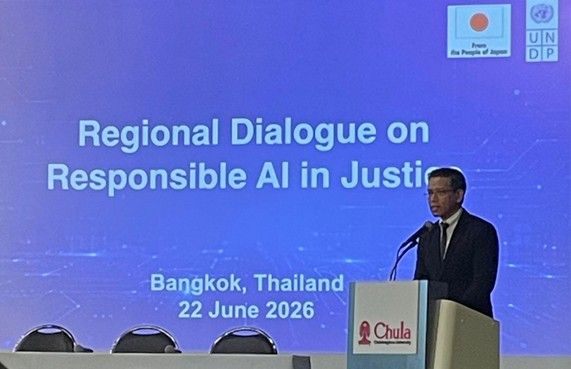
Judges, legal experts, academics and policymakers from across Asia-Pacific who gathered at Chulalongkorn University on June 22 for a regional dialogue on AI in Justice. Image: UNDP
Artificial intelligence (AI) is being used in court systems across Asia Pacific (APAC).
In Vietnam, the court’s legal virtual assistant, trained on more than 1.3 million judgments, has logged over three million uses and cut judicial workload by up to 30 per cent.
In the Philippines, an AI transcription pilot project cut transcription time by 50-80 per cent while improving accuracy from 70-95 per cent, even across mixed-language proceedings.
In India, AI is increasingly used for transcription function in courts which is traditionally done by a human, as well as translating judgements into different languages.
As the world’s fastest-growing region for legal tech investment, APAC's investments in this sector is expected to more than double, from roughly US$5 billion (S$6.5 billion) in 2023 to over US$11 billion by 2030, according to UNDP’s reporting.
“AI has great potential to help make justice systems faster, more accessible and responsive to people’s needs,” said United Nations Development Programme (UNDP)’s deputy regional director for Asia and the Pacific, Beate Trankmann.
She was speaking in a roundtable discussion titled Priorities, Frameworks & Partnerships for Responsible AI in Justice on June 22 at Bangkok, Thailand, alongside judges, legal experts, academics and policymakers from across the region.
UNDP is working with partners across the region to support its responsible use.
The event was organised by UNDP Bangkok and supported by the Japanese government, Thailand Institute of Justice and Chulalongkorn University’s Faculty of Law.
As countries in the region are exploring or implementing AI applications within their justice systems, speakers called for stronger governance frameworks to ensure that technology enhances, rather than undermines fairness, accountability and human rights in administering justice.
The speakers also stressed that decisions affecting human lives must remain under human control.
Regional experiences of how AI is used in justice
Several countries shared their experiences in integrating AI into legal systems.
Japan: Regulating legal technology
In Japan, AI is mainly used for legal research, document drafting, legal advice and operational support, said Waseda Law School’s Professor Kyoko Ishida.
While AI tools can significantly improve efficiency for legal practitioners and corporate legal departments, she said they are not replacing lawyers.
"The main challenge is determining how these services should be regulated,” Professor Ishida said.
The country’s Supreme Court took a more cautious stance, opposing the use of generative AI (GenAI) to draft judgements or analyse evidence, arguing that systems trained on past data cannot replicate the context-aware reasoning required in adjudication.
At the forum, Japanese Ambassador to Thailand, H.E. Otaka Masato, shared the same consensus.
While recognising AI as a powerful tool that could eventually perform tasks traditionally carried out by legal professionals, he stressed that governance and human accountability must remain central to its deployment.
"Final decision makers should always be human beings,” he said.
Philippines: Human-centered augmented intelligence framework
The Philippines highlighted its recently adopted ‘Human-Centered Augmented Intelligence Framework', introduced by the Supreme Court in February.
This made the Philippines the first ASEAN judiciary to formally adopt the UNESCO guidelines framework, demonstrating the practical influence of international standards on national judicial policy.
The Supreme Court of the Philippines’ Attorney Alberica C. Manuel described the framework as an example of technology designed to serve people rather than replace them.
According to her, work on the framework began as early as 2022, as the court had to confront this dilemma of how AI should be deployed as it becomes available.
It was noted that AI, which is highly technical, can save costs but the risks are inaccuracies.
The framework requires disclosure of AI whenever it is used. Additionally, AI use is authorised only in certain tasks.
“AI can assist the judiciary, but it cannot make judicial decisions,” Manuel said, adding that “innovation should always remain human-centered, by the people and for the people.”
South Korea: Strong human-in-the-loop approach
The Supreme Court of South Korea’s Chief of Judicial IT Office, Woo-Hyeon Kim, spoke about implementation of an AI-based judicial support platform.
The platform focuses on the data, large language models (LLMs), hardware infrastructure, user queries, and system evaluation used to support judicial work.
As jurisdictional information is highly sensitive, he highlights that responsible AI use in the justice system requires a strong “human-in-the-loop approach.”
The approach ensures that judges remain accountable for decisions and that trust in AI depends on human oversight rather than technological accuracy alone.
Risks of AI in the courtroom
Concerns over accountability, transparency and data quality were raised by Thai judicial leaders.
The Supreme Court of Thailand’s Secretary, Komtharnongchai Chaiphairojn, said that although
GenAI can produce decisions within seconds and reduce costs, it also poses significant risks to the justice system.
“Biased data will produce biased outcomes,” he said. “In the courts, inaccuracies are unacceptable.”
He noted that many AI systems generate recommendations without clearly revealing the underlying data or reasoning, raising concerns about transparency and accountability.
“The user is human, and justice is human,” he said. “Without human oversight, we risk stripping people of their dignity and their right to fair justice.”
Chaiphairojn added that AI developers often carried limited responsibility when systems produced errors, despite the potential harm to individuals affected by those decisions.
“We should not ban AI from courtrooms, but AI can never replace the human mind or human oversight,” he said. “Our responsibility is to ensure that technology serves humanity.”
In September 2025, Thailand’s Supreme Court issued guidance promoting the ethical and cautious use of AI technologies in court operations, emphasising human oversight, accuracy, and professional responsibility.
Building on this framework, the Civil Court issued a regulation from November 17, 2025, onwards, requiring parties and lawyers to disclose AI-generated content in pleadings.
Disclosure obligations include marking AI-generated content clearly, certifying that it has been reviewed for accuracy, verifying facts independently, and maintaining accountability for submissions.
UNDP: Human rights must come before technology
“AI is already in courtrooms across the region,” stated UNDP’s Regional Specialist on Rule of Law, Justice, Security and Human Rights, Simone Boneschi.
Boneschi used the event to launch two UNDP publications centred around how AI is shaping APAC’s justice system, and UNDP’s regional policy guidance in this aspect.
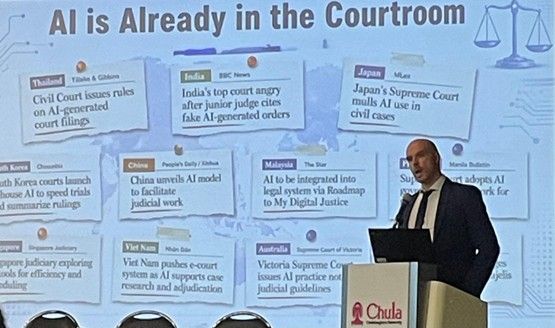
He emphasised that responsible AI in justice should be guided by foundational principles: human dignity and autonomy, non-discrimination and equality, transparency and explainability, security and reliability, and accountability and remedy.
“The first question should not be how to use AI, but whether AI is needed for a particular task,” Boneschi said.
“Human rights must come first, followed by technology, not the other way around.”
As AI adoption in justice systems accelerates across the region, participants agreed that the challenge is no longer whether courts will use AI, but how they can do so responsibly.
AI may help courts work faster and more efficiently, but justice leaders across APAC agree that technology must remain accountable to the people it serves.