
Keeping the lights on for Singapore’s digital infrastructure
By Zenith Wong
Terence Chia, Assistant Chief Executive of the Connectivity, Cybersecurity & Resilience Group at Singapore’s Infocomm Media Development Authority, shares how network safeguards, threat intelligence and practical skills help keep the country’s essential digital connections working.
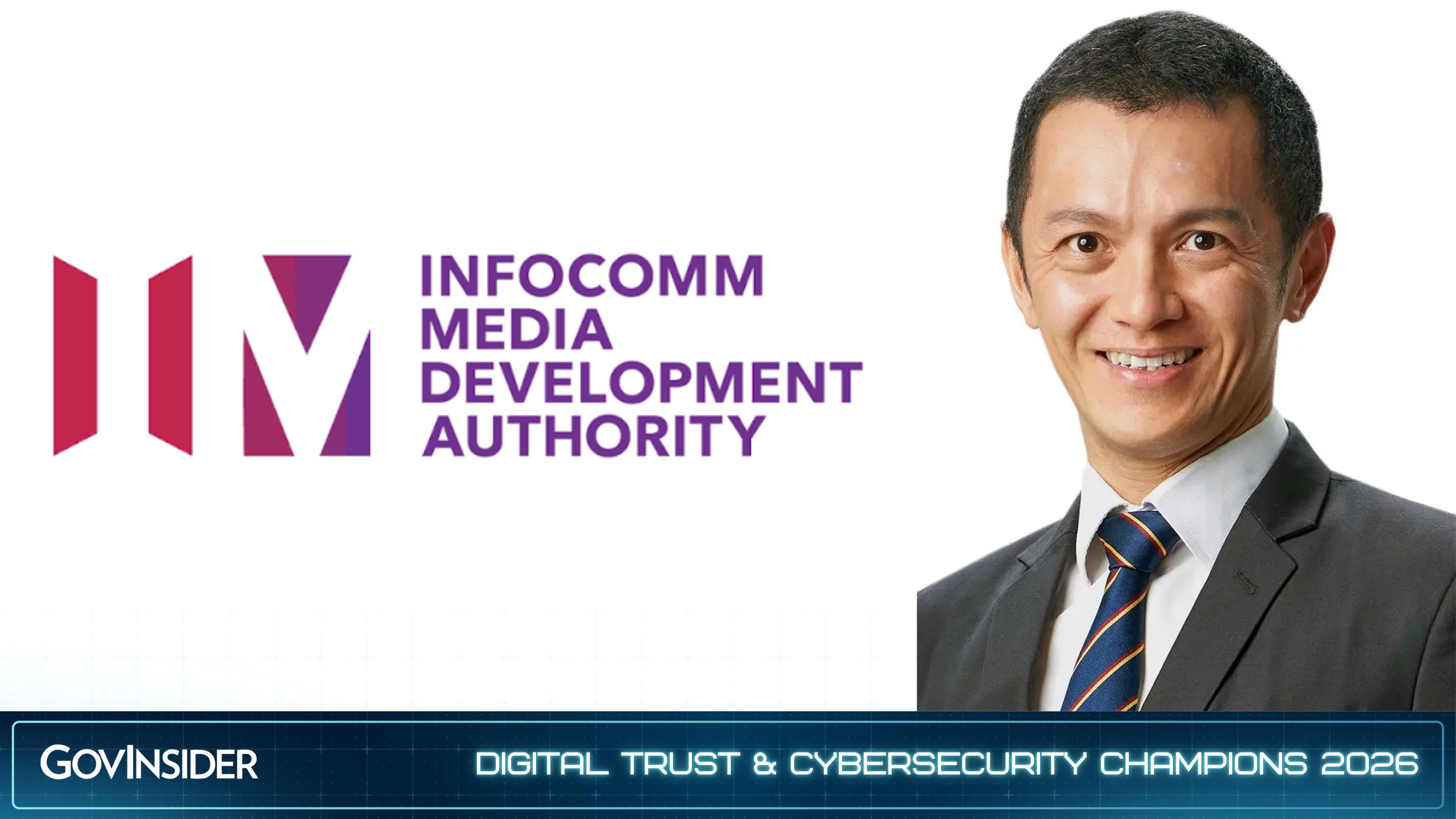
Terence Chia of Singapore’s Infocomm Media Development Authority (IMDA) says resilient digital infrastructure needs both secure network design and teams ready to detect and respond to attacks. Image: IMDA
For most people, digital infrastructure becomes noticeable only when it stops working, like when a call fails or an internet connection drops.
Terence Chia describes his job in terms of keeping those everyday connections working.
“I keep the lights on for Singapore’s digital infrastructure,” the Assistant Chief Executive of the Connectivity, Cybersecurity & Resilience Group at the Infocomm Media Development Authority (IMDA) tells GovInsider.
Chia has spent two decades in public service across policy, strategy and operations.
Before taking on his current role, he worked on building Singapore’s technology talent pipeline as part of IMDA’s digital industry development work.
His responsibilities now span cybersecurity and resilience for the infocomm media sector, alongside spectrum management, satellite regulation and standards development.
As artificial intelligence (AI) allows attackers to work faster and at greater scale, he believes it is important for the industry to get the fundamentals right: managing credentials, designing networks carefully, maintaining visibility and preparing for disruptions.
The ability to detect, respond and recover depends on how these measures work together, and on the people who put them into practice.
Looking beyond secure software
Secure software is just one part of a wider operational challenge for operators.
“It is good to have strong bones in the network but also important to have strong muscles to respond when it is attacked,” Chia says.
In today’s cybersecurity landscape, with AI, operators also need to consider how systems are deployed, how networks are connected and whether someone is ready to respond when suspicious activity appears, he explains.
Exposed endpoints and third-party components can also introduce risks after teams have put effort into developing secure software.
Cybersecurity teams should start from the assumption that an attacker could get through, says Chia. They should then question how far attackers could move and whether defenders can notice them.
Networks need to be designed with segmentation and visibility in mind. If a machine is compromised, segmentation makes it harder for attackers to use it as a springboard into other parts of the network.
Well-designed networks can also channel attackers towards “choke points” that allow better monitoring and containment of threats, he explains.
This principle of maintaining visibility is also a key part of his assessment of security tools.
Chia points to endpoint detection and response tools to monitor devices, and network detection and response tools to examine network activity.
But even sophisticated tools need someone watching and ready to act. Detection, monitoring and response have to work around the clock, he says.
“In cybersecurity, we have to assume that the attackers will always find a way in regardless of how sophisticated the network design is. With that, you can see why it is equally important to build up ability to detect and respond to attacks.”
Alongside investing in technology, keeping Singapore’s digital infrastructure resilient depends on getting those basics right.
Looking beyond the age of a system
When assessing older systems, Chia starts by asking how well the whole network is protected.
Speaking from the regulator’s perspective, he believes age alone does not establish how secure the overall environment is.
“Don’t get too fixated on whether something is legacy or not. Focus on the overall system,” Chia says.
A newer system can have vulnerabilities, while an older one may no longer support the latest patches or protective tools.
Instead, organisations need to assess what a system does, whether it remains necessary and how its connections affect the risks around it.
Where an older system cannot support endpoint detection tools, for example, monitoring network connection points may provide visibility into suspicious activity.
Segmentation can also help contain a compromise, alongside arrangements to isolate affected systems, remediate problems and recover.
The practical question is how organisations maintain protection and visibility across their entire infrastructure, including the parts they cannot immediately replace.
Turning intelligence into decisions
“We are not short of threat intelligence. What we are short of is knowing which pieces to act on quickly,” Chia says.
He describes drawing on public sources, commercial intelligence and information from partners, alongside exchanges with operators and regional counterparts.
“Ultimately, cybersecurity is the art of fusing information,” he says.
Chia stresses the value of sharing intelligence early, whether it is specific enough to inform detection rules and block threats, or a weak signal that others can help make sense of.
By comparing observations, teams can build a clearer picture and decide how to respond.
Their actions can then yield new information, feeding a continuing cycle of observing, interpreting, deciding and acting.
Keeping practical skills close to policy
Chia’s emphasis on practical capability extends to workforce development.
IMDA provides structured development pathways, with opportunities to build expertise in areas such as threat intelligence, attack simulation and threat hunting.
Training and certifications support skills in digital forensics and malware analysis, while community participation and competitions provide opportunities to learn from others and apply knowledge.
Chia did not begin his career with a cybersecurity background. He credits structured training and support at IMDA with helping him develop his own capabilities.
He also makes a point of joining his teams in practical work.
“We’re not just talking and writing regulations. We are actually practicing cybersecurity daily,” he says.
That curiosity extends to AI. Chia has been experimenting with agents across different platforms, including cloud environments and laptops, to understand their capabilities and limitations.
“I’m the proud parent of about five AI agents,” he shares.
The opportunity to experiment is part of what makes the role meaningful to him. It combines his interest in technology with his reason for entering public service: helping people.
The networks his team helps protect may be largely invisible to those using them. Keeping those connections working gives the technical work a clear public purpose.