
Leaders must cultivate risk and familiarity to unlock the AI imperative
By James Yau
Singapore public agencies can prepare its workers for inevitable changes by familiarising people with AI and fostering a culture that rewards risk-taking.

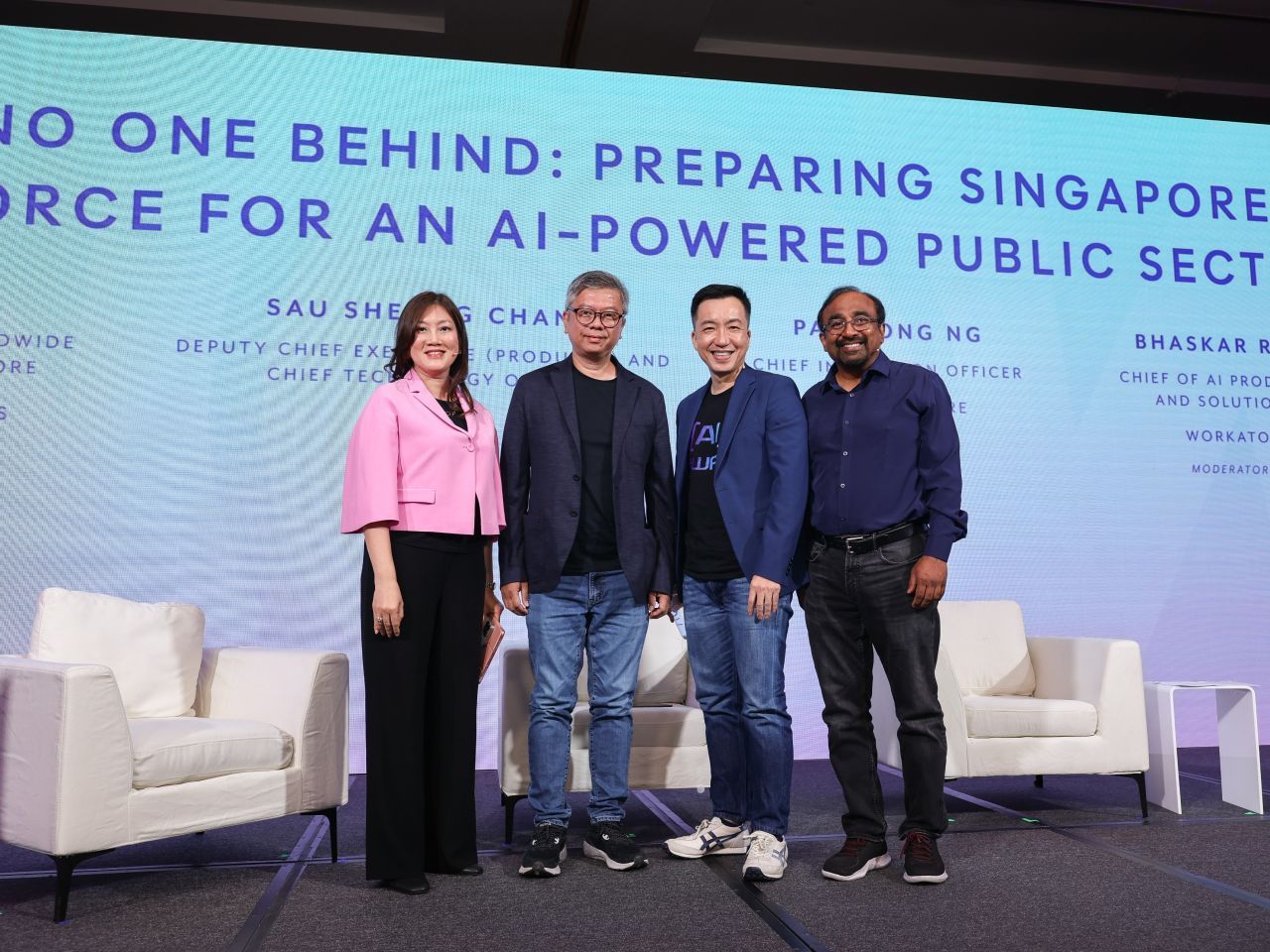
At the World of Workato Singapore event, public sector leaders discussed what was needed to prepare Singapore's workforce for widespread AI adoption. Image: GovInsider
The artificial intelligence (AI) economy is already here, prompting the urgent need to equip and empower businesses, workers, and communities with the necessary skills to prosper.
What sets the AI economy apart from previous tech revolutions is the unparalleled speed at which the technology continues to evolve.
“[As] we look at AI today, the technology is moving under our feet. I think that is something that we need to be aware of yet not necessarily afraid of.
“We need to use AI and realise that even as we're using it, the ground underneath us will shift at the same time, and then we need to adapt to it,” said GovTech Singapore’s Chief Technology Officer and Deputy Chief Executive, Sau Sheong Chang.
He was speaking at panel titled Leave No One Behind — Preparing Singapore’s Workforce for an AI-Powered Public Sector during the World of Workato Singapore event in September.
The panellists confronted an unnerving reality of the AI revolution: without rapid reskilling and a shift in workplace culture, the advancing AI wave could leave parts of the workforce behind.
“I think the uncomfortable truth that is buzzing around our ecosystem nowadays is about jobs. It is an area which the government does take very seriously, but it's not so much about the loss of jobs, it's about how jobs need to evolve,” said Amazon Web Services (AWS), Country Manager, Public Sector Singapore, Elsie Tan.
She stressed that the onus was on everybody to learn and be curious with AI.
“In AWS, we have a saying that ‘there's no compression algorithm for experience’, and I think that time frame in terms of compression algorithms is very much more heightened right now.
“I would urge everybody to really pick up on the skills, be agile and adaptable because these [attributes] will be so key,” she added.
The discussion centred on how the public sector could balance technical readiness and AI governance, ensuring that workers stay relevant in an AI-first era.
To subscribe to the GovInsider bulletin, click here.
Failure to learn
Workato’s Chief of AI Products & Solutions, Bhaskar Roy, who moderated the panel, connected failure and resilience as a “balancing act” that frames an employee’s experience with AI.
To that end, Home Team Science and Technology Agency (HTX)’s Chief Innovation Officer, Ng Pan Yong, made the distinctions between basic, complex, and intelligent failures.
Basic failures are preventable avoidable errors in standard, predictable situations whereas complex failures result from multiple, interacting system factors that cause unpredictable outcomes.
Ng used this to further challenge organisations on whether they provided an open environment needed to learn from these mistakes: “Do you have a psychological safety built in the workplace that you constantly address on these problems?”
Intelligent failure on the other end, involved "provoking a failure” with a set hypothesis in mind where insights can be derived from the mistakes that occurred in new and uncertain environments.
Citing SpaceX’s success innovating cost-effective space missions, Ng highlighted that intelligent failures provided incremental and natural learnings.
“That's what's being provoked. It's not about being silly and going after failure but having a very clear approach in learning for failure,” he added.
GovTech’s Chang noted that the emergence of AI, despite creating a potentially “different” world, doesn’t prevent the workforce from thriving.
“We still need people to do the work and if we leave people behind practically speaking, the work is done,” said Chang.
He was referring to the evolution of software creation, noting that AI systems could now generate entire applications Independently.
“What happens to the software engineers, product managers, designers and so on? We all need to change and some of these roles might disappear altogether, but it doesn't mean that work disappears,” he added.
Ng emphasised that as software engineering evolves, AI would shift the developer’s work from manual coding toward higher-order functions, such as reviewing code to ensure it meets the desired goal.
Recognising value
Roy asserted that people needed to see the value of AI to secure buy-in from the workforce and community.
As the agency supporting whole-of-government digital transformation, GovTech focuses on building platforms where other agencies could leverage to adopt AI, said Chang.
The agency also built ready-to-use applications to improve daily productivity, including language processing AI bots and AI tools that speed up public officers’ ability to generate responses for citizen requests.
Chang stressed that as a small nation, Singapore needed to be more ready and quicker than its peers when adopting AI.
“For Singapore, we need to start educating our people, we need to start adopting technologies, and we need to start using it to drive value for whatever things that we're trying to do,” he said.
AWS’ Tan believed that legacy systems would not impede AI adoption, thanks to the tools and integrations now available to bridge them with AI.
Rather, she underlined the importance of public trust in amplifying AI adoption.
“If we are not careful about the ability to test design and engineer the right AI policies, so that we, in turn, can build AI systems that our citizens can trust, then we won't be able to be strong,” she said.
“Once trust is lost, it's very seriously slow, and even when you have the technology to leapfrog, you won't be able to scale the AI spaces that the government wants to promote,” Tan added.
Agreeing with Chang on the topic of education, HTX’s Ng highlighted the strong youth enthusiasm for AI in Singapore and the promising landscape for startups and innovation.
Moreover, Ng advised leaders to embrace the vast opportunities presented by AI.
“I think as leaders, we really need to encourage our officers, our staff, to seize this opportunity that AI brings to all of us at this point in time.
“Having seen so many technology waves, I think we are already living through the most exciting one.”