
Less walled gardens, more open roads: How GovTech Singapore’s Optical builds with industry
GovTech Singapore’s Steven Koh and Keith Choo share how building Optical, the WOG web platform, meant rethinking what government should build and what it should leave to industry.
-1781062846532.jpg)
GovTech Singapore's team building Optical, the whole-of-government's web content management platform, as of November 2025. Image: GovTech Singapore
For a long time, building a government website meant working inside a walled garden, limited by legacy systems, steep licensing costs, and whatever features a proprietary platform happened to offer.
As agencies' needs grew more diverse, including stricter security requirements, greater flexibility and integration with other services, a one-size-fits-all platform can no longer keep pace.
The Government Technology Agency of Singapore (GovTech Singapore) has been replacing walled gardens with open roads.
The idea is for the agency to build and maintain the foundational infrastructure – or the roads - while empowering the industry to bring their innovations – which are the cars.
The analogy points to how public and private sectors can collaborate better together to deliver better digital government services.
GovInsider speaks to the agency’s Senior Director at Government Digital Products (Platform Products), Steven Koh, and Senior Product Manager, Keith Choo, to understand how that philosophy is being put into practice through Optical, GovTech Singapore’s whole-of-government (WOG) web platform.
A decoupled and open-source approach
Unlike its predecessor, the Content Web Platform (CWP), which bundled content management and hosting into a single monolithic system, Optical takes a decoupled approach.
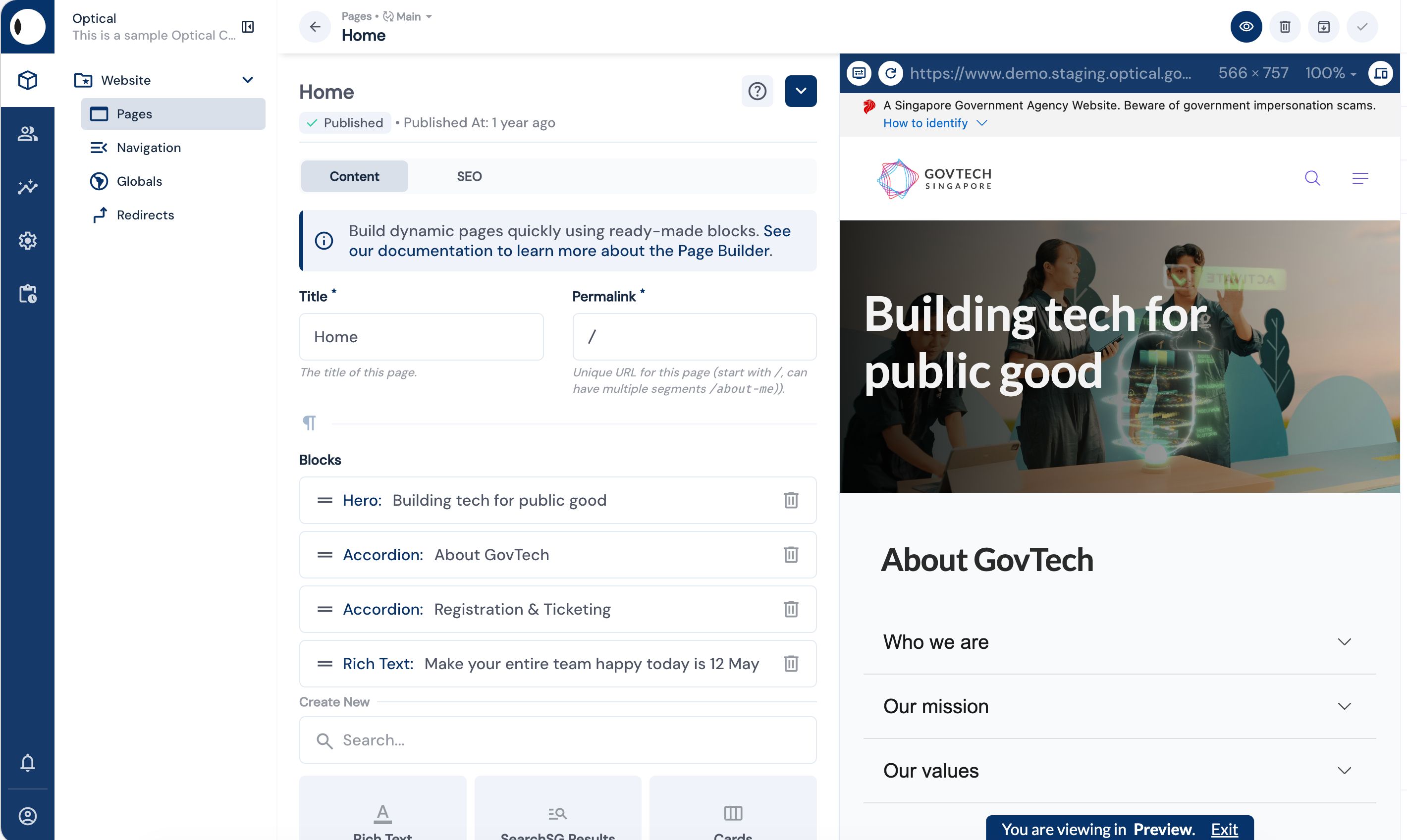
Through Optical, the backend content management can be handled by individual agencies themselves. GovTech Singapore manages the hosting infrastructure for the digital experiences or websites through Airbase (another GovTech Singapore’s product).
According to the team, the backend content management for Optical is powered by Directus, an open-source platform.
Known as a “headless content management system,” the two layers communicate via application programming interfaces (APIs).
What this separation means for agencies is less time worrying about underlying infrastructure, and more time focused on building, managing and publishing their own content.
With GovTech Singapore owning and maintaining the backend, agencies are free to build and customise their websites and digital experiences, without being constrained by a single platform.
Same road, new rules
The working relationship between GovTech Singapore and private vendors has gradually evolved over time, says Koh.
When the team began to develop Optical as the successor to CWP, vendors who had long serviced public agencies were understandably cautious and wondered about GovTech Singapore’s role.
“Some vendors were worried that GovTech would be in competition with them because we now also possess engineering capability,” he says.
The answer was a clear demarcation of roles at the start, which now forms the operational core of Optical.
While Koh acknowledges that his agency has the capability to build frontends, it consciously chooses not to, given the limited engineering resources within government and the private sector’s ability to scale and innovate much faster.
“We are not competing against them,” he explains, adding that GovTech Singapore provides “a platform for them to build on top of.”
For Koh, he is clear that the role of maintaining and strengthening backend stability must sit with the government.

“When you change the platform, there will be an upheaval,” he says.
At the scale government’s digital services operate, “you want the foundation to be stable, compliant and secure, so that agencies and vendors can build with confidence,” he explains.
Vendors and system integrators are positioned in the “driver’s seat”, as Koh calls it, for frontend development, engaging directly with agencies and building the necessary applications and services.
For incumbent vendors who had built long-standing relationships with agencies under CWP, he adds that the clarity of roles provides some reassurance to them.
For Choo, the value of vendors goes deeper than just frontend development.
Sitting closest to the agencies they serve, the vendors are often the first to catch what is not working.
Their early feedback is what allows GovTech Singapore to continuously refine the platforms, he says.
As an example, Choo shares how a vendor flagged an issue with the platform’s Singpass login integration during the early development phase.
This timely feedback allowed GovTech Singapore to resolve the issue before the website went live, preventing potential incidents.
A blue-sky look at the problem
Optical was created and driven by the necessity for change, Koh explains.
Built on legacy, monolithic systems, CWP became costly to license, difficult to maintain and had an ever-growing security burden across close to 500 websites, he notes.
For the agency, patching vulnerabilities was a constant cycle and every update has to be tested against every existing website, even for features agencies never used.
The turning point came when the team took a “blue-sky look”, as Koh says, at the problem by setting aside existing constraints and asking simply how things could be done better.
Then, GoBusiness, the one-stop portal for businesses to access government e-services, became the proof-of-concept (POC) to run on a modern, decoupled content management system.
If it worked for one agency, could it work for the wider Singapore government? Diving into the solution led the team to Optical.
Choo shares that Optical has been iterating steadily based on the team’s direct engagement with other agencies.
When Optical first launched, it offered only a content management system but has since expanded to include web hosting, scheduled publishing, and data capabilities.
From walled garden to open road
Koh underlines the importance of an open, API-first architecture, using the example of Ministry of Education (MOE)’s corporate website which migrated from CWP to Optical earlier this year.
MOE needed more than just standard publishing capabilities to include an automated data pipeline to pull content from internal systems.
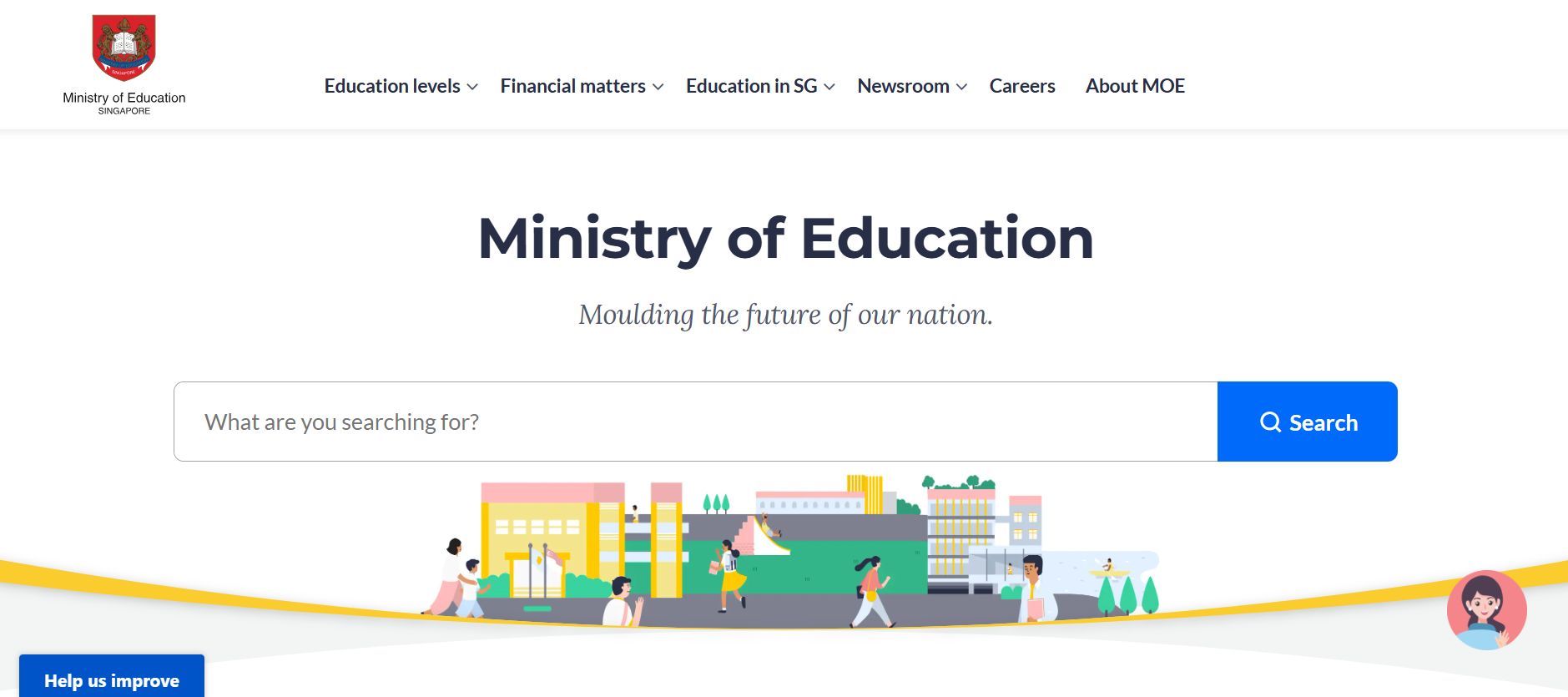
Instead of modifying Optical, its open, API-first architecture allows it to connect with two sibling products within the Singapore Government Tech Stack (SGTS): Opus, a workflow automation tool, and Cloud File Transfer, a secure file movement service.
“We used composable products across the SGTS to bring data from different systems to meet,” Choo says, highlighting that the products were already compliant by design and allows agencies to extend what a single product alone can offer by connecting to others.
Koh highlights that MOE managed to reduce its annual website hosting and licensing cost by around 20 per cent on a recurring basis.
Optical’s frontend currently runs on an open-source framework known as Next.js, says Choo.
This means that agencies are no longer tied to expensive proprietary expertise, as anyone from students to developers familiar with the framework can build and maintain their websites.
Its cloud-native infrastructure also frees agencies from the need to plan capacities to manage traffic spikes on their websites during peak periods.
Building for what comes next
The open, decoupled architecture behind Optical also future-proofs it for artificial intelligence (AI) adoption, which would have been far harder on a legacy monolithic system.
“You do not want to be between a rock and a hard place when it comes to driving innovation,” he says.
Koh explains that by keeping data in the backend and leaving the presentation layer free to evolve, agencies can develop their frontends through vibe coding or any other technologies that come in their way.
Choo shares that the team has also been testing whether they can vibe code frontend code to connect to Optical’s APIs and it “proved to work.”
The vendor ecosystem reflects that same openness.
As Optical looks to grow beyond its current eight industry partners, Koh sees a broader shift underway in how vendors think about their role in government digital infrastructure.
Where some vendors once preferred to own the entire stack, which includes both the platform and the applications on top of it, the mindset is changing as they begin to see the value of a more collaborative model.
You can read other articles covering GovTech Singapore here in our digital government directory.