Mobility advocates moved the needle on the Philippines’ public transport policy
Civil servant-turned-activist Ken Abante from the Move As One Coalition explains how a data-driven and cross-sector approach helps cut through political resistance and draw more state funding to the cause.
-1780630581436.jpg)
Six years after the coalition was formed, it secured a commitment from the government to invest around S$1.13 billion in improving the public transport system. Image: Move As One Coalition
Overworked and underpaid healthcare workers in the Philippines faced two crises amid the Covid-19 pandemic.
Apart from the stretched healthcare system, the lockdowns exacerbated the country’s transport and mobility issues. Some health professionals walked three to four hours to work after the government suspended mass transport, while public vehicle drivers were left begging on the streets.
The crises led to the formation of Move As One Coalition in 2020.
-1780630205204.jpg)
The coalition’s co-founder Ken Abante, a former civil servant with the Department of Finance, was studying the country’s pandemic budget allocations.
He was then nudged into action by friends who were trying to figure out how to encourage lawmakers to put more money into public transport.
“We quickly realised that the current proposals of commuters needed a broader coalition to pass,” Abante tells GovInsider.
The coalition works with groups across different sectors — from mobility to healthcare. It has grown into an organisation of 140 partners and 77,000 signatories advocating for safe, humane, and inclusive public transport.
Six years after the coalition was formed, it secured a commitment from the government to invest around S$1.13 billion in improving the public transport system.
In April, their work was recognised by the World Resources Institute (WRI), winning the Global Cities Prize for Transport Reform, winning US$250,000 (around S$336,500) in prize money to help support its future projects.
Data-driven insights, community-driven projects
The coalition’s proposals were backed by research and data.
Abante’s team looked at government data on public transport investment from 2010 to 2021, spanning three different presidents and a handful of Cabinet secretaries that served the Department of Transportation and the Department of Public Works and Highways.
“We did that because we did not want to be accused of partisan bias,” he says.
This highlights a persistent threat faced by Philippine civil society groups — the danger of weaponisation by political camps.
It’s a country where development initiatives and policy proposals are routinely overshadowed by intense political dynamics and entrenched government red tape.
What the coalition found in their research was striking but predictable when one looks at how the Philippines implements and shapes its transport policy.
Abante noted that of the trillions of pesos the national government allocated for road infrastructure projects from 2010 to 2021, 99 per cent was dedicated to road construction, widening, and maintenance.
Projects for pedestrians and active transport only made up one percent of the budget.
For a country where only six percent of households own private vehicles, why was the country’s transportation policy so car-centric?
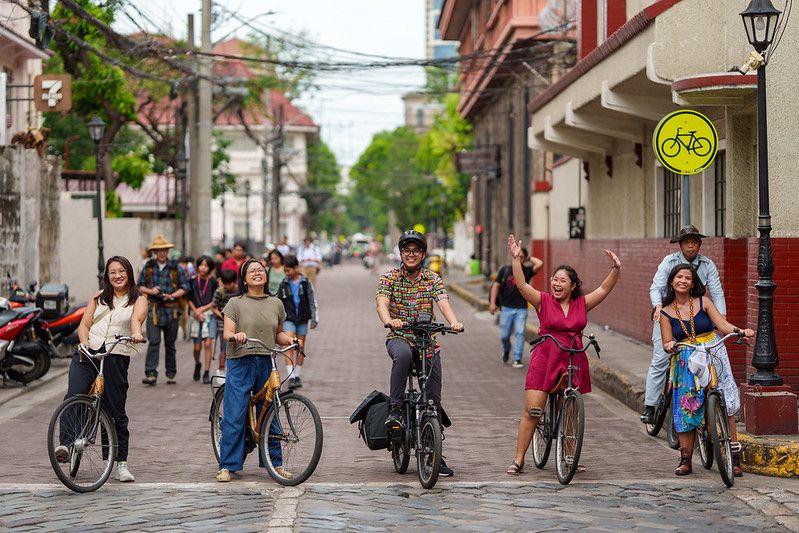
The coalition works to highlight the lived experiences of Filipino commuters and government officials are always invited to join.
Through community-driven projects, they aim to provide a firsthand look at how to navigate Philippine public transport, bridging the gap between policymakers and ordinary citizens.
Last year, the group walked 22 kilometers along Metro Manila’s main thoroughfare. Among its participants was then-transportation secretary Vince Dizon, who was appointed to the post just three months prior.
“It’s really making officials, especially those at the top, feel the urgency that we also feel,” Abante says.
“Because rank-and-file government servants commute, they [use] public transport. But the higher up you go, if you’re one of the senior officials, you’re used to having private vehicles.”
"If you don’t feel the urgency of the danger on the road, you won't act,” he adds.
The multi-partisan approach
The coalition’s partners ranged from Cabinet secretaries and local governments to political parties across the spectrum, who are interested in improving the country’s transport system.
According to Abante, sometimes it would be enough to meet at least one person within a policymaker’s team who believes in the advocacy.
“Our job is to find those people, work with them, and understand what they need from the inside. They are honest with us about their limitations.”
The coalition has become a key player in shaping the country’s transport policy, thanks to its institutional memory of transport reform.
This is important in a country without strong political parties and where there is high turnover of government officials especially in times of political turmoil.
For instance, under President Ferdinand Marcos Jr.’s administration alone, the Philippines has had three transportation secretaries since Marcos’ term began in June 2022.
There are cases in which whole teams are scrapped and replaced because a new official has been appointed.
“In the absence of strong political parties, civil society movements are the institutions that last,” Abante says.
“The campaigns you see publicly are maybe just five per cent of our work, 95 per cent are really briefings, meetings, conducting an analysis of the political situation, [and] trying to build new allies across partisan divides.”
Multiple hats
The coalition does what other transit advocacy groups across the world do— helping move policy by working with government institutions and engaging officials themselves to see from their standpoint.
But unlike Toronto’s TTCriders, whose main focus is to transform policy at the city-level, the coalition is trying to redesign the Philippines’ transport policy while wearing different hats.
Move As One Coalition acts like a think-tank — crafting policy papers, helping incoming officials by giving them briefings on the country’s transportation woes, and working with local government units on their own mobility projects.
It also convenes and trains young mobility leaders across the country. As a community organiser, it leads projects and programs to bring more attention to specific transportation woes.
From grassroots to the global stage
The Philippines has the worst traffic congestion level in Southeast Asia, based on the 15th edition of the TomTom Traffic Index. It ranks third in the world, following Colombia and Malta.
Thanks to the WRI award, it may have just secured its future.
Abante said they are planning to invest the US$250,000 prize on an endowment fund and use the interest earned to secure the coalition’s operations “hopefully forever.”