
More early adopters of AI needed in Singapore
Oleh Amit Roy Choudhury
Speaking at a fireside chat, Singapore’s Minister for Digital Development and Information, Josephine Teo, said the country needs a larger number of competent AI users than was earlier estimated to ensure continuing innovation.
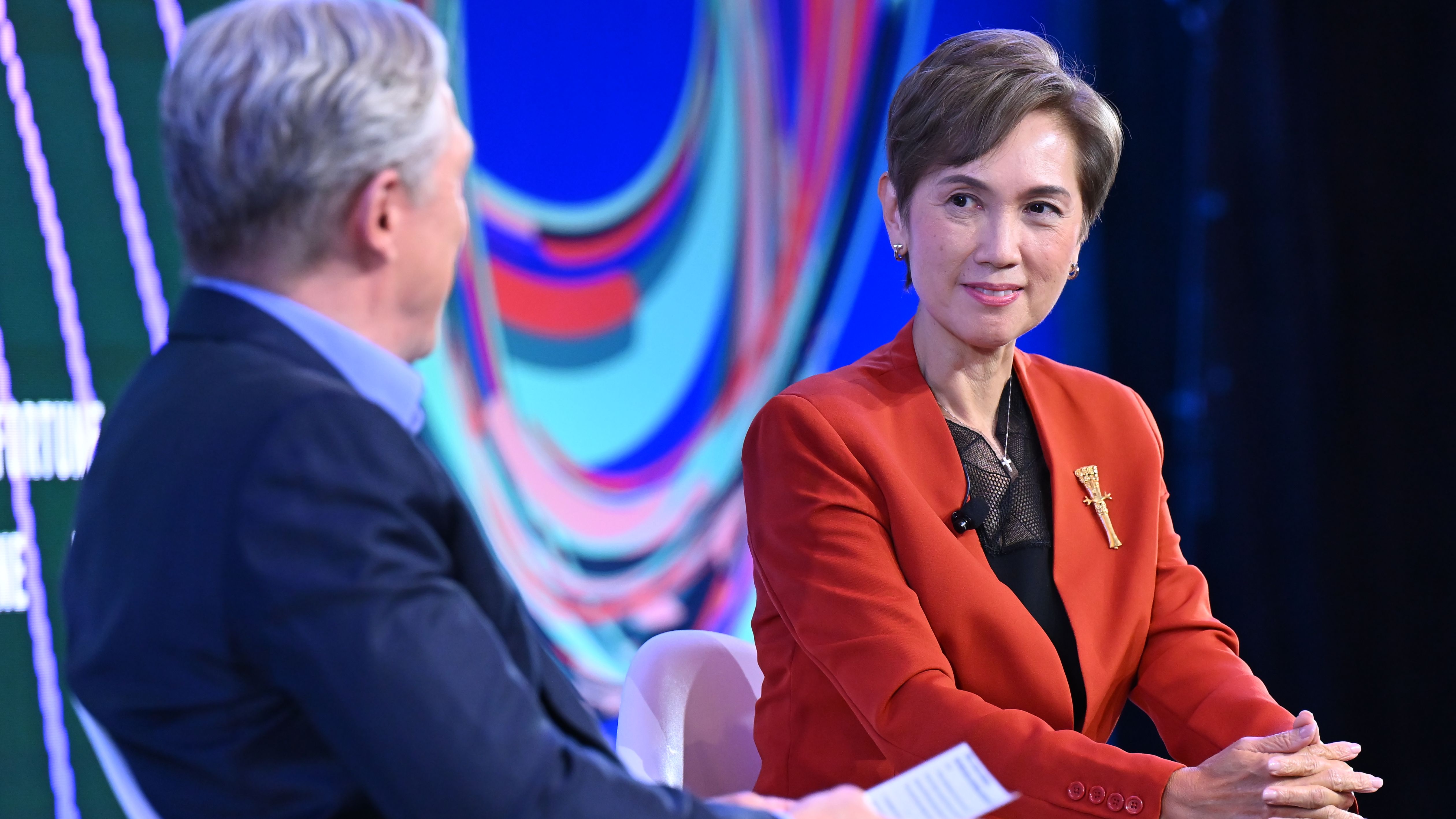
The Minister for Digital Development and Information Josephine Teo taking part in a fireside chat titled “Beyond Scale: How Small Nations Can Lead in the Age of AI” at the Fortune Brainstorm AI Singapore event. Image: MDDI.
Singapore needs a much higher number of workers who are proficient in the use of artificial intelligence (AI) than was earlier envisaged.
Singapore’s Minister for Digital Development and Information, Josephine Teo, said the government was hopeful to grow the AI talent pool to complement its existing plan of developing 15,000 specialists that was earlier announced in December 2023.
The Minister said that professionals, lawyers, accountants, and doctors will become early adopters of AI to complement the trained AI specialists.
“We're talking about people in different sectors, whether it's manufacturing, healthcare, in financial services. They themselves acquire this facility with using AI, and then they demonstrate how it can create more value for their organisations,” she said.
“In the Singapore context, our workforce is maybe 3.5 million. I think, at the level of AI users that are competent, you will need to get to a much larger number than we were talking about last year,” Minister Teo added.
The Minister said that certain basic AI skills will become as ubiquitous “as you and I being very familiar with using emails”.
She was speaking at a fireside chat, Beyond scale: How small nations can lead in the age of AI, organised by Fortune on Tuesday.
Cost an important factor
Minister Teo observed that cost was an important consideration to ensure that using AI becomes more attractive.
In this context, the minister welcomed how the Chinese AI model, DeepSeek, has brought down the cost of development of large language models (LLMs).
DeepSeek’s capabilities, which rival other top AI models, were developed at a fraction of their cost and that has led to investor scrutiny of US tech companies.
While Singapore did not use DeepSeek to develop its LLMs, it recognises that LLMs trained on Western, English-centric data struggle in Southeast Asia (SEA).
The region alone has over 1,000 local languages, she added.
To subscribe to the GovInsider bulletin, click here.
Singapore’s LLM, SEA-LION, while not the biggest, has been trained on languages that are found commonly in SEA, like Malay, Tamil and Bahasa Indonesia.
This helps the model to better respond to local contexts.
The Minister observed that within an innovative ecosystem, the best way to bring down costs was to complement one another in terms of the models that are available.
“I think they just open up the space for innovation to a larger extent… In the Singapore context, when we think about AI governance and AI innovation, the two are not necessarily at odds with each other.
“Being able to assure ourselves of safety and proper governance… can enable innovations to go further, because then the developers and the deployers know where the markers are that they should work with,” she added.
Risk assessment is important
When companies, developers, and deployers of AI think about what model they want to use, they need to assess a few things.
One would be performance, and the others would be security and resilience, she said.
“It's up to every organisation to evaluate all three and draw their own conclusions about what can be used, what cannot be used, and what they do not wish to use”, the Minister added.
In this context, she noted that “there will still be concerns about DeepSeek and other models that would cause companies to take a pause and say that maybe this is something that we are still not very comfortable with.
“I wouldn't be surprised at all. This is a very natural consequence of organisations having to weigh the cost of benefit, as well as the many dimensions of what makes innovation worth the effort,” she added.
Working with others
Talking about Singapore’s ability to work with both the US and China and their tech companies, Minister Teo said Singapore's consistent approach was to act in a way that met its interests.
“That has to be our guiding principle,” she said.
Minister Teo added that the broad idea was that AI as a technology has many applications, and “you don't want to overly restrict its growth and development”.
“On the other hand, for a technology that can be used in so many different contexts, you've got to watch that it doesn't cause harm, because the moment it does, and people become very wary of seeing it being used in even more ways, then it's much harder to recover from that sort of loss of momentum,” she said.
From a government perspective, Singapore has sought to set out the broad directions and to collaborate with organisations to define the risks and find ways to mitigate them.
That's generally the approach that we take: small steps, not necessarily always “big bang”, but when we're ready to move, then move quickly, Minister Teo added.