
Nepal's public service needs a significant digital transformation
The government needs to pursue digitalisation alongside business process re-engineering, robust cybersecurity, and simultaneously boost digital proficiency for both civil servants and the public.
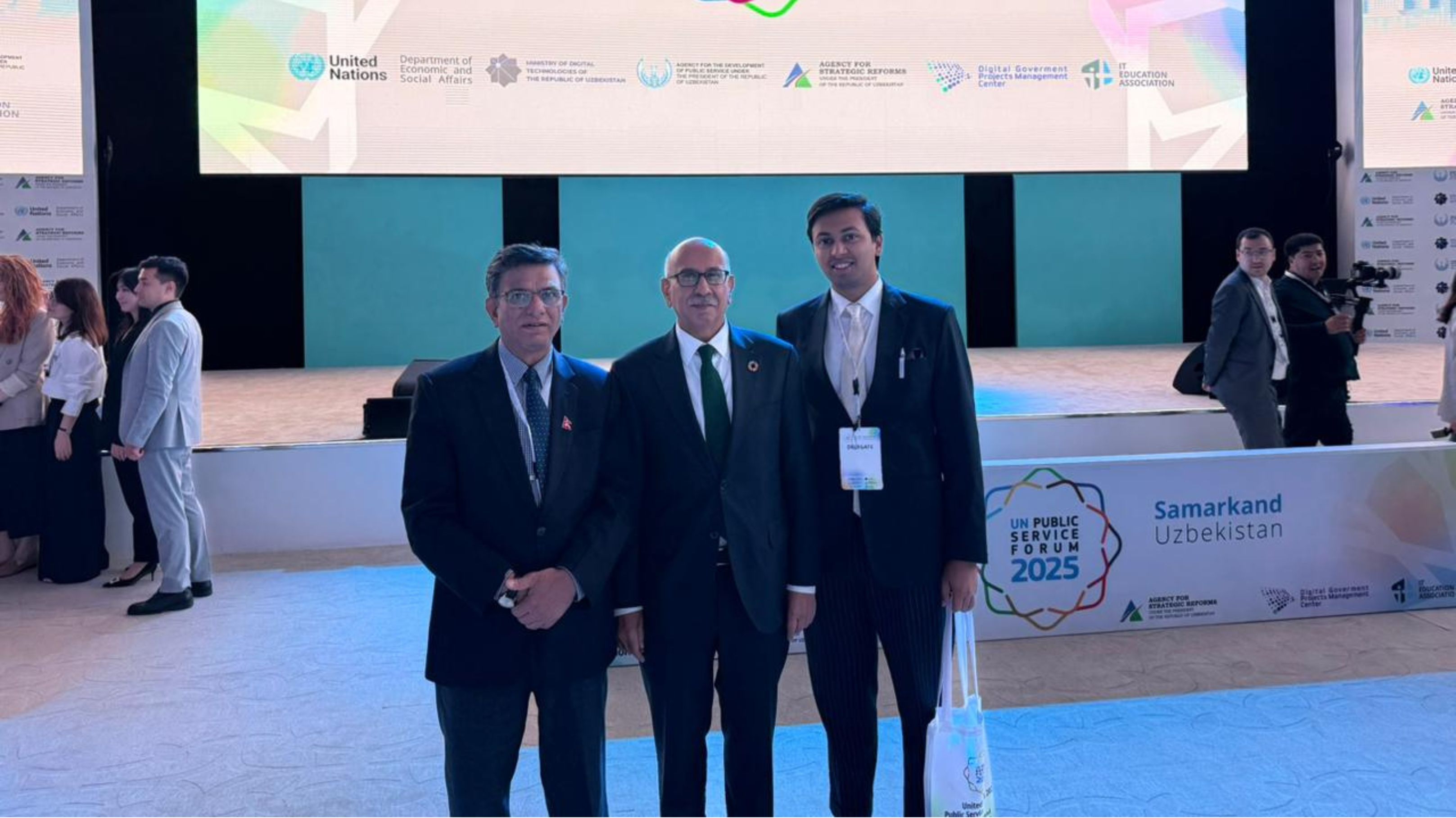
The author (first from left) recounts his learnings from the UNPSF 2025 and what it means in his home country of Nepal. From left: Tanka Mani Sharma Dangal; Navid Hanif, Assistant Secretary-General for Economic Development in the Department of Economic and Social Affairs (DESA); Bidhan Sharma, Managing Director of the Aircharge Nepal. Image: Tanka Mani Sharma Dangal
After spending decades in government, I found myself at a crossroads, eager to channel my extensive experience into a new pursuit.
My background spans a wide array of government sectors, from public and development administration to financial management, revenue, accounting, auditing, and public procurement.
While some might label this a "jack of all trades, master of none," I see this diverse knowledge as oftentimes better than being a master of one.
The UN Public Service Forum quickly emerged as the perfect platform. In this unifying field, my numerous experiences could converge, ultimately leading me to dedicate my post-retirement focus to public service reform.
My drive for reform stems from a deep-seated, persistent dissatisfaction that citizens feel about public service delivery, especially in an increasingly digital world.
My recent experiences navigating various government bodies for personal matters vividly highlighted confusion, uncertainties, and delays.
Despite having spent over four and a half decades in policy formulation, regulation, and oversight, I felt a strong urge to contribute more directly to service improvement. The UN Public Service Forum 2025 offered an opportunity to support my thoughts.
Key takeaways from the forum in Uzbekistan
The forum's plenaries, Innovation Lab, and workshops centred on artificial intelligence (AI) and innovation, emphasising AI's crucial role in our current era.
A key takeaway highlighted the need for a balanced approach: leveraging technology to enhance human intelligence and judgment, not replace it. The forum concluded by outlining the following four key points:
- AI and the public sector: AI holds transformative potential, but its adoption is fragmented, requiring foundational investment and addressing obstacles like data literacy, outdated infrastructure, and strategic alignment.
- Innovation in the public sector: Innovation must be purpose-driven, citizen-centric, built on trust, collaboration, and adaptable systems. It should solve real problems, ensuring the voices of marginalised citizens are heard, and empowering public servants with tools, training, and authority.
- Capacity building in civil service in the age of AI: Digital transformation hinges on building the capacity of civil servants and institutions, involving technical skills alongside ethical, regulatory, and operational considerations of AI. Strategic commitment and central platforms are essential.
- Mindset change and strategic vision: Lasting innovation necessitates cultural change, adaptive leadership, and a long-term vision that encourages learning, experimentation, and inclusivity. Innovation is not optional; it's a necessity.
This forum has highly motivated me to continue using my experience to improve public service in Nepal and around the globe.
State of public service in Nepal
Nepal is actively pursuing public service reform through the adoption of Information Technology (IT) and digital governance systems, a core component of its 2019 Digital Nepal Framework (DNF).
The clear goal is to enhance the efficiency, transparency, and accessibility of public services for everyone. Significant strides have been made, building on IT policies and the broader DNF.
The framework identifies eight key sectors for digital transformation: digital foundation, agriculture, health, education, energy, tourism, finance, and urban infrastructure.
Currently, the Government of Nepal provides a range of essential public services via IT and digital governance systems
.
This includes managing identity and personal documents, taxation and revenue services, financial transactions, various local governance functions, and access to employment and social security benefits, largely facilitated by platforms like the Nagarik App (Citizen App).
There are many perfect IT operating systems in government business. For instance, in revenue administration, financial management, public procurement, and government auditing, fully electronic systems are in place, where over 90 per cent of the work is IT-based.
Despite the introduction of IT systems and other reforms over the past years, the working environment at most service delivery points still requires significant improvement.
In the past, manual work might have caused minor delays; in the digital era, there seems to be increased confusion among service-seekers.
To subscribe to the GovInsider bulletin, click here.
Using hybrid systems
Many organisations now use a hybrid system that often merely adds a data entry step, rather than genuinely streamlining processes. Overall, citizens are eager to find an easy way to access services across various sectors, including through IT systems.
Shifting to an IT system from manual is not an easy task. It needs continuous effort, curiosity, habits, and confidence to work in the system.
It takes years to fully come to perfection, specifically for older generations.
People using mobile phones are becoming habituated to using IT systems, but there are still many government officials from the old generation who feel comfortable working manually only because of a lack of knowledge, skill, and confidence to operate an IT system.

Over nearly four decades in IT, I've witnessed Nepal's remarkable shift from "ICU-like" computer rooms to full digital reliance.
Manual transactions have given way to widespread digital payments, including direct bank transfers, now common in the single treasury account system - a trend that was a novelty even in developed countries just decades ago.
Yet, inconsistent information and a fragmented regulatory landscape still significantly hinder Nepal's electronic service delivery, leaving it behind more dynamic global approaches.
The path forward for public service in Nepal
Nepal's public service needs a significant digital transformation to enhance citizen well-being and national development.
While progress has been made, the immediate focus must shift to thorough business process re-engineering, robust cybersecurity, and boosting digital proficiency for both civil servants and the public.
Achieving this modernisation demands sustained, high-level political and administrative commitment, alongside the establishment of a single, dedicated coordinating agency, much like a Ministry of Public Service found in other countries.
Advancing Nepal's public service through IT systems requires further dynamism.
This future necessitates a multifaceted approach: embracing AI, adopting innovative ideas, building the capacity of both employees and citizens, fostering a transformative mindset, securing unwavering commitment from leadership, and developing a clear strategic plan.
Crucially, we must cultivate a culture where Nepal's progress in public service is actively showcased at international forums, enabling vital exchanges of experience and the emulation of global best practices.
Transforming Nepal's public sector requires a strategic shift towards IT-driven public service, digital governance, and AI integration.
This vital reform hinges on adopting global best practices and investing in extensive training for both public service employees and citizens. Government training must evolve beyond traditional regulations, prioritising the development of citizen-centric services through IT.
Simultaneously, empowering service-seekers with practical digital literacy will facilitate more efficient interactions, initiatives like Uzbekistan's plan to train a million citizens in digital literacy to enhance civil service readiness.
Ultimately, public service encompasses all goods, services, and facilities provided by the state for the welfare of its citizens. Public service is a fundamental right of citizens, and its system is in dire need of comprehensive and sustained reform.
Tanka Mani Sharma Dangal is a Nepalese retired bureaucrat with over 43 years of distinguished government service, culminating in his six-year tenure as the Auditor General of Nepal (2017-2023). He is a recognised expert in public auditing, financial management, governance, and integrity promotion, who has contributed significantly to national policy through various special assignments.