
New extended reality lab as a classroom for both healthcare practitioners and students
Extended reality tech has largely improved to build a hospital training strategy around it, says Tan Tock Seng Hospital (TTSH)'s Dr Loh Yong Joo and Nanyang Polytechnic (NYP)'s Victor Wee and Toh Da Jun on the launch of the Virtual CHI Living Lab (VirtCHILL).
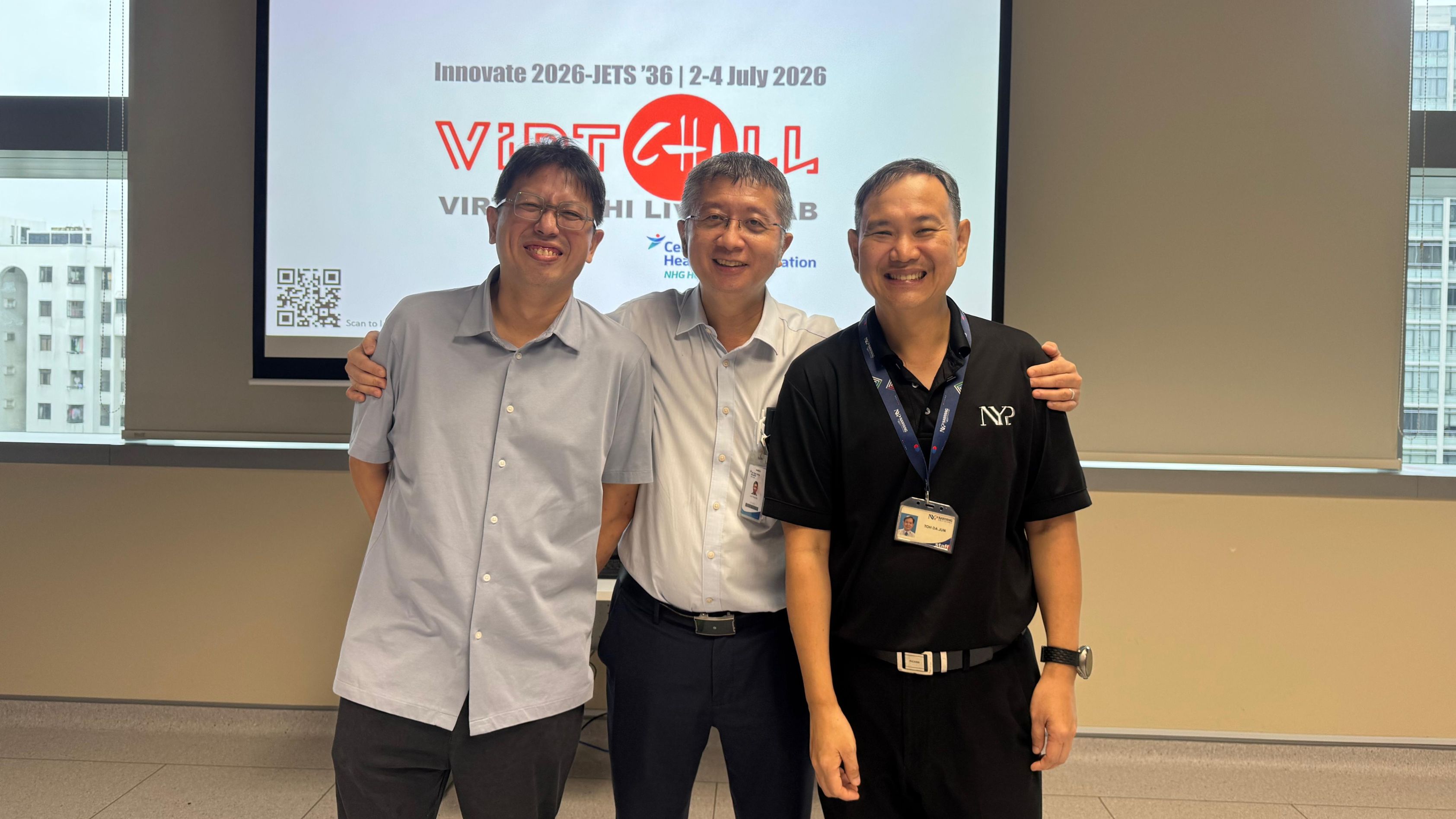
Left to right: Nanyang Polytechnic (NYP)'s course manager for the Diploma in Game Development & Technology, Victor Wee; Tan Tock Seng Hospital's Senior Consultant and Head of Rehabilitation Medicine, Dr Loh Yong Joo; NYP's senior lecturer, Toh Da Jun. Image: GovInsider
Handing a scalpel to a surgeon the wrong way could get someone cut. Doing it right is a split-second skill nurses learn on the job and with real instruments.
It's one of the few scenarios that the Virtual CHI Living Lab (VirtCHILL), which is a new extended reality (XR) platform launched by the Centre for Healthcare Innovation (CHI), is building.
The lab will tap into a mix of academic and industry partners to build simulations for scenarios that are too risky or resource-intensive to rehearse on real patients.
These scenarios include nurses feeding patients with difficulty in swallowing, medical social workers preparing difficult family conversations, or teams rehearsing for emergency resuscitations.
Partnerships with local academic partners like the Lee Kong Chian School of Medicine (LKCMedicine) and Nanyang Polytechnic (NYP) are underway to integrate and scale these solutions in Singapore's public hospitals.
XR technologies cover virtual reality (VR), augmented reality (AR), and mixed reality (MR).
For educators at NYP, every one of those scenarios presents an opportunity for their students to work on solving a real-world problem.
We speak to the lab's lead, Tan Tock Seng Hospital (TTSH)'s Senior Consultant and Head of Rehabilitation Medicine, Dr Loh Yong Joo, as well as NYP's course manager for the Diploma in Game Development & Technology, Victor Wee, and senior lecturer, Toh Da Jun, to find out more.
The problem no hospital can solve alone
While hospitals know what their staff need to practice, what they don't tend to have is a reliable way or opportunity to let them practice their skills.
Like a resuscitation drill, using an instrument in an operating theatre, or having a hard conversation with a dying patient's family member, these are the moments that staff most need to rehearse.
Yet, they are the ones hospitals can least afford to "stage" on demand and at scale, without posing risk to real patients, says Dr Loh.
"Sometimes it's not enough to only train within the hospital itself as it can be very opportunistic [depending on the "right" cases emerging], or you may take a lot of manpower and resources to conduct the training," he explains.
What has changed is that technology has finally caught up with the problem. In the last few years, extended reality (XR) technologies have improved largely to build a hospital training strategy around it.
Dr Loh recalls a time when headsets used to leave users feeling "very giddy" with poor graphics to feel real.
NYP's Wee points to improvements to the display resolution, frame rates that no longer trigger motion sickness, and lighter hardware with better battery life that makes it more wearable for training.
In a trial conducted among 72 of TTSH's nurse educators and speech therapists, using VR to teach staff to perform feeding for patients with swallowing difficulty saw a higher pass rate (98.5 per cent compared to 71 per cent in traditional classrooms), as well as 63 per cent less classroom time needed (55 minutes compared to 150 minutes).
The build that becomes the lesson
Closing the training gap means partnering with people who understand what's technically possible - and this landed on NYP among the other academic and industry partners.
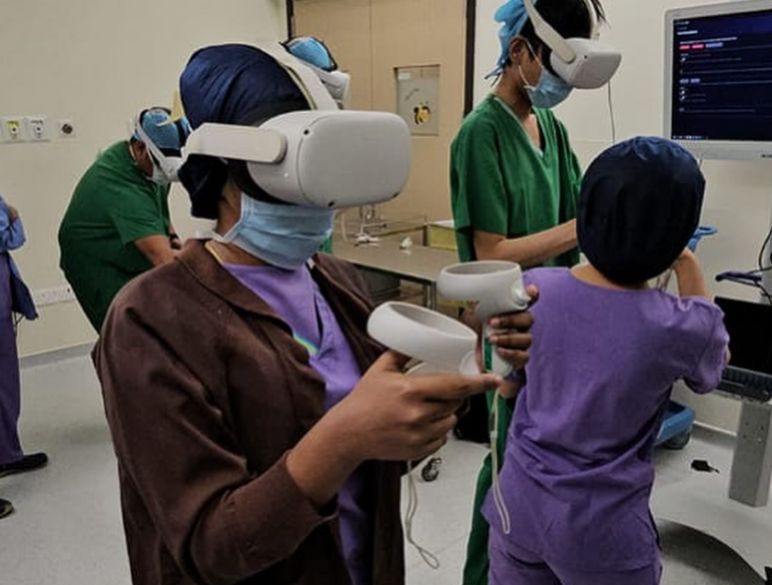
"We're trying to strike multiple wins," says Loh, adding that the lab today provides students with a conducive environment to interact with clinicians, collaborate on problem statements and solving.
"While they build prototypes with us, they also learn," he notes.
The learning also comes from getting things wrong at first, citing that the VR simulator used for the “Code Blue” emergency resuscitation was the second attempt by the students.
"Code Blue" indicates a life-threatening medical emergency requiring healthcare staff’s immediate response.
The simulator was developed by students at NYP’s School of Design & Media for Institute of Mental Health (IMH)’s nurses to practice how to manage an emergency with
real-time physiological feedback and team interactions.
Wee highlights that the first multiuser VR experience ran into technical issues, but it became a learning ground for the team to improve its expertise.
Because XR remains in a field where large parts still need tweaking and developing, Toh says that every project pushes the team past what they already know.
"We are also gaining new knowledge and trying to better prepare our students moving forward," says Wee, highlighting that the lessons from these projects will be integrated into the course curriculum.
It's a structure where NYP has built its wider teaching model for students to work on live, industry projects in their third year to make them industry-ready.
Structure before prototyping, then scale
For Dr Loh, that structure has to exist before a prototype build gets underway.
"For this project to land, it must be part of the process and the service. We need to think of that before we even come up with the prototype," he says.
The pathway of embedding XR technologies into hospital service must be planned in advance before any prototypes are developed.
During the launch event, Dr Loh said that an accreditation framework is currently being developed for XR technologies used in the public healthcare setting.
He also highlights plans to scale the current XR prototypes within NHG Health's campuses, and eventually across other clusters.
At the event, NHG Health's Deputy Group CEO (Population Health), Prof Eugene Fidelis Soh, also described a future where patients help shape the XR prototypes built for their own care.
"We may even get to the point where patients themselves are entering this metaverse in terms of how they can be participatory in their care," he said, highlighting the prospect of a multi-stakeholder ecosystem of patients, healthcare practitioners and tech partners working together.
It's a bigger version of the same principle running through the theme of the story: structure, then scale.