
Pakistan Digital Authority’s big ambitions to rewrite the social contract between government and citizens
The newly minted agency is focusing on sub-sectoral stacks for its national DPI, and global partnerships to tap into country’s developer community to build open-source solutions, says the agency’s Chairperson Dr Sohail Munir.

Dr Sohail Munir is the Founding Chairperson of the Pakistan Digital Authority. Image: Dr Munir
This story is part of GovInsider's Digital Government initiative, which aims to feature stories from digital government agencies around the world. Click here to view our interactive map.
Pakistan Digital Authority (PDA)’s Founding Chairperson Dr Sohail Munir in one of his writings recounts a conversation he had with his father asking him what exactly he does at work.
“I am reimagining the government,” he said, where years later he had a follow-up conversation with his daughter trained in design thinking about what reimagining the government looks like in practice.
“Reimagining means you can’t think of the government as a fixed institution but a system or machine with parts that can be redone to better meet human needs,” she responded.
The PDA was formally operationalised under the Prime Minister’s Office just four months ago. The three-person team, including Dr Munir, has been tasked to work on a national digital master plan among other priorities.
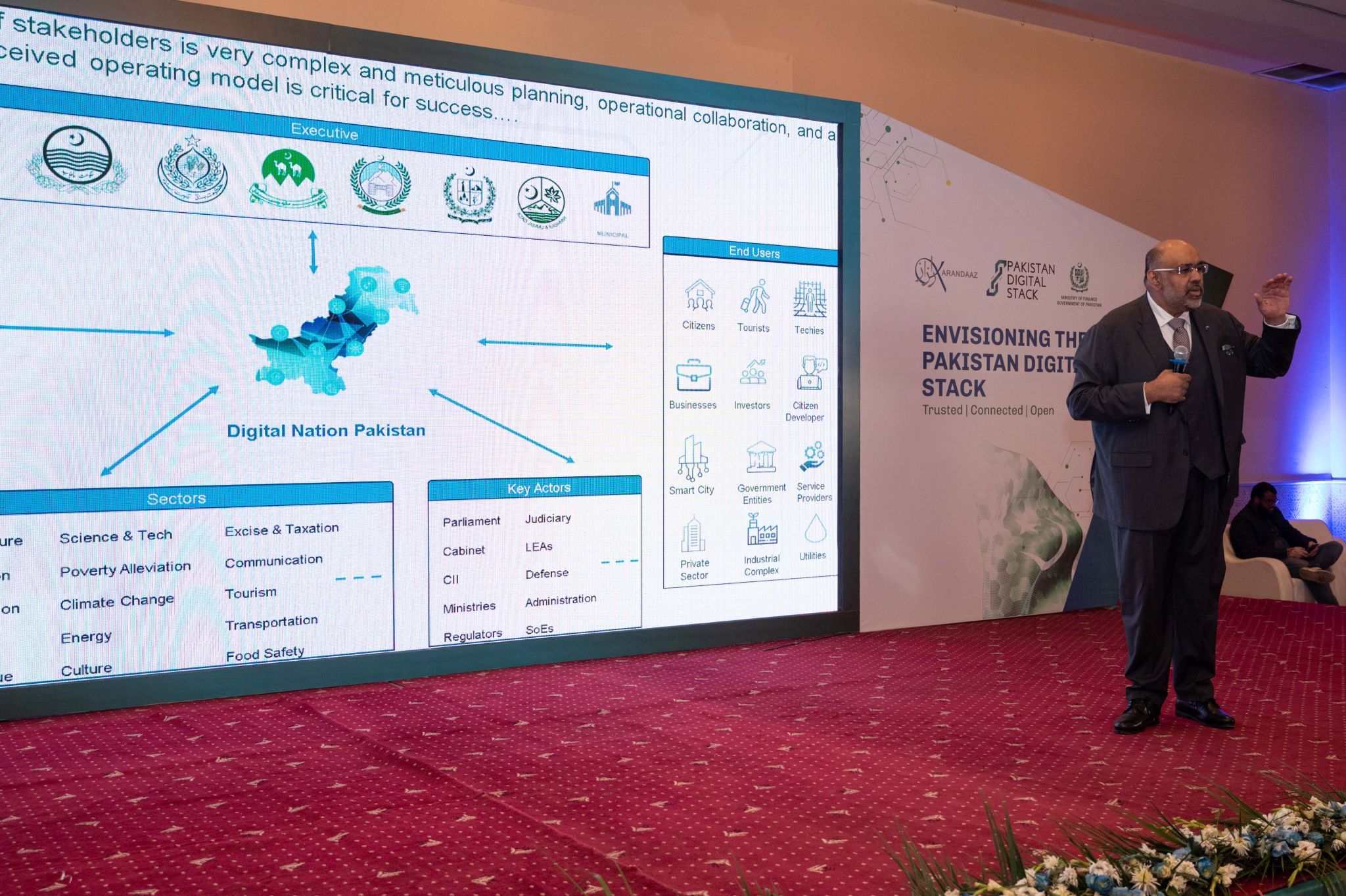
Speaking to GovInsider, Dr Munir shares how the role of the new govtech agency extends beyond digitalising processes, but taking on a broader, systemic role to enable a shift in the social contract between the government and the people.
“In countries who have done [digital transformation] well like Singapore, Dubai or Abu Dhabi, what they have done well is moving processes which were previously government-centric to citizen-centric.”
Dr Munir has previous experience building key digital government systems in the United Arab Emirates (UAE), including the UAE Pass, Smart Dubai platform, and Abu Dhabi’s vision to be the world’s first artificial intelligence (AI) native government.
Applying global lessons to local digital transformation, Dr Munir shares more about how PDA is pursuing the parallel track of building foundations while incorporating an agile mindset in the civil service.
DPI-first and open-sourcing can unlock opportunities
The PDA is adopting a “Digital Public Infrastructure (DPI)-first policy”, says Dr Munir, adding that this ensures every ministry uses these shared building blocks rather than reinventing the wheel to create more systems.
Traditionally, governments have focused on developing the three core components of DPI, which are digital ID, digital payments, and data exchange.
“While we are looking at the main pillars for whole-of-nation integration, we are also looking at particular sector needs,” he explains, adding that the PDA will focus on developing sectoral masterplans, and DPI sub-stacks for key sectors like healthcare, education, and real estate.
“If this works for the entire government, it should also work for every sector,” he notes.
According to him, these sub-stacks (for instance, health ID and health records for the healthcare sector) would allow provincial governments, the private sector, and other stakeholders to leverage shared infrastructure, and accelerate innovation in these sectors.
“A significant value that Pakistan brings to the table is that we have a very large developer community.
“Having access to that talent pool, we are going to focus on creating the sub-stack components and to collaborate with other countries to make it available to others,” Dr Munir shares.
This needs to be accompanied by setting digital standards to provide regulatory clarity for stakeholders.
He underlines DPI as a key enabler of digital transformation. By consciously packaging the core components into the DPI concept, this structural approach has "really changed the entire ecosystem and how we look at digital transformation,” he notes.
Dr Munir also calls open-sourcing “the best way to bring others to the table.”
“Open sourcing allows us to bring in expertise from the whole world, and is available for the world to take it forward. So, we certainly will have a commitment towards open source,” he explains.
He highlights that Pakistan has benefited a lot from GovStack’s open-source specifications and Estonian government’s X-Road.
To subscribe to the GovInsider bulletin, click here.
Applying global lessons to Pakistan
Dr Munir’s team has studied 30 countries deeply for global best practices to bring home, with these learnings documented in his colleague Mohammad Sear’s book.
One lesson learned is the importance of putting in place codified infrastructure, over ad hoc digital projects.
“Governments will change, so you need to put in place the right enterprise architectures and [common] platforms for the whole-of-government (WOG) [to enable continuity of this transformation], he says.
This was why developing the national digital master plan was prioritised as the fundamental framework to guide the implementation of these plans.
He notes that some of the PDA’s top influencers include Estonia and Singapore for their enterprise architectures and WOG platforms, UAE for delightful and seamless citizen experiences, and the UK for proper digital governance.
The paradigm shift from a control-obsessed bureaucracy to a citizen-centric government also entails transforming the civil servant’s role, he notes.
“The typical civil servant has to move from being a file mover and gatekeeper, to a systems steward and the data interpreter.”
High-level political needs to go hand in hand with grassroots, collaborative service design, and a future-forward tech strategy to transform processes.
“To reimagine the governance, we are establishing innovation labs across every sector in the government and conducting design thinking sessions with stakeholders,” he explains.
Last week, the PDA conducted a session like this for the legal sector among judges of the Supreme Court and High Courts, as well as lawyers.
Reimagining the processes is iterative, ongoing to improve governance, he notes.
“Imagine the North Star, then have a road map for how to practically implement this. But that would also mean changing a lot of government processes, current rules and regulations,” he adds.
Tackling local challenges and charting its unique path
Pakistan’s largest city of Karachi, where Dr Munir is from, has a population of twenty times larger than smaller states like Estonia, Singapore and Denmark.
“Learning from the North Stars, you have something to aspire for. You then start looking at the challenges,” he says, recognising that many digital transformation lessons must be adapted rather than transplanted into Pakistan.

Given the country’s sheer size, urban-rural mix, as well as the federal and provincial government structures, there cannot be “one single policy or approach to address the problems because they are very diverse.”
He highlights that the government’s biggest challenge is instilling hope in “disgruntled and disengaged youth”, especially given the high unemployment rate in the country.
The PDA is wrestling with the dual challenge of opportunity and challenge when it comes to emerging tech like AI.
“How do I show them the opportunity of what the new economy can provide them, while making sure it’s secure for them?” he reflects.
On one hand, the government expects to roll out the first AI use cases within the Prime Minister’s Office by National Day on March 23 next year. On the other hand, the PDA must regulate the tech to scale it securely.
He adds that PDA’s role is to ultimately enable the private sector, startups and youths to capitalise on shared infrastructure as to build digital economy capabilities.
Beyond the digital economy, the PDA is looking at tapping into the data economy.
“We are declaring the data as a national asset,” he notes, highlighting that this means the government has a duty to protect it and use it to benefit citizens.