
People-centredness an imperative for smarter cities
By Sol Gonzalez
The Smart City Expo Kuala Lumpur brought together city leaders and industry players to discuss how regional collaboration, participatory designs, and technology contribute to making cities more inclusive, sustainable, and uplifting.
-1758693188161.jpg)
Malaysia's inaugural Smart Cities Expo Kuala Lumpur 2025 featured exhibitions and speaking sessions where leaders highlighted the need to place people first in the design of smart cities for a resilient future. Image: Smart Cities Expo Kuala Lumpur Facebook.
The current challenge for smart cities was in building culturally vibrant urban centres, where the use of technology raised the living standards of the people, said Malaysia’s Prime Minister Datuk Seri Anwar Ibrahim.
He was speaking during his opening address at the Smart City Expo Kuala Lumpur (SCEKL) 2025 event on September 18.
To this end, Ibrahim emphasised the importance of people-centredness to build smart cities that ensure all citizens benefit equitably from digital innovation and access to smart city resources.
“Despite the pressures of an ever-changing landscape, we must hold steadfast with thoughts of inclusivity and sustainability, we must decisively shape cities around people and address their concerns,” he noted.
Themed AI Cities: Shaping Our Digital Future, the three-day SCEKL event saw over 10,000 participants and 2,000 delegates from around the world, gathered to discuss how cities should approach smart innovation in the digital era.
City mayors also discussed about artificial intelligence (AI), sustainable and resilient cities, digital entrepreneurship and economic development and community empowerment through digital solutions.
Malaysia’s Minister of Digital, YB Gobind Singh Deo, said the event was an opportunity to share ideas and learn from the experiences of different cities in tackling diverse urban challenges.
“This marks the inaugural effort on part of Malaysia to showcase its talent in terms of building smart cities in our region, together with partners around us in ASEAN,” he said.
To subscribe to the GovInsider bulletin, click here.
Smart cities not just for mega-sized
One of SCEKL’s focused areas was on the strategic vision regarding ASEAN-wide alignment toward AI-powered cities.
Iligan’s City Administrator, Darwin Manubag, shared how the city in the Philippines embarked on a digital transformation journey three years ago. He was speaking at the City Leaders Dialogue: Building Inclusive AI Cities.
He noted that while Iligan City was one of the 33 highly urbanised cities in the Philippines, the innovation process faced a bottleneck due to the lack of understanding among leaders regarding the purpose and application of digital tools for urban development.
This was where consultation and openness to sharing about plans and ideas were key:
“You need to ensure that the idea of AI for humanity is embedded into what you’re doing… So, in everything that we do, there’s always consultation, there’s always collaboration,” he noted.
Before creating a plan, the administration upgraded its Digital Transformation Office from a single unit to a five-division department. This move was to help more employees become familiar with AI and other technologies needed for their smart city goals.
Manubag added that the city then created the Smart Cities Council comprising representatives from the government, industry and academia to ensure collaborative decision-making.
He shared a success story about an AI-powered smart city command centre, which helped solve around 300 traffic problems by serving as a one-stop centre to monitor and respond to issues.
Manubag said even tier-two cities like Iligan can be a model for best practices in smart city development. He emphasised the importance of exchanging ideas within ASEAN through a "big sibling, small sibling approach," where cities can learn from each other.
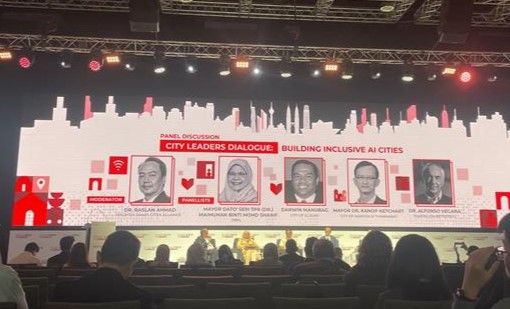
Nakhon Si Thammarat, situated in southern Thailand, was another medium-sized city that has adopted a people-centric approach in developing a smart city to improve the lives of its residents.
Mayor Kanop Ketchart shared his city's plan for citizens to report urban problems using a mobile platform.
People can snap a photo of an issue, submit it through a digital form, and the city promised to resolve the problem within 48 hours.
This ensured the city could tackle problems more directly and efficiently, addressing issues that were specifically reported by citizens.
He explained that the city used the complaint data to generate a heat map, which allowed for more efficient city planning and budget allocation.
The platform has 100,000 active users - accounting for 70 per cent of the city’s population - and has solved more than 36,000 complaints, Ketchart added.
People-centred smart cities
During the panel Living Labs of ASEAN: Future Citizen Use Cases You Can Adopt Today, the panellists, representing different sectors, engaged in a simulated case study to explore different approaches to living labs.
A living lab was a real-world environment where multiple stakeholders collaborate and create ideas together to solve urban problems, considering perspectives from the ground to ensure feasibility and impact.
Urbanice Malaysia’s Chief Executive, Norliza Hashim, who was moderating the session, invited speakers to envision a plan in a small city.
With a limited budget and tight timeline, what would they focus on first?
City of Narra’s Project Manager, John Vincent Gastanes, from the Philippines, said that going to the relevant community was the first and most important step to ensure a participatory model and identify local strengths.
He would then use the limited budget to gather quality data to inform policy support and attract external partners to scale up projects.
For instance, Narra’s strengths in the fishery industry would call for regional partnerships (like the BIMP-EAGA initiative) upon directing initial funds strategically to secure larger investments, he said.
To subscribe to the GovInsider bulletin, click here.
Providing a perspective from private tech, Amazon Web Services’ (AWS) Smart Cities Leader, Sapan Kumar, explained that funding would work best in those projects that provided tangible benefits to the communities in which they’re deployed.
Kumar agreed that the first step would be to gather community feedback to understand and prioritise the pressing problems. With a limited budget at the initial stage, it was essential to do “ruthless prioritisation” and focus on the most important problems.
If the solution worked, it could receive additional funding and be scaled up for widespread use through initiatives like AWS’ Proof-of-Concept Credits, Kumar added.
“Living labs with different kinds of objectives can build up to make cities more sustainable, more resilient, and contribute to a better living for everyone,” concluded Hashim.
Strategic innovation for the region
While technology and data were not the start and end of smart city development, these were still important tools toward achieving future-resilient cities.
This point was brought up at the Cross-border Data, Local Impact: ASEAN’s Advantage in AI Innovation panel.
The discussion highlighted the need for harmonised standards and policies to leverage the region’s growing innovation and expand on public-private partnerships.
According to Malaysia’s National AI Office (NAIO)’s Chief Executive Officer, Sam Majid, industry experience combined with national policy frameworks could help to create national standards aligned with country-specific needs and regulations.
When countries align their national standards, it created more opportunities for sharing data across borders because they operate using compatible frameworks.
The speakers noted that cross-border data sharing in the context of smart city success was essential since cities don’t operate in isolation.
Creating interoperable systems also hinged on sharing best practices and analysing data from other urban contexts to make more informed decisions about infrastructure and services.
For example, a disaster management solution developed in the Philippines could inform solutions in natural disaster-prone islands in Thailand.
Ultimately, cities must work with the capabilities they have available to ensure that innovative plans have a clear objective, said SmartCT Philippines’ Kristen Villanueva-Libuano.
“If we just push AI or any technology to control or really orchestrate what happens in the city, we will miss out a lot when it comes to the culture of the city itself… We need to ask ourselves, what is the local impact I want to drive [with] this technology?”
Also read: