
Seeing and leveraging polarities for a higher purpose in healthcare
Polarities thinking can help healthcare leaders to move away from reactive decision-making to intentional collaboration, aligning divergent stakeholders around common goals and sustainable results.
-1775037274673.jpg)
Photo of CHI 23 Masterclass by Dr Douglas O’Loughlin, Associate Consultant, Civil Service College (CSC); Principal, The Dao of Thrving. Image: CHI
Healthcare leaders today operate in environments shaped by ongoing tensions, such as balancing innovation with stability, efficiency with empathy, and individual needs with population health outcomes.
These challenges are rarely solved once and for all. Instead, they require leaders to continuously navigate competing yet interdependent priorities.
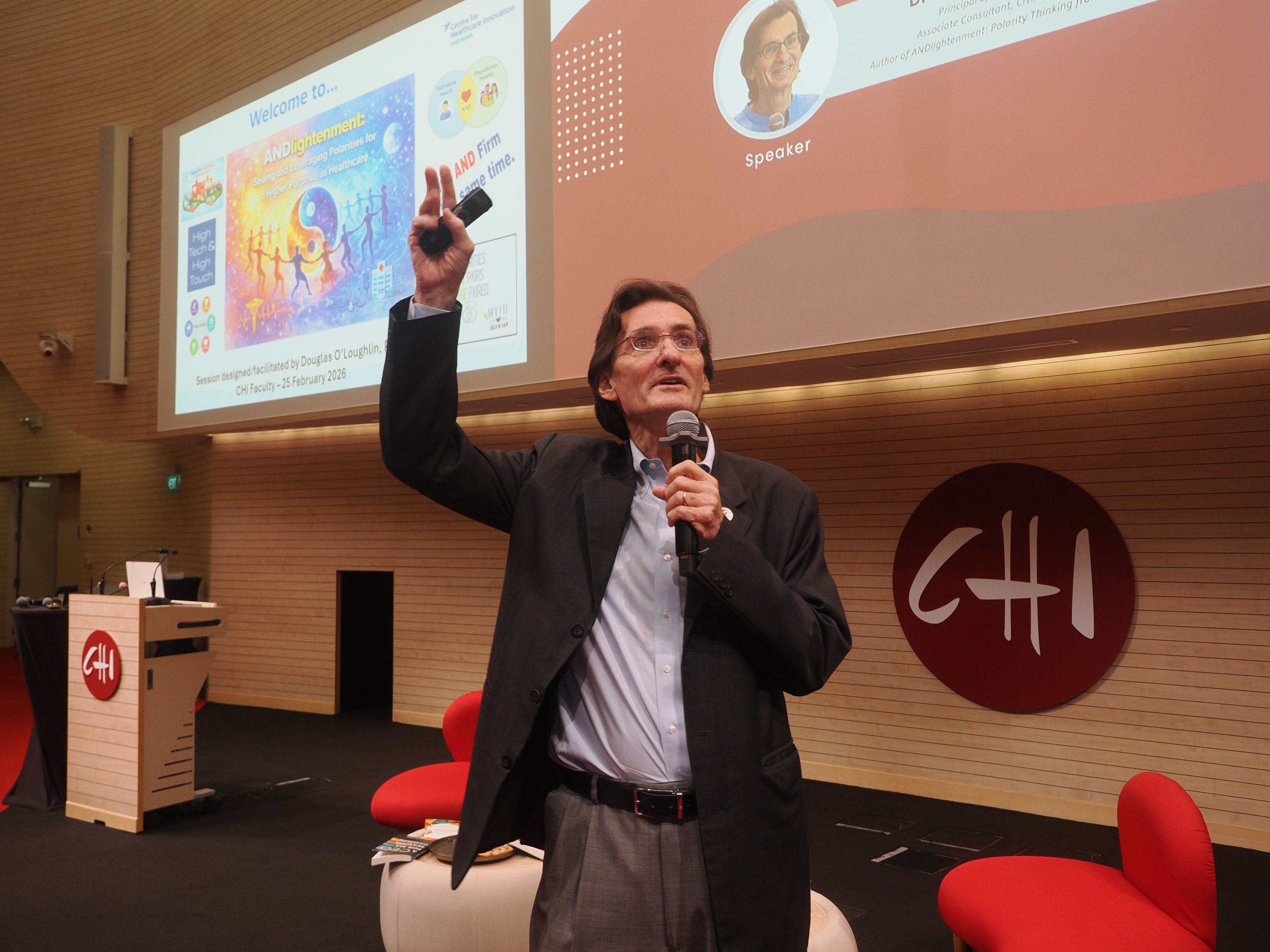
In the recent Centre for Healthcare Innovation (CHI) masterclass, Dr Douglas O’Loughlin, Principal at the Dao of Thriving and Associate Consultant at the Civil Service College (CSC), introduced polarity thinking as a key leadership capability for navigating such complexity.
Organised by CHI in partnership with Population Health’s POP Class, the session explored how leaders can shift from “either/or” thinking towards a more integrative “both/and” mindset, recognising and leveraging tensions rather than attempting to eliminate them.
The session clarified the definition of polarities, surfaced common healthcare examples of polarities, and shared practical tools and ways for leaders to work with polarities.
From problems to polarities
Dr O’Loughlin clarified a common misconception: not all tensions are problems to be solved.
While some leadership challenges require decisive solutions or trade-offs, others represent ongoing
dynamics where both sides are necessary and interdependent.
He distinguished between problems (solvable), dilemmas (requiring trade-offs), and polarities, recurring tensions that cannot be resolved permanently because each pole carries both value and risk when overemphasised.
Importantly, polarity thinking is not new. Leaders have long navigated tensions such as stability and change, or compassion and accountability.
What is relatively new is the structured process and shared language for recognising and intentionally leveraging them.
Polarities are everywhere. The more
aware we are of them, the more
effective we are in life.
Polarity thinking, therefore, is not about finding the “right” answer.
It is about recognising the genius of AND, strengthening one pole when the other has been overextended, and doing so in service of a higher purpose.
Polarities in healthcare leadership
Through familiar examples such as high-tech and high-touch care, individual and population health, stability and transformation, being firm and kind, participants saw how polarities play out in
everyday leadership.
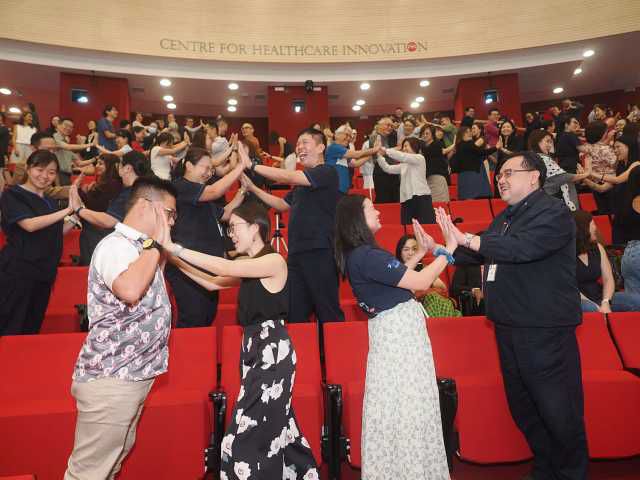
response. Image: CHI
These examples reinforced that polarities are not abstract concepts but lived realities shaping everyday decisions.
Leaders frequently encounter situations where prioritising one pole exclusively leads to predictable downsides, efficiency without empathy, innovation without stability.
Yet, the purpose of these examples was not to create a checklist of polarities, but to invite a change in perspective.
By naming these interdependent dynamics, leaders can move beyond reactive decision-making and more intentionally leverage both poles in service of sustainable outcomes.
Leveraging polarities in practice
Beyond recognising polarities, the masterclass emphasised how leaders can work with them intentionally.
A key insight was that polarisation often stems not from rejecting the other pole, but from fearing its potential downsides.
Effective polarity leadership therefore involves affirming the value of both sides and anchoring conversations around a shared higher purpose.
"People aren’t afraid of the other
pole, they’re afraid or worried about
the downsides of the other pole." – Dr Douglas O’Loughlin
Addressing the question of “what to do with polarities,” Dr O’Loughlin provided several practical possibilities rather than a fixed formula:
- Notice the polarity – some tensions simply require awareness. Recognising recurring dynamics, such as advocacy and inquiry, helps leaders step back from reactive responses.
- Be intentional in practice – Leaders can consciously shift emphasis, for example balancing firmness with kindness or action with reflection.
- Bring people together – Many polarities require dialogue and multi-stakeholder engagement to explore both poles collectively.
- Think strategically – Structural tensions such as centralisation and decentralisation benefit from deliberate system-level consideration.
- Map the polarity when helpful – Tools such as polarity mapping can make the benefits and risks of each pole visible and support more intentional action.
Across these approaches, the underlying shift was from reacting to engaging with tensions deliberately.
The session also highlighted the importance of making one’s thinking visible. Leaders who shift emphasis without explanation may be perceived as inconsistent.
By articulating the reasoning behind their decisions and linking them to shared goals, leaders
help others see coherence where they might otherwise see contradiction.
Curiosity and dialogue emerged as essential meta-skills.
By engaging stakeholders in conversation and exploring how both poles contribute to common outcomes, leaders move from defensive debate toward constructive dialogue that supports clearer decisions and more sustainable outcomes.
Developing awareness in polarity leadership
Recognising polarities is only the first step; working with them requires ongoing awareness and discipline.
One common trap is treating polarities as problems to solve, attempting to eliminate tension rather than learning to navigate it.
Leaders may also become overly attached to one pole. Having a natural preference is both normal and expected. Each individual brings personal values, experiences, and instincts that shape how they approach tension.
Polarity thinking does not require abandoning these preferences. Rather, it calls for greater self-awareness.
By recognising where one’s instinctive leaning lies, leaders can more intentionally shift perspective when needed, instead of reacting unconsciously.
Working with polarities is not about
becoming less of one thing, it’s about
adding what’s missing. When you’re
too ‘heaty’, you don’t become less
heaty – you add coolness by drinking
白花蛇草⽔ [Oldenlandia water]!
Participants were also encouraged to resist oversimplifying polarities into fixed ideals. Maintaining clarity about the distinct strengths and risks of each pole helps leaders remain responsive to context while staying grounded in purpose.
Conclusion
The masterclass reframed the tensions that leaders encounter daily as enduring dynamics that, when engaged intentionally, can generate stronger and more sustainable outcomes.
Polarity thinking is not a technical tool but a leadership capability, one that requires perceptual shift, relational skill, and self-awareness.
In complex systems like healthcare, developing this capability allows leaders to hold competing demands with greater clarity, not to eliminate tension, but to work with it more consciously and effectively.
--------------------------------------------------
Vanessa Audris Lim is the Assistant Director (Organisation Development) at CHI, and Shermaine Ong is the Senior Manager (Grants & Innovation Office) at CHI. CHI is hosted by the NHG Health, and serves as a transformation engine driving innovation across Singapore's healthcare system.
The original article was first published on CHI Learning & Development System here, and then edited.