
Shipping fast vs. sovereignty? Five takeaways from SAS Innovate on Tour 2026
By SAS
Public sector sessions at the event on August 4 in Singapore highlighted how fast government can move without losing its grip on data, systems, and trust.

Five key takeaways from the SAS Innovate on Tour 2026 event in Singapore. Image: SAS
"Moving slowly is not a conservative choice," said Open Government Products (OGP)'s director, Li Hongyi, highlighting it as the "riskiest choice in a world where the technology has just passed you by."
He was speaking in a fireside chat at the SAS Innovate on Tour 2026 event in Singapore on August 4.
A few sessions down, a sovereignty panel was making the argument that governments need to know exactly what they can control.
The two instincts turned out to be less opposed than they first sounded. Here are five key takeaways from the sessions at the "Government track" of the event.
1. Slow is the risky choice now, not the safe one
OGP's Li debunked the myth in the government that caution is inherently responsible. Citing how quickly scammers weaponised deepfakes once the technology emerged, he argued that hesitation is what leaves public agencies exposed.
The technology gets used either way, and agencies that wait simply cede the advantage to whoever moves first.
His point extended beyond fraud. As citizens now live large parts of their lives online, he argued, a government that only governs where people are in physical space is governing a society that no longer fully exists.
In his framing, inaction (not conservatism) is a different, less visible kind of risk.
2. Ship to five people before five thousand
OGP's actual method for moving fast is built on small teams testing small slices before anything goes wide.

Li described the trap most agencies fall into, which is quietly planning a big launch, then scrambling to fight fires the moment it goes live, a pattern he called "firefighters in the kitchen."
OGP's alternative is to launch to a handful of users first, refine, then expand, so that by the time an agency makes a big public announcement, "there is no risk because you already have had hundreds of people using it."
Roughly 100 ideas surface at OGP's annual hackathon, with about 25 becoming working demos within a month, and only around five reaching production.
He mentions that it's not about chasing a higher hit rate. "You are optimising your resources for your best bets, not to be successful every time," he said.
The real test, he added, is that "a product is good when people willingly use it."
3. Sovereignty is a question of control, not walls
The sovereignty panel opened by asking five people what "digital sovereignty" means, and we would expect five different answers.
IMDA's director for ecosystem development and engagement, Jamin Tan, reframed the term away from borders.
"At the heart of it, it's really a question of control," he said, adding "Do you know what's in your house, whether you have control over the various systems, and if you have confidence that they'll work when you need them to?"
SAS' chief privacy strategist for EMEA and Asia Pacific, Kalliopi Spyridaki, defined sovereignty as an umbrella over data, cloud and artificial intelligence (AI) sovereignty, with control spanning software, hardware, platforms, services and infrastructure.
She noted little global convergence on the concept, as the EU has legislated sovereignty into public procurement, while Canada and Australia favour local preference, and Japan pursuing open sovereignty.
Singapore, in her words, is "sovereignty agnostic," betting instead on interoperability.
Business Software Alliance (BSA)'s Vice President of APAC Policy, Jared Ragland, broke down the motivations into three categories: jurisdictional control, protectionism policies, and geopolitical trust.
The third one is now amplifying concerns fastest, he said.
The practical way through, as per Tan, is risk classification: By mapping data, algorithms, hardware and network layers individually, then asking which systems would cause the most disruption if they failed.
4. Trust in clinical AI comes from showing your work, not accuracy scores
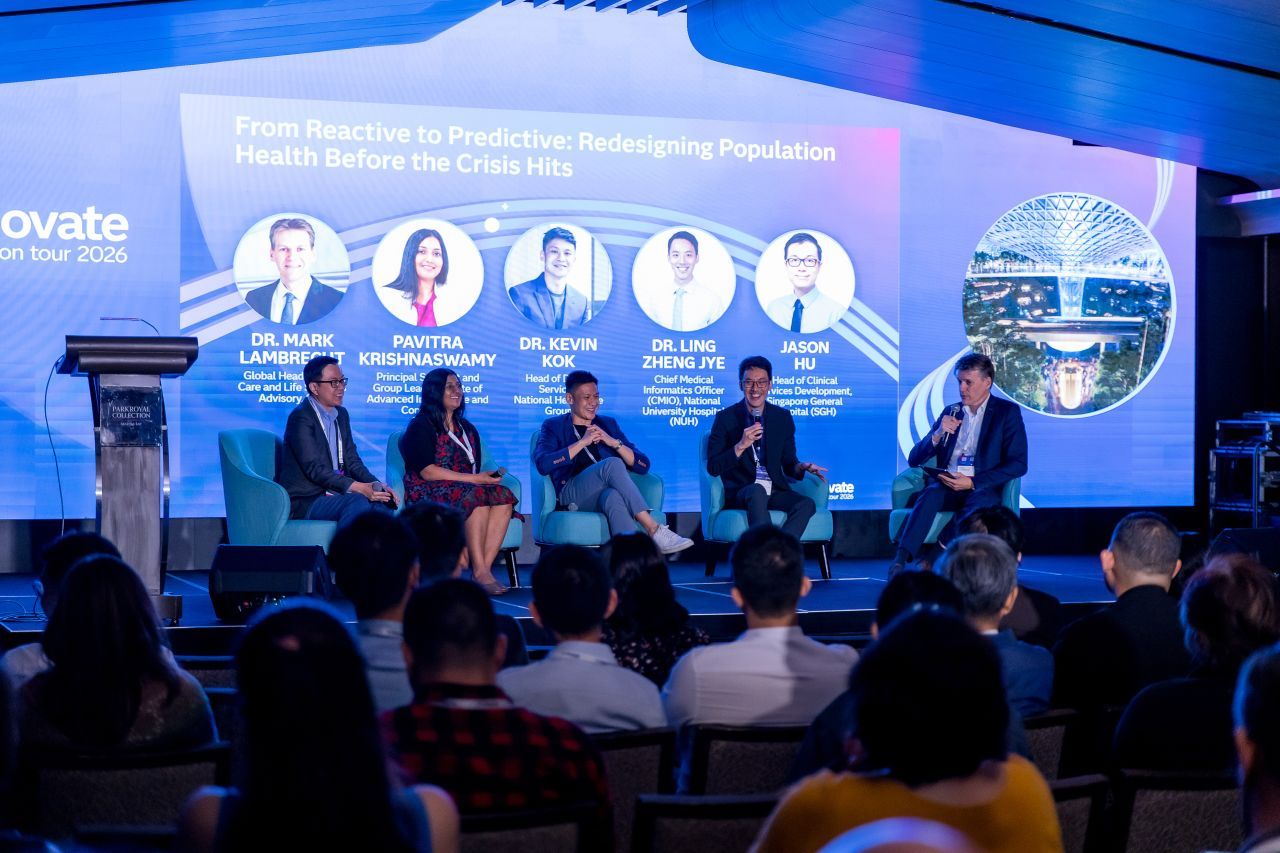
At the healthcare panel, National University Hospital (NUH)'s Chief Medical Informatics Officer (CMIO), Dr Ling Zheng Jye, told a story that undercut a common assumption in AI deployment.
This is that better accuracy automatically earns clinicians' trust.
Years ago, the team rolled out a traffic-light system predicting whether ICU patients were safe to discharge. Adoption was low until, without changing the underlying model, the team simply started showing doctors the top three factors behind each recommendation.
The compliance went up. "We did nothing else different," said Dr Ling. "We just showed them the three reasons... and then it just went up."
Singapore General Hospital (SGH)'s Head of Clinical Services Development, Jason Hu, framed what clinicians need before they'll act on an AI signal.
This is that it must be clinically validated for the target population, integrated into workflow rather than adding to alert fatigue, and paired with a feedback loop so clinicians can override it.
Accountability, he stressed, still sits with the doctor. "We cannot outsource the risk to the company or to the system."
5. Government isn't the AI laggard anymore, but people need to stay in the loop
Opening the day, SAS' Senior Director, Global Customer Advisory, James Ruotolo, pointed to IDC research with an unexpected finding.
Government, long stereotyped as slow to adopt new technology, is now moving faster on AI than much of the private sector.
Citizens now expect government services to feel as seamless as their favourite consumer apps, new risks like prompt injection attacks have entered agencies' risk registers seemingly overnight, and public trust in AI has to be earned.
He illustrated how easily trust gets traded for convenience. Most people would never hand a stranger their financial data, he said, but plenty will hand over their behavioural data for "really funny videos of cats," receiving a knowing laugh from the room.
Even as adoption accelerates, Ruotolo was clear that SAS sees humans as staying central to the work: "we firmly believe that we need to have humans in the loop."
Speed and control, under the same instinct
The tension between shipping fast and staying sovereign looked less like a contradiction and more like two expressions of the same discipline.
OGP moves fast because it knows exactly which small piece it's testing. The sovereignty panel's answer was the same, which was to classify your risk, know your control points, then decide what needs protecting.
For public officers, the takeaway isn't about picking a side, but doing the unglamorous mapping work first, so that when it's time to move, you can move quickly and know exactly where you stand.