Singapore adopts ‘queen bee’ approach to move SMEs towards sustainability reporting
By Sol Gonzalez
Singapore’s Council for a Competitive Climate Transition will get large enterprises to invite at least 100 SME suppliers, partners, and customers to begin their sustainability journey, using Gprnt digital platform.
-1779776262345.jpg)
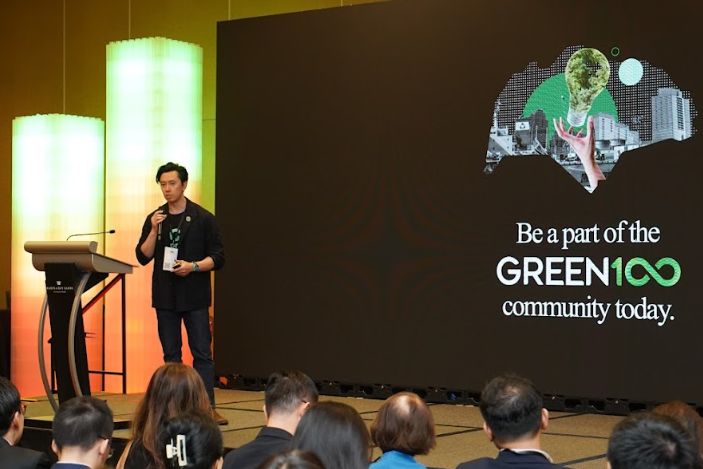
The inaugural Singapore Climate Transition Forum, at the sidelines of Ecosperity Week, featured the launch of Green 100 and Singapore's National Sustainability Standard TR 149. Image: Gprnt.
Singapore continues to advance sustainability efforts to help enterprises achieve green growth, and has identified small and medium enterprises (SMEs) as a key stakeholder to achieve the country’s net-zero ambitions.
SMEs currently make up 99 per cent of businesses and contribute about 40 per cent of emissions.
The Council for a Competitive Climate Transition (C3T) has launched Green 100, a national movement to help businesses accelerate sustainability adoption through simplified disclosures at no cost.
Under Green 100, large enterprises would invite at least 100 SME suppliers, partners and customers to undertake basic sustainability reporting through Gprnt, a digital platform launched by the Monetary Authority of Singapore (MAS) that facilitates sustainability reporting at no cost.
This approach aimed to encourage large enterprises to strengthen their sustainability engagement across their value chains, enabling SME partners to enhance their resilience and competitiveness, and facilitate rapid adoption of national sustainability standards.
“Climate action is not a mere reporting exercise that sits outside business strategy. It is increasingly shaping markets, financing, procurement, and competitiveness itself,” said Singapore’s Ambassador for Climate Action, Ravi Menon.
Menon was speaking at the launch of Green 100 at the inaugural Singapore Climate Transition Forum during Ecosperity Week.
New sustainability standards
Alongside Green 100, the Forum saw the launch of Singapore’s National Sustainability Standard (TR 149:2026), a structured framework that helped businesses in every sector assess the maturity of their sustainability efforts and identify areas for improvement.
The framework was launched by Enterprise Singapore through the Singapore Standards Council.
Through Green 100, SMEs were introduced to the TR 149 Essential level requirements to help businesses begin their sustainability journey while paving the way for higher levels of sustainability readiness over time, underlining that sustainability was not a one-time effort.
Onboarding SMEs
SMEs who wanted to tap on Gprnt for basic sustainability reporting could either sign up directly on the website or respond to email invitations from large enterprises (known as Queen Bees).
GovInsider previously covered how Gprnt, acting as a digital public infrastructure (DPI), was helping SMEs get started on their sustainability journey.
Gprnt’s Chief Executive Officer, Lionel Wong explained that SMEs that completed their essential disclosure received a digital Green 100 Badge on the platform, which included a unique digital identifier to support third-party verification and provide SMEs access to opportunities.
Some of these opportunities included a listing on the Green 100 Supplier Registry, which enhanced visibility to buyers looking for sustainability-ready suppliers; access to the Green 100 network to share alerts on green procurement leaders; and a first step toward more advanced sustainability qualifications based on their needs and business context.
“The badge allows you to profile yourself, and acts as a common first step for sustainability. In terms of visibility, it’s not just to buyers, it’s visibility of the SMEs themselves to the buying and financing opportunities that are in the ecosystem,” shared Wong.
The Green 100 network resembled a LinkedIn socials page curated with Singapore Business Federation (SBF) and Green 100 partners to ensure that relevant opportunities to the community are reflected in the page.
Beyond the first badge that SMEs could obtain upon completing the essential disclosure, they could also move to Bronze, Silver, and Gold levels, according to more advanced TR 149 standards.
Wong shared that 22 large enterprises have joined the movement and started inviting their SME partners to participate.
Sustainability as competitiveness
Sustainability leaders at the Singapore Climate Transition Forum emphasised that sustainability was not compliance, but competitiveness.
-1779688173582.jpg)
Menon highlighted that climate action could unlock enterprise value through collective efforts as an ecosystem, which was what Green 100 sought to achieve by connecting Queen Bees, SMEs, government, financial institutions, and partners.
“Sustainability is not a cost. It can help you unlock value and enable you to get on more markets,” said Singapore Environment Council’s Chairman, Isabella Huang-Loh.
She was speaking at a panel session Unlocking Green Business Value Across the Public and Private Sectors at the Forum.
She emphasised that the growing economic potential of green trade was an incentive for more companies to get started on their sustainability journey.
Another incentive came from government procurement, noted Ministry of Sustainability and the Environment, Chief Sustainability Officer, Lim Tuang Liang.
He explained that the government incorporated green procurement criteria into various projects aiming to align with the national Green Plan.
“With Green 100 we hope to simplify green procurement so that we can measure whether companies are green, and assess which ones are fit for certain contracts, since the TR 49 allows us to see their maturity level,” explained Lim, adding that this initiative could help to generate productive competitiveness for the ecosystem.