
Singapore leverages digital public infrastructure to make sustainability reporting seamless
By Sol Gonzalez
Gprnt, a digital platform for sustainability and ESG reporting, provides businesses with granular and verifiable ESG data, and is integrated with Singapore’s national DPI to facilitate sustainability reporting for SMEs in support of the country’s goal of developing a greener economy.
-1774425542192.jpg)
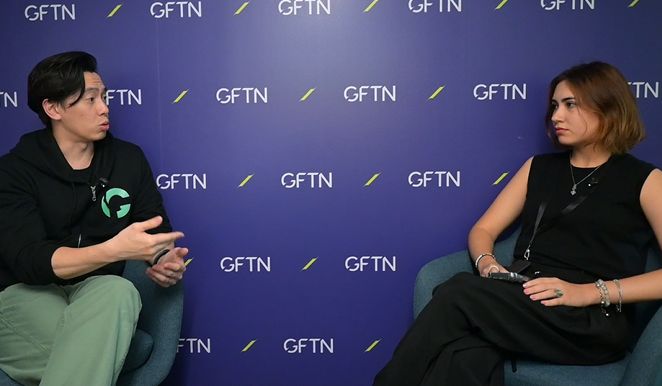
Gprnt’s Chief Executive Officer, Lionel Wong, shares how this fintech initiative and sustainability data platform can help small and medium enterprises (SMEs) generate sustainability disclosures that in turn can unlock economic benefits for themselves. Image: GovInsider.
Think of how easy it is to make digital payments today.
With three steps: keying in an individual’s phone number, adding the amount of money to send, and hitting the transfer button – done in an instant.
Recreating this simplicity is the idea behind Gprnt (pronounced “greenprint”), a fintech initiative and national sustainability data platform started by the Monetary Authority of Singapore (MAS) to simplify and streamline sustainability reporting.
“Could we not, through the existing Singapore digital infrastructure, enable average business users to generate sustainability disclosure seamlessly without cost?” says Gprnt’s Chief Executive Officer, Lionel Wong, while describing the thought behind the initative.
Wong oversees the platform’s development and integration with Singapore’s digital public infrastructure (DPI), which is also known as the Singapore Digital Utility Stack (SDUS).
By tapping into MyInfo Business (data exchange) and Corppass (corporate digital ID) developed by GovTech Singapore, Gprnt’s platform enables businesses to securely retrieve utilities data on a consent basis from PUB, Singapore’s National Water Agency, as well as the Energy Market Authority (EMA) for their sustainability reporting.
In a conversation with GovInsider, Wong shares how the platform can help small and medium enterprises (SMEs) generate sustainability disclosures that in turn can unlock economic benefits and keep Singapore on track toward the Green Plan 2030.
A game-changer
Traditional sustainability reporting for small and medium enterprises (SMEs) involves cost and burden concerns, notes Wong.
The burden comes from an unclear view of the “carrots and sticks” around sustainability disclosures, as well as limited visibility into the tangible business value.
Costs can also run into several thousands of dollars.
“That’s why I think it's useful to do anchor Gprnt in the way it originated from, which is from the regulator,” says Wong.
This origin reflects Gprnt’s role as a national initiative designed to make sustainability reporting simple, accessible, and free of cost for all businesses – enabling participation without adding compliance burden, so that more businesses can easily get onboarded on their sustainability journey.
ESG reporting for small businesses tends to focus on generating Scope 1 and Scope 2, which refer to a company’s direct and energy-related greenhouse gas emissions.
Since the data needed to generate this information sits in government agencies, the journey to obtain the information can be made as easy as making a digital payment.
“We know that people want to just get point-to-point in the same way that I want to send payments point to point. So, we tried to [enable] that by just saying ‘we will generate for you your [sustainability metrics] if you consent to put your data in and let us do the calculation for you’,” he explains.
This automated experience enables Singapore businesses to generate basic sustainability disclosures at no cost, using government-sourced utilities data.
In minutes, businesses can generate baseline emissions data that can support request for proposal (RFP) submissions, identify cost-saving opportunities, and access green financing.
“From these disclosures, businesses can unlock economic benefits to themselves. There won't be a stick, but at least they have carrots,” says Wong.
Since May 2025, the platform has onboarded over 1000 SMEs and close to 100 solution providers.
Sustainability reporting as a utility
A major enabler of Gprnt is Singapore’s strong foundation of national digital infrastructure, notes Wong.
Core systems such as Corppass and MyInfo Business securely manage business data across government agencies.
The only thing missing has been the ability to connect these systems through an integrated data infrastructure that can connect agencies and have the data be consumable by the average business or individual, given issues of confidentiality and other policy matters.
“With the Singapore Green plan and logic, it stands to reason that businesses should be able to pull their utilities data and thereafter compute it into sustainability metrics,”
This led to the development of the underlying infrastructure that now powers Gprnt’s platform, explains Wong.
A project for the future
Wong took on the role of CEO for Gprnt after wrapping up his 15 years at MAS, where he oversaw the project that preceded the current platform.
Before green projects, his focus was on payments. At MAS, he had led the first linkage of two national fast payment systems between Singapore and Thailand and laid the ground for subsequent linkages with other countries like Malaysia and India.
The importance and success of that project inspired a question for him: “Do I want to introduce something that is meaningful and that is changing the world?”
Motivated to work on a project that could bring about positive impact at scale, he took on the leadership role at Gprnt, understanding the complexities that exist in an ever-changing landscape as is climate and sustainability, he shares.
“We focus on building something that is meant as legacy. We’re doing it for the next generation and future generations in that respect.”
Wong notes that the upcoming generations are having clearer motivations toward achieving sustainability goals and hopes for that energy to continue fuelling the vision and mission of those that work in the climate sphere.
“It is the belief that we can achieve things that will change the world, and I think that’s more important than staying safe and staying sound,” he says.
You may watch the interview here!