
Singapore launches gateway to provide countries access to digital resources
Announcing the SGDG, Minister for Digital Development and Information, Josephine Teo, noted that the Online Safety (Relief and Accountability) Bill was on track to be tabled by end of this year.
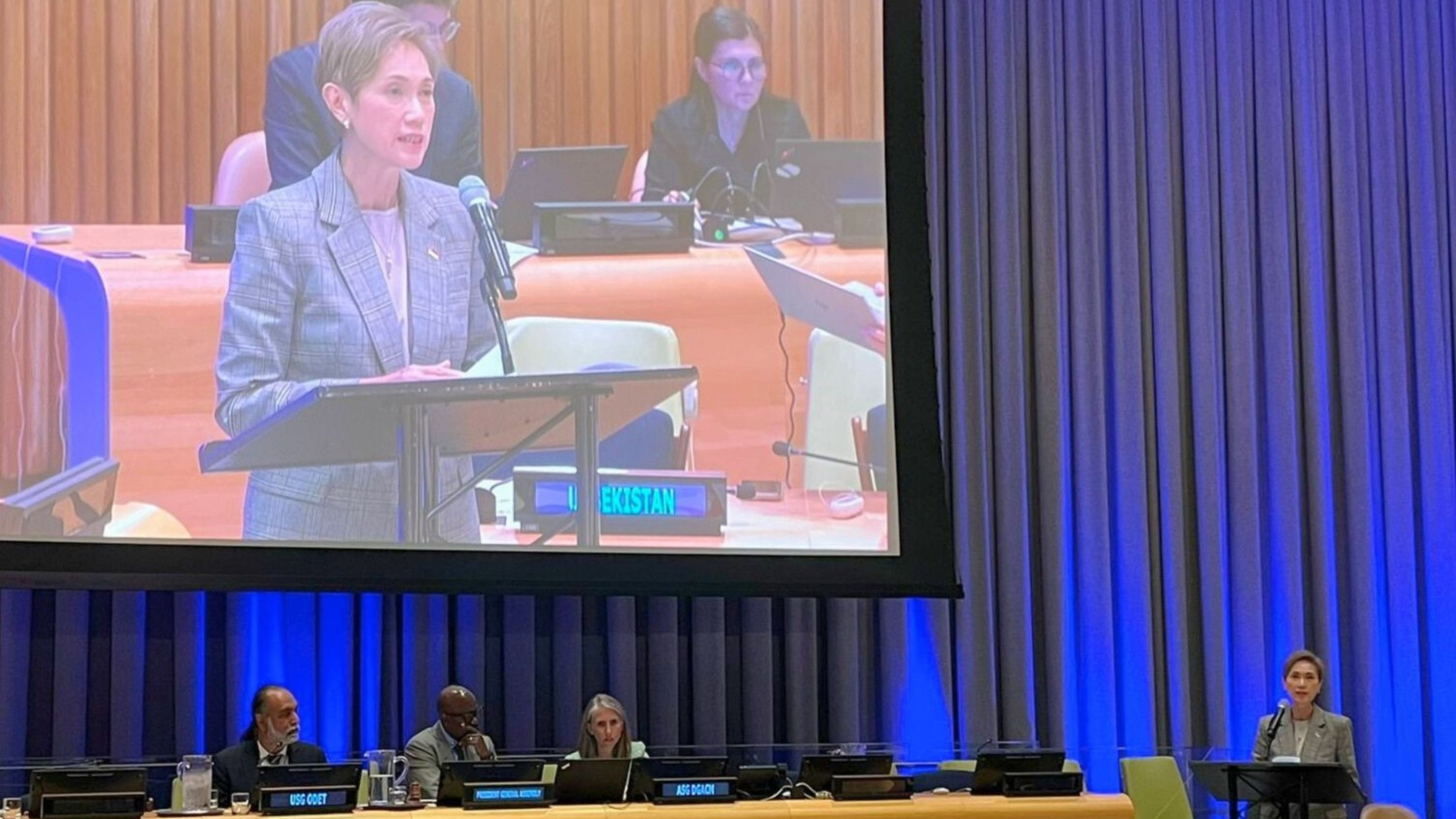
Singapore’s Minister for Digital Development and Information, Josephine Teo, giving her speech at the Global Dialogue on AI Governance at the United Nations. Image: LinkedIn/Joesphine Teo.
Singapore has launched an online platform for global policymakers and multilateral organisations to access more than 30 digital resources that have helped the country's digitalisation journey.
The Singapore Digital Gateway (SGDG) encompasses Singapore’s digital and artificial intelligence (AI) strategies, blueprints, governance frameworks, guides, playbooks, and open-source tools.
This was announced by Singapore’s Minister for Digital Development and Information, Josephine Teo, at the high-level multi-stakeholder informal meeting to launch the Global Dialogue on Artificial Intelligence (AI) Governance in New York on September 25, 2025.
The meeting was organised by the United Nations General Assembly (UNGA), convening UN Member States, observers, UN agencies, and other stakeholders to discuss inclusive and accountable AI governance.
The SGDG would also offer training courses and capacity-building initiatives, co-created by the Ministry of Digital Development and Information (MDDI) and international partners, such as the World Bank and the United Nations Development Programme (UNDP), she added.
SGDG to initially cover AI and digital government
In its initial phase, the SGDG will cover the AI and the digital government domains.
The AI section would include Singapore's National AI Strategy 2.0, the AI Verify testing framework for evaluating AI systems, and Project Moonshot, one of the world's first comprehensive toolkits for testing Large Language Models (LLMs).
Countries would also be able to access the AI Playbook for Small States, developed by Singapore jointly with Rwanda.
The digital government domain would feature Singapore's Digital Government Blueprint with 14 key performance indicators like the Singpass digital identity system architecture, and open-source tools like FormSG for creating secure digital forms and Isomer for building government websites.
MDDI would progressively expand the SGDG to cover more areas such as cybersecurity, online safety, smart cities, and the digital economy, in phases.
Commitment to Tech for Public Good
The Minister noted that the SGDG demonstrated the MDDI’s commitment to Tech for the Public Good, building a more inclusive, trusted, and transformative digital future for Singapore and the world.
Explaining the importance of the initiative, she noted that countries were at different stages of digital development and faced different challenges.
To subscribe to the GovInsider bulletin, click here.
Singapore hoped to contribute by “sharing our experience, practical tools, and tested approaches as additional resources for those who may find them useful”, she said.
Consolidating capacity-building initiatives under the Singapore Cooperation Programme (SCP) broadened access to resources and provides opportunities for training and implementation support.
Interacting with journalists, Minister Teo highlighted two main reasons why the government introduced the SGDG.
On was to facilitate digital cooperation and the other was to tackle the digital divide.
When it came to digital cooperation, the theme that was quite consistent with the need for digital inclusion, she said.
Concerns over the digital divide
“Another way of looking at it is the concerns about the digital divide within countries,” she said.
She noted that in Singapore, during the debate on the President's Address, several Members of Parliament expressed concern about how “we can ensure that digital development remains inclusive for particular groups, like seniors, persons with disabilities, and by extension, countries as well”.
The challenge involved not only uneven digital development within countries but also the digital divide between them, as some nations were better equipped to keep pace with digital advances than others, she said.
She also highlighted that Singapore's experience in the digital domain was well-regarded and often served as “a source of inspiration for our colleagues [from other countries]”.
“We are frequently asked about how we build up digital infrastructure and utilities, how we enable skills development, how we look out for those who have more difficulty keeping up, how we operate digital government, how we strengthen digital security, as well as how we promote the digital economy,” she explained.
Minister Teo noted that Singapore wanted to share its digital government experiences “with our international colleagues, but we must find a sustainable way of doing so.
“For many of our colleagues around the world, finding a resource or a central platform to easily discover these experiences has not been the easiest or most convenient,” she said.
The Minister said the “reception to this has been very positive,” adding that some members of the Forum of Small States (FOSS) were already aware of Singapore’s work and had provided “useful inputs as to what to include.”
Online Safety (Relief and Accountability) Bill on track
Talking about the Online Safety (Relief and Accountability) Bill, she noted that it “has been some time in the making”.
She reiterated the government’s commitment to table it for first reading in Parliament by the end of this year.
“We are on track to do so, and in the process of preparing for the first reading, we have been in close consultation with our partners, particularly those in industry,” she said.
The Minister emphasised the importance of consulting the industry since they would be responsible for implementing many of the new directions.
During her current trip to the US, she met with tech company leaders to discuss enhanced protections for victims of online harms.
“I should say that the meetings went well, and these companies have been very much involved in thinking through and shaping the legislation,” she said.
The Minister noted that the government believed in a collaborative approach and “wants to get the companies to strengthen their commitment to protect victims of online harms because this is a topic of concern”.
She added that the companies' response to the bill has been very encouraging.
“They expressed understanding of why we would want to introduce such legislation. They also understand the way in which we are seeking to implement the legislation in support of the victims,” she said.
The passage of the Bill will enable the Online Safety Commission to be established and empower it with the tools to help victims seek timely relief from online harms.