
Singapore turns to nuclear energy and innovating power grid to strengthen energy security
By Sol Gonzalez
SIEW 2025 spotlighted Singapore’s efforts to build up energy capabilities that adapt to the rapid changes driven by AI, low-carbon technologies, and digitalisation, as the country aims to achieve a low-carbon future.
-1761648481927.jpg)
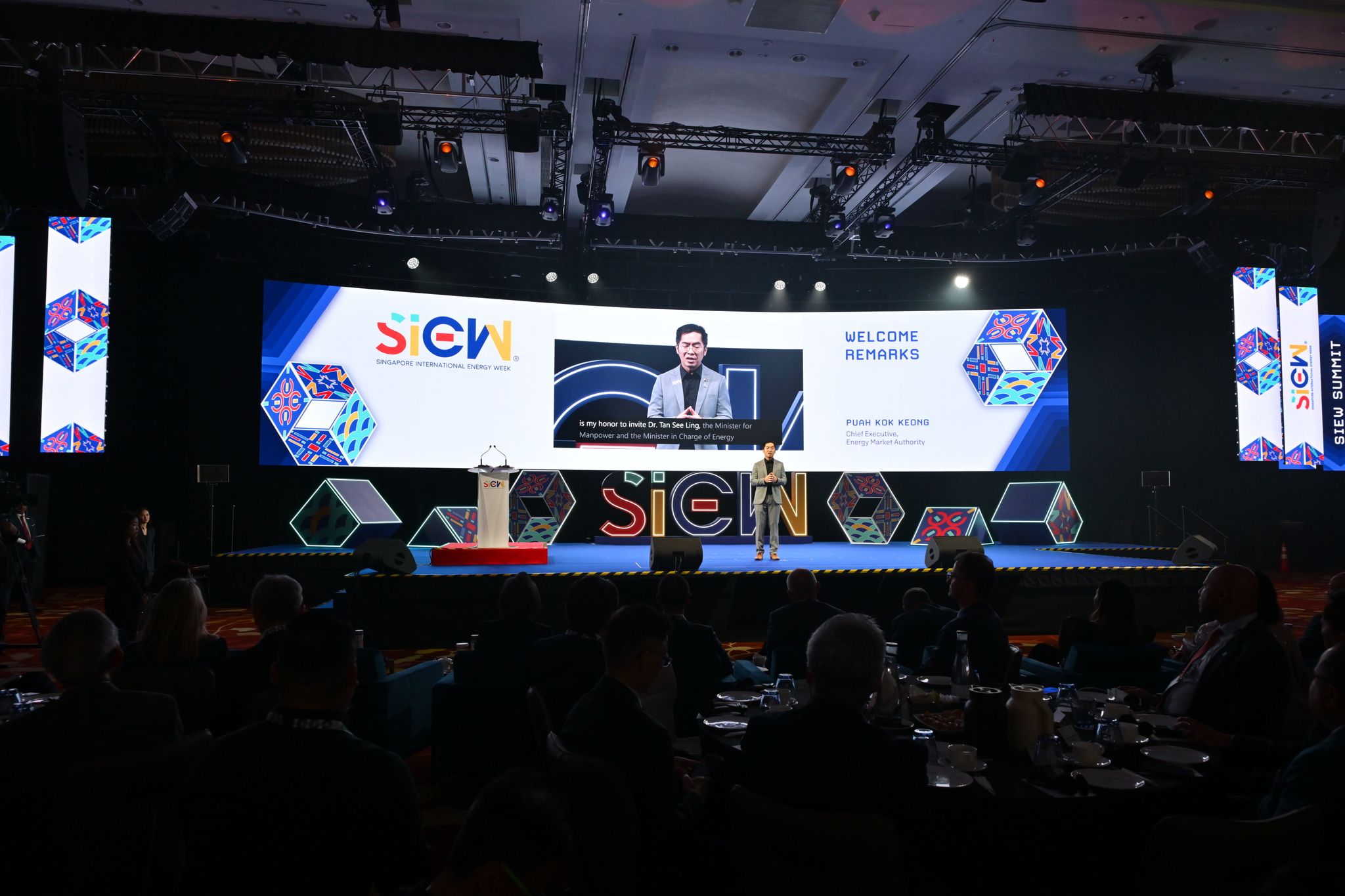
Minister of Manpower and Minister in Charge of Energy and Science & Technology, Tan See Leng, noted that "energy is an existential issue for Singapore". Image: SIEW 2025.
Nuclear energy stood as a potential deployment for Singapore to diversify its energy mix and pursue more sustainable pathways.
At the Singapore International Energy Week (SIEW) 2025, the Energy Market Authority (EMA) signed new cooperation agreements with the state-owned Idaho National Laboratory and non-profit organisation Battelle Memorial Institute from the United States (US) to strengthen nuclear energy capabilities.
Minister of Manpower and Minister in Charge of Energy and Science & Technology, Tan See Leng, highlighted in his opening address that Singapore is embarking on “the next chapter of its energy story”.
According to Minister Tan, Singapore was navigating an “energy trilemma” to find the balance between sustainability, security, and cost-competitiveness.
“To secure a low-carbon energy future for generations to come, we must plan smarter and work harder,” he said, noting that decarbonisation may come with trade-offs that the sector must prepare to mitigate.
SIEW returned this year with the theme Envisioning Energy Tomorrow, Building Systems Today from 27 to 31 October.
EMA’s Chief Executive, Puah Kok Keong, said that the theme was “a commitment and a call to action, as we must design and build systems that are resilient, inclusive, and ready for the challenges ahead”.
Aside from new nuclear agreements, Singapore launched initiatives to enhance Singapore’s power grid and advance innovation in energy technologies.
To subscribe to the GovInsider bulletin, click here.
Envisioning a nuclear future
Singapore’s new cooperations with the US builds on the Agreement for Cooperation Concerning Peaceful Uses of Nuclear Energy (123 Agreement) signed last year, and the Memorandum of Understanding Concerning Strategic Civil Nuclear Cooperation signed in January 2025.
The aim of the new collaboration is to build capabilities and study the feasibility of deploying nuclear energy for power generation in Singapore, said Minister Tan.
This would be supported by the Battelle Memorial Institute – an independent, non-profit organisation that applies advanced science, technology, and engineering to develop solutions.
The EMA would work alongside and leverage Battelle’s expertise to assess the potential of advancing nuclear energy and reactor technologies in the country.
The second part of this collaboration with the US involved a Letter of Intent (LOI) for Idaho National Laboratory (INL) to work with EMA on nuclear energy.
This would entail working together toward establishing a Cooperative Research and Development Agreement (CRADA) to enhance capabilities, understanding, and technical expertise in advanced nuclear energy technologies.
“The US stands strongly with Singapore… We want to be your partner in technology, in artificial intelligence, and in all things energy,” said the US’ Secretary of Energy and Vice-Chair of the National Energy Dominance Council, Chris Wright, in his keynote address.
EMA’s Puah noted that this collaboration with the US would strengthen the efforts toward pursuing potential pathways to reduce carbon emissions and meet Singapore’s energy needs.
Enhancing Singapore’s power grid
As part of the Future Grid Capabilities Roadmap, Minister Tan announced several initiatives to ensure the reliability of Singapore’s power grid via R&D, pilot projects, and new solutions.
One of these initiatives was the Virtual Power Plant (VPP) Regulatory Sandbox.
A VPP is a network of decentralised, distributed energy resources (DERs) that are aggregated and managed like a conventional large power generation plant.
DERs are small power generation units, such as electric vehicle chargers or rooftop solar photovoltaics, that are installed to produce, store or use electricity.
The expansion of DERs would be expected as Singapore incorporates more renewable sources in its energy mix, and DERs start to play a greater role to support the needs of the grid.
The VPP helps support the commercial feasibility for DERs to provide grid services, as it may not be viable for each DER to individually provide services given its smaller scale.
Through the regulatory sandbox, which will run for two years, the EMA would evaluate the benefits of VPPs to the power system and inform future market design to encourage investments into new DER assets.
The sandbox includes the participation of Blue Whale Energy, Nanyang Technological University, and SP Group.
Another initiative to support the reliability of Singapore’s future grid, was the Energy Grid 3.0 Grant Call.
The Grant Call sought proposals from research institutions, private companies, and institutes of higher learning to enhance grid planning and operations capabilities to manage the grid as more renewables and DERs are involved.
To subscribe to the GovInsider bulletin, click here.
Encouraging lower carbon emissions
“As our systems grow more complex, our energy ecosystem must also grow more resilient. We will achieve this by enhancing natural gas-based generation systems,” said Minister Tan.
To this end, the EMA rolled out an incentive scheme to encourage the adoption of advanced natural gas power plants that are more carbon efficient.
Under the Advanced Combined Cycle Gas Turbine (CCGT) Incentive Scheme, EMA will award up to S$44 million to Keppel Electric and Sembcorp Industries to support their deployment of the first two advanced power plants in Singapore by the end of next year.
“Energy is an existential issue for Singapore… as we step into this new chapter, I invite all of you, our partners in ASEAN and around the world, to join us as we write this important chapter in our journey together,” concluded Tan.
Read also: Singapore to build its first district-level smart grid, November 4, 2024