
Singapore's A*STAR expands shared infrastructure to help startups launch faster
The expanded A*StartCentral 2.0 targets faster time-to-market, stronger intellectual property protection, greater cost-efficiency, and cross-disciplinary innovation.
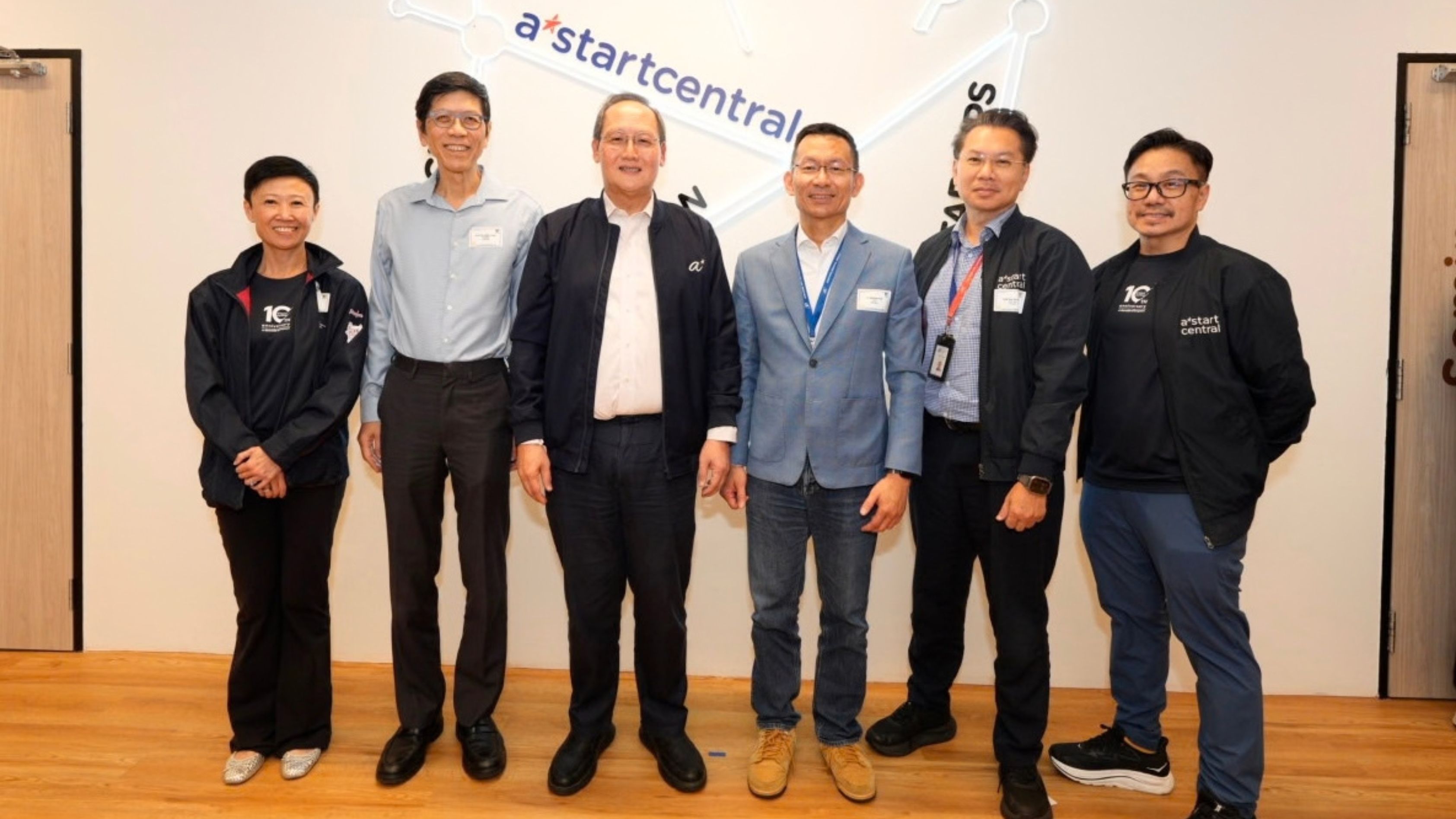
(Left to right) Irene Cheong, Assistant CE, Innovation and
Enterprise, A*STAR; Prof Tan Chorh Chuan, Chairman, A*STAR; Dr Tan See Leng,
Minister for Trade and Industry (Energy and Industry); Beh Kian Teik, CEO, A*STAR; Prof Yeo Yee Chia, Deputy CE, Innovation
and Enterprise, A*STAR; and Anthony Chong, Acting Director, Innovation and
Enterprise, A*STAR, during the launch of A*StartCentral 2.0 on 23 September 2026. Image: A*STAR
It takes about four months for a startup to conduct a compliance test and if that fails, it’s another four months. Outsourcing the prototyping process risks more time wasted, while also compromising the startup's intellectual property (IP).
These are the kinds of trade-offs that deeptech startup founders face, and the same ones that the Agency for Science, Technology and Research (A*STAR) is looking to tackle with its expanded shared lab.
A*STAR is Singapore’s public agency for research and development.
-1790217763422.jpg)
address at the launch of A*StartCentral 2.0 on 23 September 2026. Image: A*STAR
As it marks its 10th anniversary, it announced on September 23 that it has expanded its A*StartCentral 2.0 space from 10,000 to 18,000 square feet.
Serving as a shared lab for startups across various deeptech domains from life sciences, food, sustainability and more, the expanded lab covers new open benches, private laboratory suites, as well as facilities to enable more advanced prototype development and pre-compliance testing.
An example of this facility is a radio frequency shielding room that allows startups to conduct testing on-site and reduce the cost, complexity and delay associated with external testing.
“In the startup world, we always ask if a startup sustains more than five years. The time wasted decreases the [startup’s] chance to survive,” said Anthony Chong, Acting Director for Innovation and Enterprise, A*STAR, at the launch event.
He added that the purpose of a space like this is to “compress” the time needed for startups to launch.
Sharing the cost of experimentation
According to Chong, shared equipment meant lower costs for startup founders who would otherwise have to buy the facilities themselves.
The concern was shared by CartiFuse’s co-founder and CEO, Xiao Zhaotan, who noted that some equipment would “sit idle most of the time between clinical trial cycles.”
The medtech startup, which is a spinoff from A*STAR and SingHealth, used the shared chemistry lab to synthesise the biopolymer behind its cartilage regeneration implant.
Chong added that the previous 4,000 sq ft space ran at an 80 to 90 per cent occupancy rate.
As the startup ecosystem matured, founders increasingly wanted dedicated lab suites to protect their IP and avoid cross-contamination between experiments.
On what constitutes shared infrastructure for its diverse startups, Chong says to GovInsider that the facility was designed around broadly useful, shared equipment identified through consultations with its existing startup base.
Besides infrastructure, A*STAR also provides mentorship and networks.
CartiFuse’s Xiao pointed to the community itself as a way to navigate the scale of A*STAR’s resources, helping the startup to “exchange notes and ideas, find synergies and navigate policymakers and governments.”
Matwerkz Technologies (a startup specialising in thermal management solutions)’s Dr Leong Yew Wei said that the mentors introduced by A*STAR have helped him to think through its IP management and go-to-market strategy.
Over the last decade, A*StartCentral has supported over 100 ventures, which have collectively raised over S$1.6 billion in capital and created 1,800 jobs.
Grown, not greenhoused
According to Chong, A*StartCentral 2.0 uses a tiered “startup pricing” model to nudge startups to graduate from the space over time.
The first one to two years are priced lower to help early-stage teams get started, rising by around 20 per cent yearly after that.
By the fifth to sixth years, the fee would have approached market rates.
Once a startup has grown to need more benches, lab suites, or services, it might be more economical for them to move to their own premises, he says.
“By then, they will also know what kind of equipment and workflows they need to set up. We have startup teams who come in less than six months and eventually go build their own lab,” he tells GovInsider.
Early-stage startups also benefit from the community building initiatives that help build their soft skills as well as networks, Chong adds.
These initiatives ranged from Open Mike, an open pitching platform for innovators to test ideas, gather feedback and explore commercial opportunities for emerging tech, to fireside chats with investors to find out what they look out for.
Cross-disciplinary innovation as next leap
Chong notes to GovInsider a broader shift of innovations moving towards becoming cross-disciplinary, highlighting the convergence of life sciences and engineering.
He cites CartiFuse’s work as one venture drawing on two different lab types.
The startup synthesises its biopolymer in the shared chemistry lab, while using the 3D printer in the engineering lab to produce a prototype to showcase to its customers and investors.
Beyond its own facilities, A*STAR partners with other institutions and public agencies to help its startups move towards commercialisation.
Startups working on decarbonisation and chemicals can access A*STAR's Institute of Sustainability for Chemicals, Energy and Environment (ISCE²) on Jurong Island, where facilities support pressure testing up to 200 bar, which is around ten times what's available on-site at A*Start Central.
-1790217831617.jpg)
a startup representative during the facility tour at the launch of A*StartCentral 2.0 on
23 September 2026. Image: A*STAR
Healthcare ventures can tap on co11ab Novena, a biomedtech incubator formed by A*STAR, NHG Health and Lee Kong Chian School of Medicine (LKCMedicine) that connects startup founders to clinicians and patients for test-bedding opportunities in the hospital environment.
Dr Rachel Sim, the founder of Ocellivision, a medtech startup developing imaging tech for cancer surgery, shared why that pathway matters.
She highlighted how navigating the transition from lab to hospital was “quite difficult” on its own, but the programme at A*StartCentral 2.0 focused on customer discovery which connected her team to doctors and pathologists at two of Singapore’s public healthcare clusters.
That process eventually led to a clinical collaborator at Singapore General Hospital (SGH) and a clinical pilot for breast cancer surgeries, with the team having since collected imaging data from about 30 patients.