
Singapore's Digital Utility Stack shifts from building infrastructure to enabling an ecosystem
The next phase of digital public infrastructure (DPI) looks less like new pillars and more like deeper roots, extending what already exists in specific sectors and across borders, shares IMDA’s digital utilities cluster director, Liau Eng Soon.

While one of IMDA’s remits is the digital economy, the agency’s approach isn’t to build apps for every sector but instead lays down reusable, trusted digital infrastructure that ecosystem players can build on for their own services. Image: Canva
It’s one thing for the government to build a digital public infrastructure (DPI), but another to embed DPI into everyday transactions for residents, businesses and government agencies.
According to Singapore’s Infocomm Media Development Authority (IMDA), the next phase of its digital utility stack (SGDUS) is about enabling the ecosystem to use common digital trust infrastructure across the society and economy.

“Our mission is more outward-facing to enable the industries in making life easier for citizens and businesses,” says digital utilities cluster director, Liau Eng Soon, to GovInsider.
While one of IMDA’s remits is the digital economy, the agency’s approach isn’t to build apps for every sector but instead lay down reusable, trusted digital infrastructure that ecosystem players can build on for their own services.
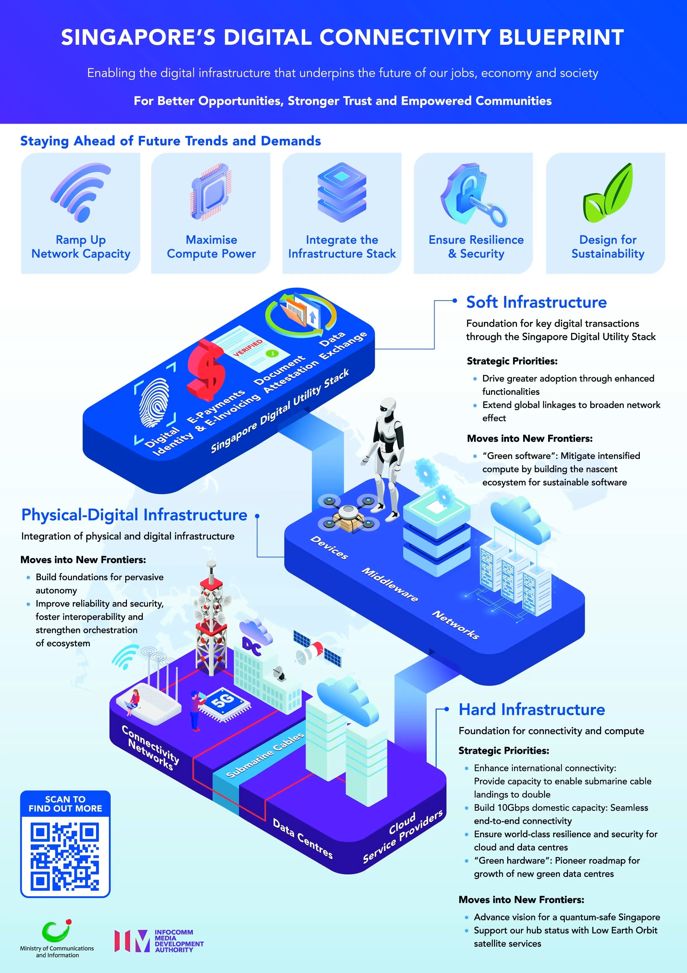
Also known as DPI in most other countries, Singapore’s digital utility stack comprises five components that connect with each other, namely the digital ID, e-payments and e-invoicing, document attestation, and data exchange.
These are foundational digital services provided by the government to enable citizens and businesses to transact seamlessly and securely in the digital economy.
Making adoption of digital utilities easier
“We want to make it easier and cheaper for them to come onboard,” says Liau.
His team wants to reframe interoperability, enabled by digital utilities, not as a costly market barrier but as a gateway that enables every business to participate in the digital economy.
He shares three main levers that IMDA has put forth to make adoption of digital utilities easier, including multiple entry points, monetary incentives to drive adoption and system upgrades, and working with other governments agencies to move whole sectors.
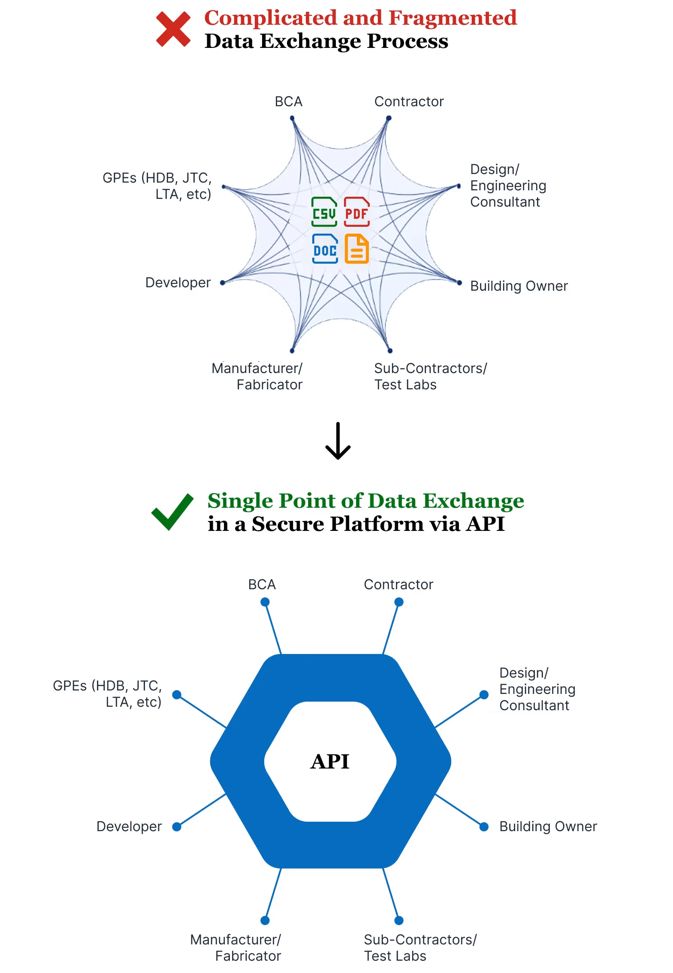
Instead of assuming that every business is ready to plug into application programming interfaces (APIs), IMDA has built multiple entry points for users to engage in data exchange (DEX).
DEX allows businesses to engage in secure and efficient data sharing with their ecosystem partners, as well as across sectors.
Digitally mature businesses can tap directly into DEX via APIs. But for many smaller or less digitalised players, they can still use a simple web interface to manually input information and access data from their ecosystem partners.
Take the example of submitting data to the Building and Construction Authority (BCA).
Previously, a business would have to scan a physical document and upload it, which results in the information trapped in a static image file than being truly digital.
With access to digital data, BCA can monitor broader industry trends with dashboards.
As InvoiceNow undergoes a phased rollout ahead of becoming a mandatory requirement, IMDA provides grants and subsidies to help companies transition.
Companies can either subscribe to an IMDA-accredited InvoiceNow-ready solution provider or integrate their ERP system with an accredited access point provider.
“If they use it and find it useful and productive, they can always buy the software,” Liau notes, highlighting how the incentive allows businesses to test the waters risk-free and comfortably onboard the digital utility when they see its value.
In parallel, IMDA co-designs the incentives and digital utilities alongside sector-specific government agencies, while using the agencies’ existing regulatory and operational touchpoints to pull stakeholders in.
For instance, while GovTech Singapore manages national digital ID systems like Singpass and Corppass, IMDA complements this by exploring how verifiable credentials and private sector data sources can be unlocked for new use cases.
Designing for cross-border interoperability from day one
“There’s no point doing a digital utility just for Singapore,” Liau says. For a major trading nation like Singapore, trade depends on how easily data can move across borders.
The cluster’s Assistant Director, Kay Ren Yuh, highlights IMDA’s strategic choice to adopt shared standards and a decentralised architecture for its cross-border digital utilities.
A large economy, Liau notes, may invent its own standards and others will fall in line. And he was candid about Singapore’s constraint in this regard.
This is why Singapore deliberately adopts globally-recognised standards so that digital transactions can extend beyond national borders.
For example, the country’s e-invoicing network runs on Peppol, a standard developed in Europe, making it the first outside Europe to adopt it nationally.
TradeTrust, IMDA's blockchain-powered framework for cross-border trade documentation, also aligns with globally-accepted standards outlined in the United Nations Commission on International Trade Law (UNCITRAL).
It is also built on a decentralised architecture, as trade needed a system no single party could control on its own, says Kay.
“Half the community is not in your borders anyway, so that's where you do need something democratic and hence, the use of decentralised infrastructure and technologies,” Kay explains.
DEX, however, runs as a centralised, domestic, and government-operated architecture.
“Most people trust the government, so that's where we start linking businesses together [by sectors],” Liau says, adding that IMDA first linked up trade data (SGTraDex), then expanding into construction (SGBuildex), healthcare and agri-food.
Even for Singpass, which was built more than a decade ago and sits on centralised infrastructure, the team recognises that not every use case requires citizens to disclose their full identity card details, like proving you’re old enough to buy alcohol.
That’s the gap that IMDA’s work in verifiable credentials aims to fill.
Digital Identity and Document Attestation’s Assistant Director, Priscilla Chen, shares that the team is exploring verifiable credentials that complement SingPass by allowing organisations to issue and verify trusted attributes suited to different contexts.
Think employee credentials, professional licences, memberships, which for instance, doesn't need the same level of verification as a bank login.
What's next
The next phase for Singapore's digital utility stack looks less like new pillars and more like deeper roots.
That is extending what already exists in new documents, new sectors, and across borders.
According to Chen, the team hopes to extend OpenCerts, an open-source platform built by the Singapore government to issue tamper-proof digital certificates, to cover all government-issued documents.
She explains how government-issued and industry-issued credentials can actually tap into a common trust infrastructure, allowing digitally verifiable documents to be recognised across sectors and eventually across borders.
Currently, it is used mostly for educational certificates. She says that early conversations with government agencies to do so for other forms of documentation are underway.
Once a critical mass of adoption is achieved domestically, the next step is cross-border recognition.
Singapore has already piloted the e-Apostille initiative with Shanghai, letting businesses authenticate legal documents online instead of having paper ones couriered across borders.
Similarly, for TradeTrust, while it currently focuses on electronic bills of lading, the technical framework is actually built to handle a broader range of digital trade documents.
“We’re looking at the whole digital trade process and see what else we can digitalise with the TrustVC technology,” says Liau.
As for DEX, its next phase is about connecting the sectors that already exist. Liau shares an example of connecting the health and construction sectors.
Calling it “cross dexes,” Liau shares an example of connecting the data from both sectors to streamline the management of workplace injuries, instead of having SGBuildex build its own connection into the databases of over 1,000 clinics in Singapore.
The logic of “connected once, connect to all” holds just as well beyond Singapore’s borders.
Where a country might once have needed a separate connection for each type of Singapore data it wanted, a single connection into Singapore's DEX would now be enough to reach all of it.
With a centralised architecture, the government also maintains control over what flows out and to whom. Liau shares that a different data-sharing agreement can apply to one country than another.
While it was built as a domestic infrastructure, DEX runs on international standards which allows it to connect bilaterally and remains interoperable.
To enable everyone to participate in a trusted digital ecosystem, the team reiterates that common standards, reusable infrastructure, lower integration costs enabled by subsidies, grants and free software, and network effects have been key.
As more sectors and jurisdictions adopt compatible approaches, trusted digital transactions become simpler, more secure, and increasingly borderless.