
Singapore’s public healthcare workers can now build their own AI agents
By Zenith Wong
Synapxe’s Agentsea lets public healthcare professionals build AI agents with little to no technical expertise, with more than 12,000 agents created since the platform’s introduction in June.

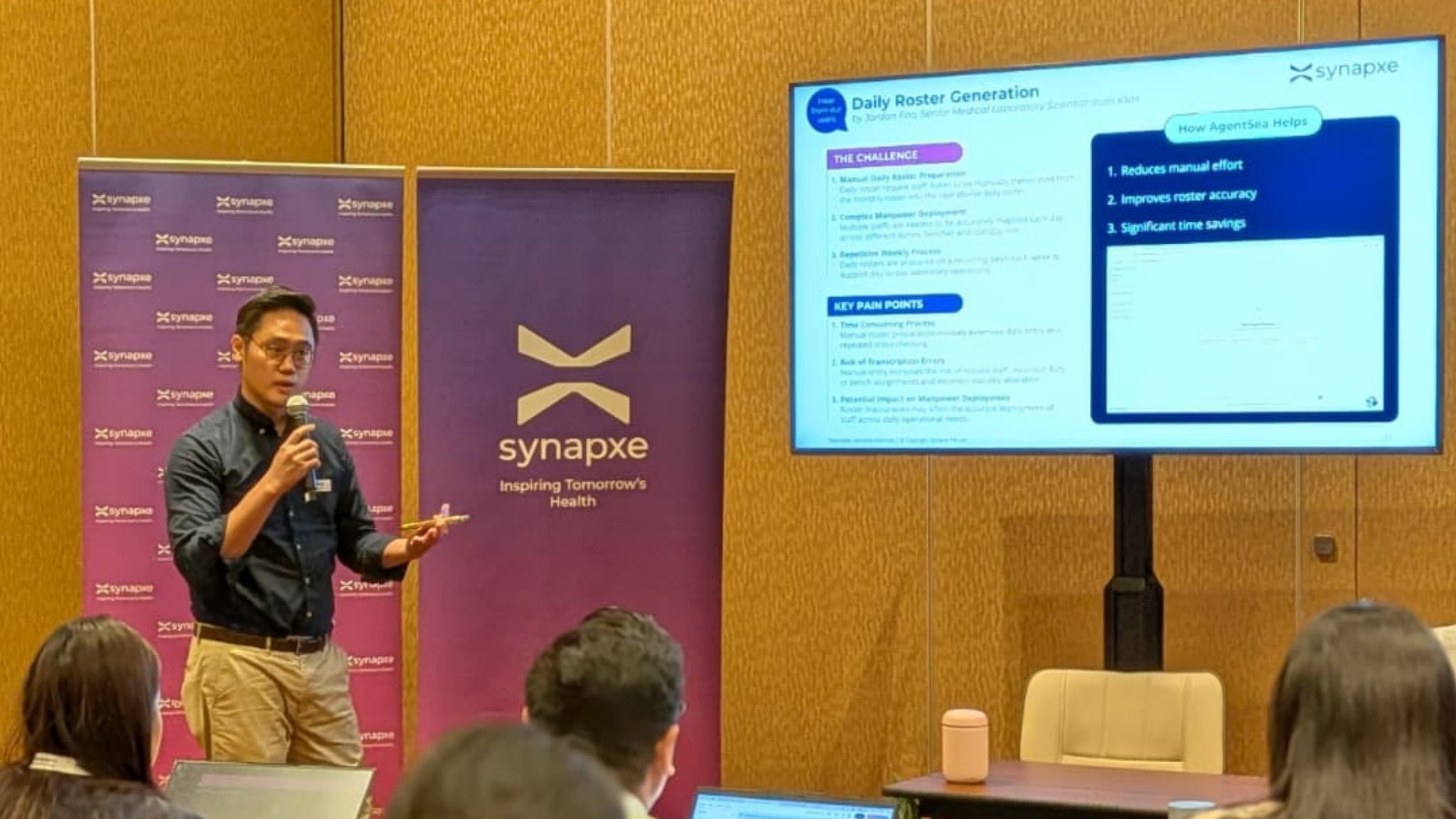
Public healthcare professionals can use Agentsea to build AI agents for tasks ranging from clinical record summarisation to roster generation. Image: Synapxe
Using a sector-wide platform, all public healthcare professionals in Singapore can build their own AI agents to automate work tasks with little to no technical expertise.
The platform is known as Agentsea, which can be operated with natural language. It was developed by Singapore’s national healthtech agency, Synapxe.
This was announced by Tan Kiat How, senior minister of state for the Ministry of Digital Development and Ministry of Health of Singapore, at the Healthcare Information and Management Systems Society (HIMSS) Global Health Conference and Exhibition.
Tan framed Agentsea as part of a broader push to redesign workflows around AI, adding that AI in healthcare should “make the health system more productive and more resilient” and enable care teams to intervene earlier and focus on patients rather than paperwork.
How it works
The agent will first ask the user, in plain language, what kind of agent they want to create and what job it should do.
Following that, users just need to plainly describe the agent’s desired functions, as well as input the required documents for the task.
Examples of tasks include summarising clinical records, reviewing procurements, generating rosters.
The platform then automatically proposes a working agent with suggested tools attached, which the user can then review and tweak.
Through a chat-like interface, the user can then refine and test the agent through a chat-like interface that provides sample outputs that can be checked for accuracy.
Since its introduction in June, over 12,000 such agents have been built by healthcare professionals.
“By empowering our healthcare professionals with practical AI capabilities, we enable them to simplify time-consuming tasks and spend more time on patient care, collaboration and other areas where their expertise matters most,” said Synapxe's Chief Data Officer, Andy Ta, at the launch event.
How agents are used in healthcare
Doctors can use Agentsea for pre-clerking, which is the preparatory research work done prior to patient consultations.
“It can take considerable time and effort, includes reviewing patient histories, flagging relevant clinical details and consolidating records,” said assistant professor, Dr Kenneth Michael Chew, consultant from the Department of Cardiology at National Heart Centre Singapore.
Chew said he created a pre-clerking agent with Agentsea with no coding experience.
Verifying his agent with Agentsea’s in-built agent-testing mechanisms also helped improve the accuracy of the agent’s outputs, he said.
“This has not replaced the need for verification or my own clinical assessment, but has made my preparation more efficient, allowing me to focus on delivering more personalised care during consultations,” said Dr Chew.
Collaborations are underway between healthcare professionals and Synapxe to develop new complex enterprise agents, such as systems that can automate human resource processes and clinical operations.
These systems aimed to “reduce manual effort, improve turnaround times and enhance operational efficiency for our public healthcare professionals,” said Synapxe in a media release.
Built-in safety guardrails
Commenting on GovInsider’s question on built-in safety guardrails, a spokesperson from Synapxe says that the platform ensures sensitive information is protected and not transferred out of public healthcare institutions through “robust security, data protection and privacy safeguards.”
For example, the system can detect information such as identification numbers and financial credentials and prevent them from being used by the AI agents.
Requests that are flagged by the platform’s safety controls may also be blocked from proceeding.
“The more agency we give to AI, the stronger the safeguards around those actions must become,” said Tan, adding that “good assurance is what gives innovation the potential to scale.”
Editor’s note (August 31): The article has been corrected to clarify how Agentsea prevents sensitive information from being used by AI agents.