
Tatiana Fernandez, Head of Transformative Innovation, Government of Catalonia, Spain
By James Yau
Meet the Women in GovTech 2025.
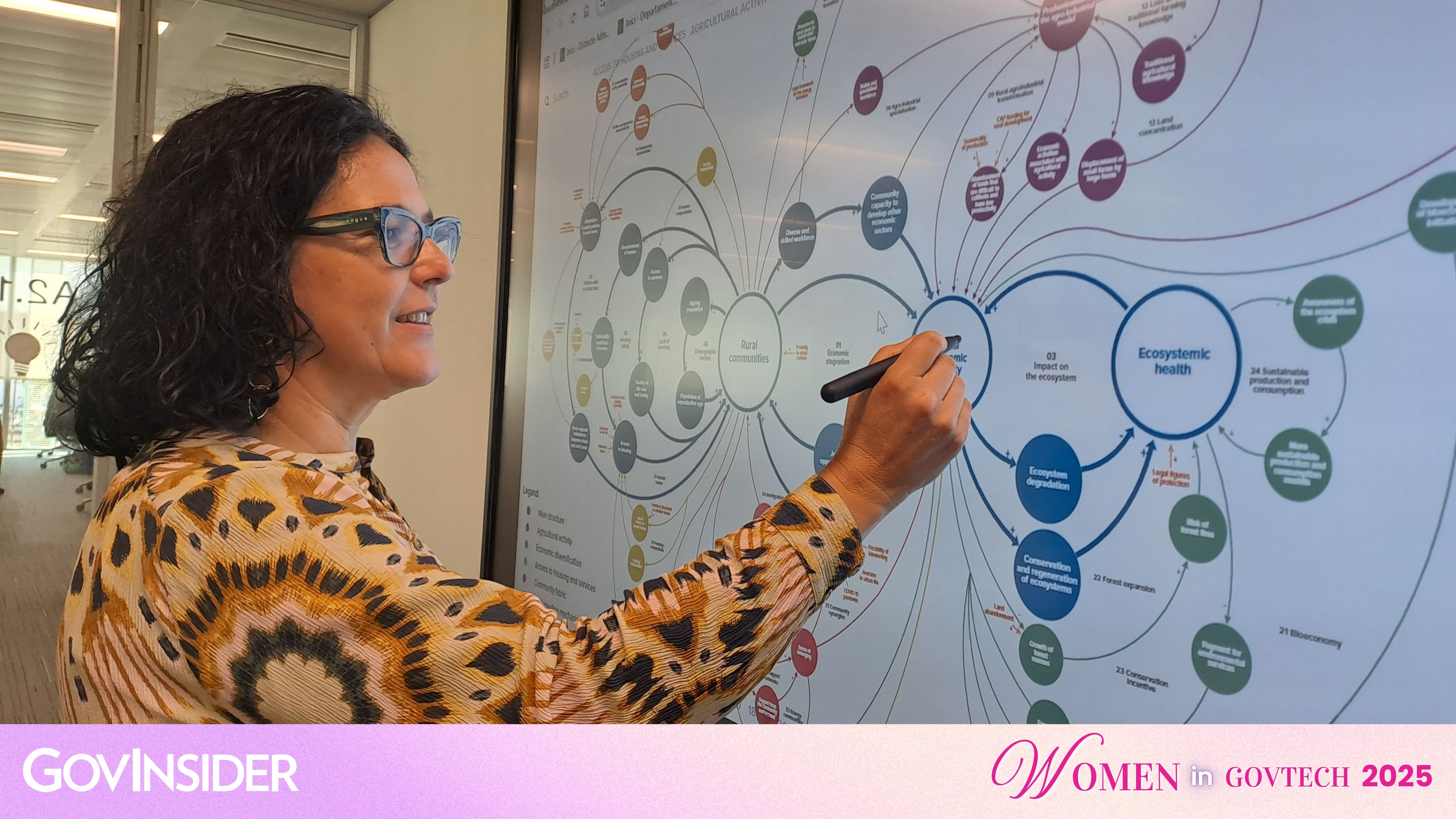
Tatiana Fernandez, Head of Transformative Innovation, Government of Catalonia, shares about her journey. Image: Tatiana Fernandez
1) How do you use your role to ensure that technology and policy are truly inclusive?
My work is primarily focused on policy, and many of today’s major challenges cannot be addressed by public administrations alone.
They require collaboration among actors with different perspectives, responsibilities and forms of knowledge, which means policy has to be organised in ways that make this collaboration possible.
A key part of our role is therefore to rethink how problems are framed and how public action is coordinated, so that different actors can contribute meaningfully to shared objectives. Technology helps in this process, but it is never the starting point; it is an enabler that can support better understanding and coordination.
Data platforms, digital twins and system-mapping tools help connect evidence and visualise interdependencies, but their impact depends on the human and institutional infrastructures that support shared interpretation and joint action.
Our work is about aligning these elements so that innovation and technology genuinely support inclusive, place-based and challenge-driven policies that respond to what matters in each context.
2) What’s a moment in your career when you saw firsthand how technology or a new policy changed a citizen’s life for the better?
One meaningful example is the NutriAlth3D project, developed by Fundació Althaia, Fundació Universitària del Bages, the JOVIAT Culinary School and several local companies.
The initiative uses 3D-printed meals to address the everyday reality of people living with dysphagia - difficulty swallowing - which affects many older citizens and people with chronic or neurological conditions. It restores both the pleasure and the safety of eating.
Students from culinary and health programmes work directly with patients, designing and testing recipes such as fish with peas and carrots, paella or tiramisu, with adapted textures and nutritional compositions.
These dishes look and taste familiar, allowing patients to eat safely without losing the sensory and social experience of food. What makes this initiative special is how it brings together technology, education, health and care to address a very human challenge.
It shows how innovation can emerge when different actors collaborate around the practical needs of people’s daily lives.
3) What was the most impactful project you worked on this year, and how did you measure its success in building trust and serving the needs of the public?
Our work is not about managing individual projects but about creating the conditions, spaces and tools that make systemic change possible. This year has marked important progress in two complementary lines of work:
-
Shared Agendas have matured into a recognised way of addressing place-based challenges, bringing together governments, companies, research centres and civil society around shared purposes linked to green and just transitions. What began as an experiment has become an operational framework that helps institutions collaborate across silos and sustain change over time.
-
The Public Procurement of Innovation programme has successfully closed 18 projects addressing social and environmental challenges. These projects - from AI-based environmental monitoring to digital twins for health, mobility and energy - are improving public services while changing how administrations work with knowledge institutions and companies.
4) What was one unexpected lesson you learned this year about designing for real people? This can be about a specific project or a broader lesson about your work.
Our work is not about designing better services, but about supporting systemic ways of addressing complex challenges that matter to people and to the places where they live.
Challenges such as dependency and health, decarbonisation or territorial resilience cannot be solved through isolated projects or technologies. They require shared understanding, institutional coordination and consistent collective effort over time.
A key lesson for me is that effective solutions emerge when actors learn to work together, not when tools are designed in isolation. We understand design as the process of building shared purpose and enabling people and organisations to align their actions.
This takes time, facilitation and trust - but these are the conditions that make change meaningful and lasting.
5) We hear a lot about AI. What's a practical example of how AI can be used to make government services more inclusive and trustworthy?
AI can improve public services when it supports human judgement and helps connect information that is usually fragmented. Several projects from our Public Procurement of Innovation Programme illustrate this:
-
A Social-Health Data Lake integrating health, social, cultural and environmental data to generate insights that help professionals design better support for people living with chronic conditions or dependency.
-
A Digital Twin for the Hospital de la Santa Creu i Sant Pau, using immersive simulation to understand patient flows and improve the experience of care while optimising hospital management.
-
A Digital Twin for Mobility Infrastructure, using AI-based analysis of traffic, emissions and road conditions to improve maintenance, anticipate incidents and strengthen the safety and sustainability of mobility.
Across these projects, AI does not replace decision-making; it enhances collective intelligence, making patterns and risks more visible so that institutions can act earlier, more coherently and more transparently.
To subscribe to the GovInsider bulletin, click here.
6) How are you preparing for the next wave of change in the public sector? What new skill, approach, or technology are you most excited to explore in the coming year?
The next wave is not about adding more technology, but about using what already exists in more connected and purposeful ways. Most tools are available; the real barriers are institutional silos, fragmented data and limited capacity to work across boundaries.
Preparing for what comes next means strengthening systemic capability - improving coordination, data interoperability and shared learning - so that technology can genuinely support better decisions and more coherent public action.
Our focus is on combining existing technologies with the human and organisational capacities needed to apply them effectively to real, place-based challenges.
7) What advice do you have for public sector innovators who want to build a career focused on serving all citizens?
Start from the challenge, not the tool.
Dedicate time to understanding how the challenge works as a system - its actors, incentives, regulations and underlying assumptions. Better understanding always leads to better outcomes.
Create spaces for collaboration and trust across departments and sectors, because many solutions require new ways of organising and managing public services. And remember that meaningful innovation needs programmes and funding frameworks that adapt to real learning cycles, not to annual budget calendars.
8) Who inspires you to build a more inclusive and trustworthy public sector?
I’m inspired by people who engage deeply with their communities and places - public officers, researchers, teachers, entrepreneurs, health professionals and local leaders who work every day to make things function better for others.
They often act quietly but decisively, creating trust, connection and small improvements that, over time, make institutions more open and societies more resilient.
9) If you had an unlimited budget, what would your dream project be?
My dream project would be to build an infrastructure for coherent action, bringing together governance, data, monitoring and learning so that public institutions, companies, researchers and communities can work in a more aligned way on the transformation of systems such as food, care or mobility.
It would create a shared architecture that supports multi-actor and multilevel efforts, making it easier to understand and sustain progress as these transitions evolve.
10) Outside tech, what excites you the most?
What excites me most is collaborating with curious, generous people who want to learn together. Even small joint efforts contribute to building societies that are more open and sustainable.
Seeing how collective intelligence grows when people with different backgrounds share a purpose gives me hope and direction.