The five Cs of Singapore’s next phase of the energy transition
By Sol Gonzalez
The Singapore International Energy Week (SIEW) 2026 kicked off with announcements on initiatives for meeting clean energy and security goals amidst global disruptions and challenges.
-1793076291951.jpg)
Minister for Energy, Trade and Industry (Energy and Industry), Tan See Leng, said that Singapore is raising its ambitions for the next phase of the energy transition anchored in five ‘Cs’: confidence, competitiveness, carbon, connectivity, and cost. Image: SIEW.
The Singapore International Energy Week (SIEW) 2026 kickstarted with the message that energy is an “existential priority” for countries around the world.
Singapore government reflected this by including “energy” as part of the rebranded Ministry of Energy, Trade and Industry (METI) in early-October 2026, since the Ministry of Trade and Industry (MTI)’s inauguration in 1979.
In his opening Singapore Energy Lecture on October 26, the Minister for Energy, Trade and Industry (Energy and Industry), Tan See Leng, said that the country is raising its ambitions for the next phase of the energy transition anchored in five ‘Cs’: confidence, competitiveness, carbon, connectivity, and cost.
The announcements at the opening of the two-day event aligned with the abovementioned ambitions.
Energy as a source of confidence
Net-importers of energy like Singapore must pay close attention to energy flow disruptions such as the crisis in the Strait of Hormuz to mitigate their impact and ensure continuous energy supplies, said Tan.
“Because energy is existential, we must ensure that our system resilience continues to be a source of confidence for our people.”
This is why it’s essential to have diverse sources of gas.
Singapore's Energy Market Authority (EMA) and JTC Corporation announced a joint intent with Saudi Arabian oil company, Saudi Aramco, to establish a crude oil storage arrangement at the Jurong Rock Caverns in Jurong Island.
Storage operations are expected to start in the second half of 2027.
The stored crude oil was aimed to support Singapore’s energy needs in the event of a supply disruption and enhance the resilience of the Saudi crude oil supply chain in Southeast Asia.
Additionally, Singapore GasCo, the central procurer and supplier of natural gas to the power sector, signed an MOU with Thai state-owned petroleum and natural gas company PTT in Thailand to explore liquefied natural gas (LNG) supply optimisation.
Earlier this year, GasCo secured replacement gas when supply from Qatar was disrupted.
“Our preparations have allowed us to mitigate the worst of this crisis. While prices have risen this year, there have been no fuel shortages or power outages.
“We will continue to maintain and expand our options, strengthen our partnerships around the world, and build greater resilience. By preparing well ahead of time, we can face any change in circumstances with calm and confidence,” said Tan.
Energy to boost economic competitiveness
EMA released a five-year Energy Infrastructure Plan around how Singapore will expand its power system to meet the growing electricity demand.
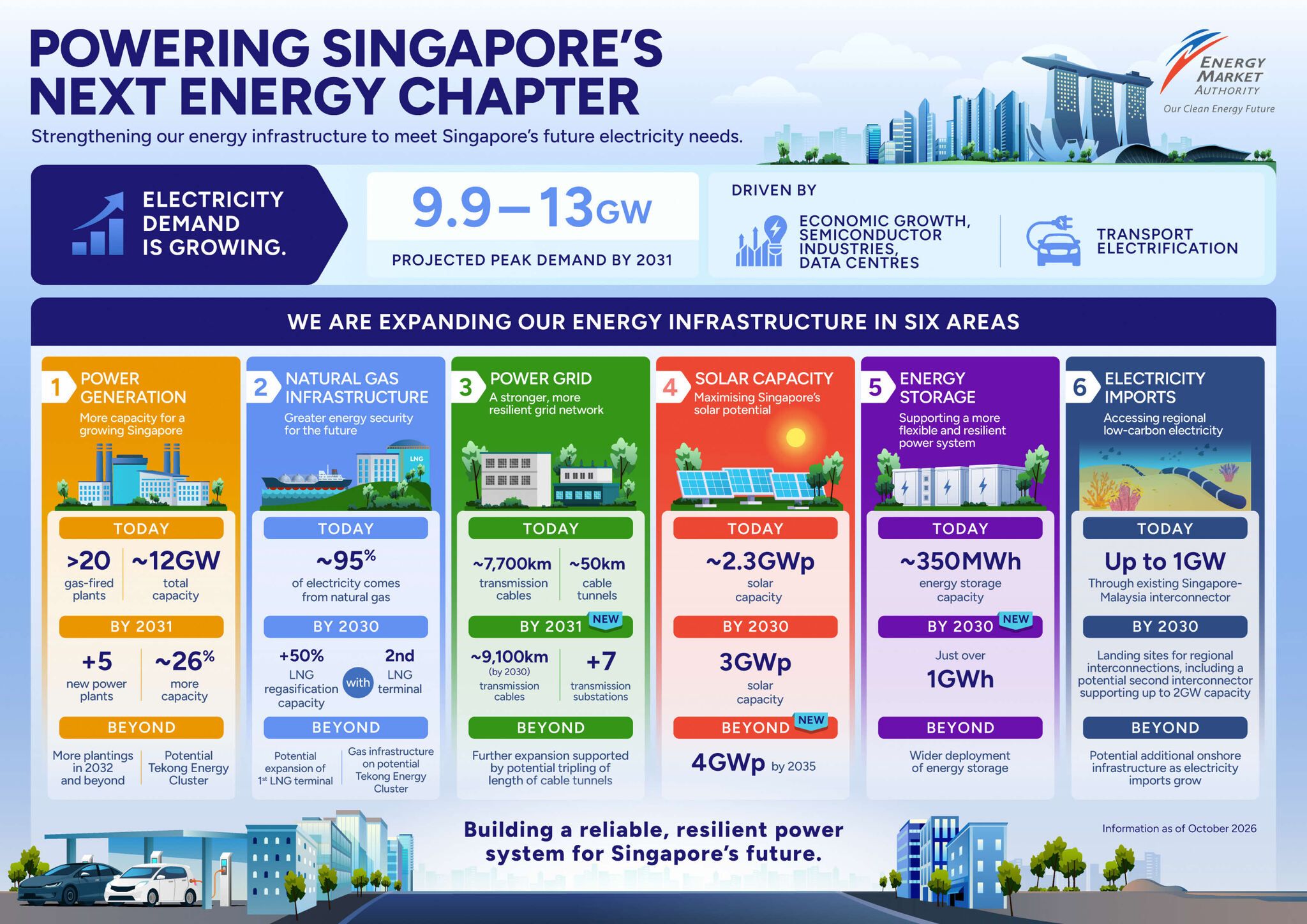
Five new natural gas-fired power plants will be operational between 2026 and 2031 to expand the electricity generation capacity by 26 per cent from around 12 GW today.
Since natural gas contributes around 95 per cent of Singapore’s electricity needs, the country will increase the LNG regasification capacity by 50 per cent from 10 million tonnes to 15 million tonnes per annum.
The second LNG terminal at Jurong Port, which will be operational by 2030.
The plan also outlined expansion of the grid to support industrial demand in areas like Changi, Pasir Ris and Paya Lebar with 7 new substations to be built by 2031.
Solar capacity will also be expanded with a target of 4 GWp by 2035 (2.3 GWp achieved today).
(Low) Carbon energy pathway
Tan noted that Singapore continues to push solar energy deployment as the most viable indigenous renewable energy source.
Under the Singapore Pilots for Energy and Enterprise Decarbonisation programme (SEED), Singapore is piloting next-generation solar panels in collaboration with EDP APAC and GCL Perovskite.
The project aimed to generate more solar energy using the same amount of space through higher-efficiency panels.z
Tan shared this as an example advancing low-carbon technologies through the $800 million Decarbonisation Grand Challenge.
He added that the challenge was accompanied by the launch of the Power Decarbonisation Funding Initiative, which will fund research in technologies that enable the decarbonisation of power and industry sectors.
While solar energy cannot meet more than 10 per cent of Singapore’s projected electricity demand in 2050, it should still be part of the energy mix alongside other low-carbon energy sources, noted Tan.
Nuclear energy was highlighted as a potential energy source, and Singapore’s energy sector must prepare for it.
METI and EMA launched three schemes to support this.
The new Nuclear Manpower Development Programme (NMDP) for the public sector targeted to facilitate capability-building partnerships between Singaporean public officers and global nuclear organisations.
The broader ecosystem would be supported with the Nuclear Manpower Development Programme (Industry; NMDP-I), aiming to provide opportunities for professionals in selected Singapore-based companies to gain experience with international partners.
The third scheme was the Singapore Future Energy Fellowship (SFEF), bringing in international energy leaders to provide strategic advice on Singapore’s long-term energy strategy, policy, and low-carbon technologies.
The first batch of Fellows with expertise in nuclear energy will be appointed this year, supporting Singapore’s efforts in preparing for the Integrated Nuclear Infrastructure Review (INIR) Mission in 2027.
Connectivity with the grid
Committed to progressing low-carbon electricity import projects, EMA awarded a Conditional Approval to Sembcorp Utilities to import up to 1.3GW of renewable electricity from and through Peninsular Malaysia to Singapore.
Tan also noted that Singapore has made significant improvements on the infrastructure front to enable electricity imports with Malaysia.
EMA and Energy Commission of Malaysia (Suruhanjaya Tenaga - ST) renewed their MOU to strengthen technical cooperation on planning and reliability of electricity and piped gas systems, implementation of cross-border electricity trading, and interconnection capacity, as well as regulatory exchanges and knowledge sharing.
“This [agreement] can facilitate greater renewable electricity trade, support investments in renewable energy projects, and advance a more interconnected regional power system,” said EMA’s Chief Executive, Puah Kok Keong.
While progress on energy imports was celebrated, Tan emphasised that import must “offer a viable and competitive price relative to other decarbonisation pathways, including the use of offsetting international carbon credits.”
As such, Singapore will continue to balance imports with the pace of regional collaboration and market conditions.
Keeping energy costs in check
“Decarbonisation will come with costs, but it must never come at the expense of our livelihoods and system security,” said Tan.
“We will continue to provide targeted support, including U-Save rebates to help households manage utility bills, as well as grants to help businesses improve energy efficiency and reduce costs, such as the Energy Efficiency Grant and Resource Efficiency Grant for Emissions.”
He noted that all the announcements were the result of building the foundations for a resilient energy chapter in Singapore’s story.
They ensure that the energy system continues to be a “source of confidence, harness energy to bolster our competitiveness, pursue low carbon energy pathways, and deepen connectivity with our partners, while keeping costs in check.”