The new urban planner doesn’t just build cities, but listens to them
Innovation in the public sector is a willingness to experiment, collaborate, and co-create with stakeholders in the community, says a spokesperson from Singapore’s Centre for Liveable Cities (CLC).
-1781246312328.jpg)
Innovation in governance isn’t only about tech but co-creation, says the CLC’s spokesperson, pointing to skills like design thinking, community engagement, and rapid prototyping for effective public sector work. Image: CLC's Building Community Resilience playbook
When residents of Yio Chu Kang, a neighbourhood in Singapore, were asked to help redesign their estate, they didn’t just answer a survey, then hand it back to the planner.
They shaped the urban planning process throughout.
Over 100 caregivers and community stakeholders gathered in workshops and focus groups, contributing more than 1,000 data points on how dementia affects daily life in their estate.
Prototypes were tested with the stakeholders, feedback was gathered, and adjustments were made quickly.
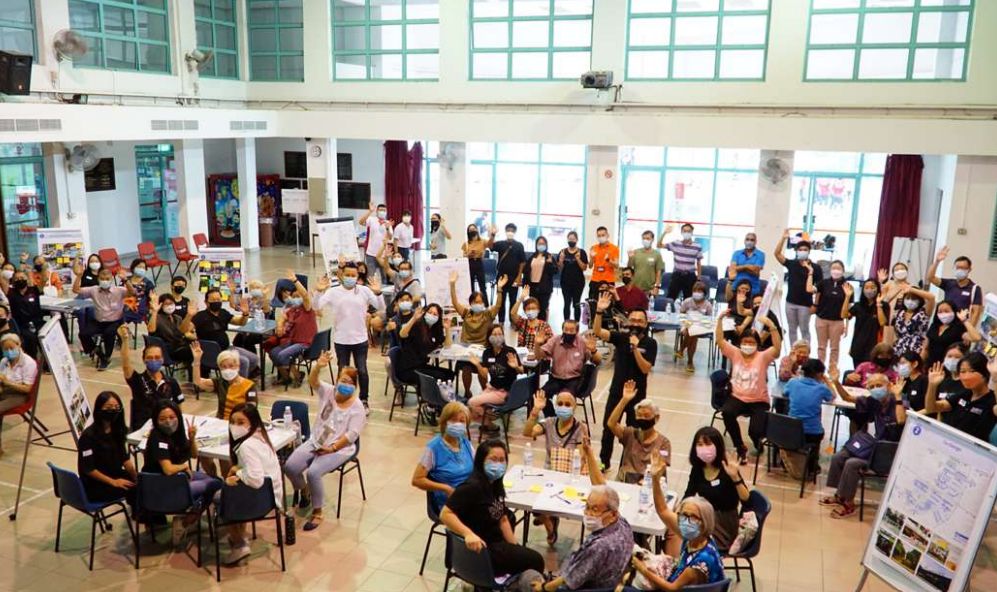
Compared to traditional planning methods, an iterative approach led to shorter implementation timelines, and new urban design interventions across the estate, including colour-coded blocks and rest points to support wayfinding.
More navigable streets were a visible benefit for residents. But underneath that was something much bigger: a new model of governance.
While Singapore has long been admired for its top-down precision, the question for urban planners today isn’t so much about what gets built, but who gets to shape it.
“A human-centric city is about putting people, their everyday experiences, needs, and aspirations, at the heart of how cities are planned and governed,” a spokesperson from the Centre for Liveable Cities (CLC) tells GovInsider.
That means going beyond efficient services or economic growth, but designing policies and infrastructure that improve the quality of life in citizens’ own terms and lived experiences, he adds.
CLC is a research think-tank jointly established by Singapore’s Ministry of National Development (MND) and the Ministry of Sustainability and the Environment (MSE).
Building the capacity to co-create
Innovation in governance isn’t only about technology but co-creation, says the CLC’s spokesperson, pointing to skills like design thinking, community engagement, and rapid prototyping for effective public sector work.
Referring to the Yio Chu Kang pilot, he explains how a successful partnership between public sector, academia and community looks like.
That is: Residents feeling empowered to shape their environment, researchers bringing about innovative solutions, and the public agencies demonstrating flexibility and openness to experimentation.
Reshaping urban governance starts with reshaping the public officer.
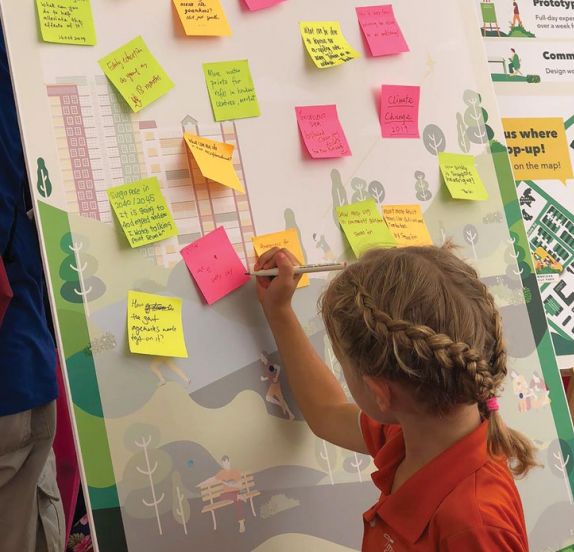
about climate change during a community
engagement. Image: CLC's Building Community Resilience playbook
“The role of the public officer is to connect national strategic goals with grassroots and community aspirations,” he says.
The CLC team has developed the Building Community Resilience playbook, serving as a toolkit for public officers to engage the community.
The toolkit contains approaches that officers can use for ground sensing in the early planning stages, through to co-creation and implementation.
Beyond a means to gather inputs, the crowdsourcing process also helps citizens understand the messy reality of planning.
The spokesperson also highlights that while communities often have the intention to act, they often lack the confidence to begin.
To close the gap, CLC also organises capacity-building workshops and peer-to-peer training.
“Having the right skillsets and knowledge will allow deeper and wider community participation, thereby encouraging the community’s sense of ownership, agency and action,” he notes.
How this looks like on the national scale
While the earlier pilot showed what co-creation looks like at the neighborhood level, Singapore has been testing what it looks like at the national scale.
As part of the Long-Term Plan Review in 2021, the Urban Redevelopment Authority (URA) engaged more than 15,000 people over one year to gather their ideas and aspirations to shape Singapore's land use strategies for the next 50 years and beyond.
More recently, URA conducted its “most extensive public engagement exercise to date” for its review of the Draft Master Plan 2025, according to the spokesperson.
The master plan serves as Singapore’s official land use blueprint for the next 10 to 15 years.
Over the two years, close to 220,000 people have participated through town halls, small group reviews, and mini exhibitions on proposed development plans.
The engagement ensures that the proposals reflect Singaporeans’ aspirations, and to balance national priorities with community interests, says the spokesperson.
CLC also refreshed Singapore’s liveability framework in 2024 since it was first developed in 2010.
Instead of choosing between outcomes, CLC sees liveability as a balancing act between a high quality of life, a competitive economy, and a sustainable environment.
Turning urban challenges into co-creation opportunities
In a dense urban environment, no challenge exists in isolation as the needs and priorities of different stakeholders intertwine.
“A purely functional approach may not yield the best outcome,” says the spokesperson.
For CLC, as the organiser of the biennial World Cities Summit (WCS), this complexity makes the case to leverage shared conversations and networks among diverse stakeholders across different cities.
-1781245998294.jpg)
A more open society, the spokesperson acknowledges, doesn't come without friction.
These challenges also create opportunities to strengthen collaboration with the community.
He cites the Our Coastal Conversation, a series of community dialogue sessions, facilitated by CLC, Public Utilities Board (PUB) and the Ministry of Culture, Community and Youth (MCCY), as an example.
As the starting point of a longer dialogue alongside actual planning, the engagement brought together residents, civil society, coastal business owners and industry leaders to discuss the risks around sea level rise and plans for coastal protection.
For public officers, the job today isn’t simply to plan and deliver, but to foster collaborative ecosystems to bridge national strategic goals with grassroot aspirations.