
The Philippines’ independent tower firms organise to gain direct access to regulators
What does it take to improve connectivity in a 7,600-island archipelago? For the government and the private sector, the answer is robust collaboration.

The Independent Tower Companies Association of the Philippines (ICTAP) was established to give the tower industry a unified voice and strengthen collaboration with policymakers to support a digital infrastructure ecosystem. Image: Anti-Red Tape Authority
The Philippines’ independent tower companies, which build and maintain wireless communication towers and passive infrastructure, have been dealing with government bureaucracies by themselves for years.
This is set to change.
On July 22, the firms launched the Independent Tower Companies Association of the Philippines (ICTAP), formalising what the industry wants to act as its bridge to policymakers.
This marks an important step for an archipelago working on connecting its over 7,600 islands digitally in the coming years.
“We will give the tower industry a unified voice, collaborate with the government in fairly forward-looking recommendations, and promote a sustainable business environment where reliable productivity leads to everything that we want,” said ICTAP Vice President, and Chief Commercial Officer at Frontier, Hendrik-Jan Kroon, during the association’s launch.
“By standing together, we ensure that our insights are valued, our challenges understood, and our contributions align with the nation's institutional goal,” he added.
The Department of Information and Communications Technology (DICT) recorded 9,632 registered independent tower companies in 2023.
Compared with neighbours in Southeast Asia, the Philippines lags behind one of the most important aspects of going digital, lacking the needed infrastructure to digitally connect its 112.73-million population.
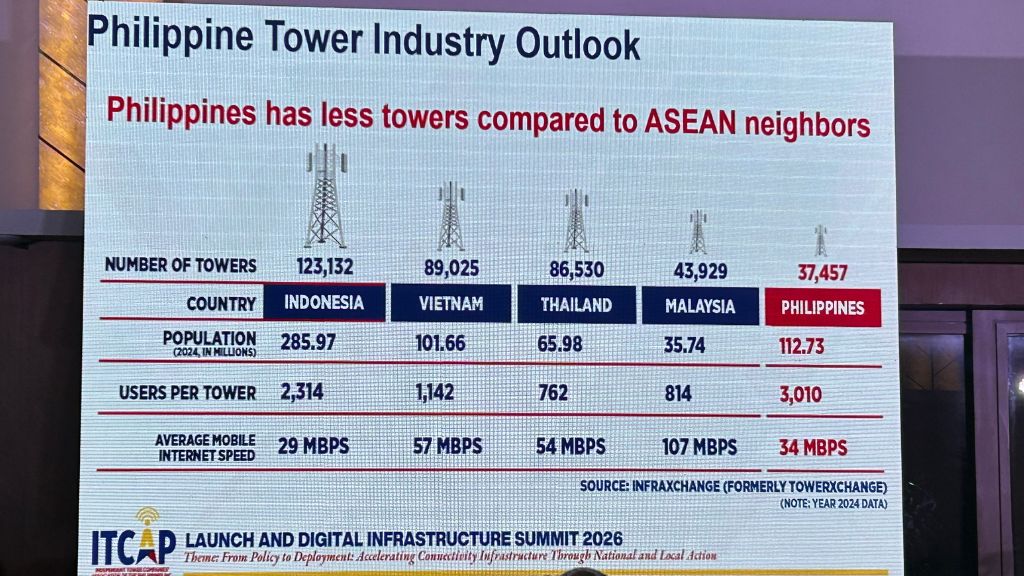
There are currently 37,457 towers across the country, with each tower serving 3,010 users at just the speed of 34 Mbps.
“We need at least another 50,000 to catch up with neighbouring countries such as Indonesia, Thailand, and Vietnam, in terms of network quality," Kroon said.
“The tower industry is committed to making this happen, which will require a new hub, resources, and capital in place.”
Reforms helped
The government has implemented a handful of reforms in recent years in order to make digital connectivity cheaper and more accessible to most Filipinos.
Amid the Covid-19 lockdown, the government streamlined the permit application process to construct telecommunication towers. In 2023, the country implemented Executive Order No. 32, which cut red tape by having cities create a one-stop shop for tower construction permits.
Anti-Red Tape Authority (ARTA)'s Director General Ernesto Perez said these developments cut paperwork for telco companies, who now needed just eight permits instead of the initial 13 and 35 documentary requirements from the previous 86.
Processing time fell to just over two weeks or 16 days from the initial 241-day application timeline.
The Department of Interior and Local Government noted that, as of July 10, 2026, cities and municipalities all over the country have approved over 12,000 telecommunications permits.
“Executive Order 32 [has] expanded fibre optic networks and cell towers by allowing projects to proceed within shorter processing periods,” said Perez.
“As permitting approvals increased, reliable internet reached schools, health facilities, and as telecommunications projects expanded, accessible reference materials also became indispensable for everyone involved.”
The ARTA has acted on complaints from private sector partners who have experienced delays in the processing of permits for towers.
For instance, Manila Electric Company (Meralco), the country’s largest power distributor, faced a three-year delay on one of their projects in Manila City after facing opposition from a local government chief.
However, with the ARTA’s intervention, the project was approved within 24 hours.
“I would like to tell you that you have to trust this government by simply opening up to us,” Perez said.
Need for open communication
It’s not an unusual experience for the private sector, wherein they come in with projects that abide by national standards but face issues with how the local government implements the law.
Some local governments still need assistance to capacitate their local officers to ensure that “policies are localised” when adapted.
The Department of Local and Interior Government (DILG), Bureau of Local Government Development's Director, Anna Liza Bonagua, said government units wear multiple hats, advocating for their communities while carrying the task of enforcing national laws.
There have been communities who expressed concern over alleged health risks related to the construction of telco towers.
“There is a need to inform, to instill awareness, even cooperation from the local communities," Bonagua said.
Bonagua has called on private sector partners to notify them in case they encounter local government units “deviating from the standards.”
“We cannot assure you of a uniform experience across local government units,” Bonagua said.
“But we have to call attention to some local government units that are lagging behind not just in terms of development but also in terms of compliance.”
While big cities in the metro such as Quezon City and Makati are able to keep up, she noted that some far-flung areas do not even have a business permit officer.
However, Bonagua remains thankful that the private sector is always flagging those who do not comply with national standards because for the industry, what matters is consistency.
“If the requirements are usually communicated and applied consistently, and they are coordinated across the different agencies… both local and government… this will improve the delivery of goods,” said Patrick Belicena, Chief Operating Officer of Unity Digital Infrastructure Inc.
“It will deliver connectivity to the community much faster,” he added.
The Independent Tower Companies Association of the Philippines sees the country’s gap as an opportunity. Telco companies have invested a combined P200 billion (S$4.2 billion) into constructing towers across the country.
PhilTower Chief Finance and Risk Officer Maida Bruce said the industry is expected to invest another P30 billion (S$631.56 million) in the next two to three years.
Apart from helping the national government effectively implement infrastructure policies through open feedback, the industry association wants to play a role in shaping rural connectivity and building disaster-ready infrastructure.
“Because of the association that we have right now, we do have a stronger voice,” ITCAP Spokesperson Kalvin Laurence Antonio Parpan said.
“This is a good opportunity for us also to be able to give a lot of information to a lot of our stakeholders who have to know what would be the importance of these infrastructures moving forward.”