
The Philippines made digital inclusion land by making communities co-own it
Referring to the Smart Villages and Smart Islands initiative in the Northern Midanao region, DICT Region 10’s Kenneth Asuncion says that isolated communities can become models of innovation and resilience through collaborative digital transformation.
Managing a partnership with more than 30 active organisations across multiple sectors and geographically isolated communities is no easy feat. Image: Canva
Announcing digital inclusion programmes is easy, but making sure its benefits reach the last mile is another matter altogether.
For the Philippines’ Department of Information and Communications Technology (DICT) in the Northern Mindanao region, last mile reach of these programmes is more of an ownership problem than one constrained by connectivity.
Women who once loaded sweet potatoes and coconuts in baskets to sell in the market can now confirm their sales online before leaving home, without risking unsold produce, the extra spending on fuel and the need for middlemen.

But this advantage did not appear automatically when internet coverage arrived. It came after digital literacy training built around each isolated community’s economic lives.
The harder work has also been in building the partnership machine to sustain transformative work.
“One of the most important lessons was creating shared accountability,” says DICT’s provincial officer for Misamis Occidental, Kenneth Asuncion, to GovInsider.
The ambition was to move partners, including government agencies, industry, and local communities, away from seeing themselves as donors or implementers to co-owners of a shared development agenda, he says.
“By joining more partners, the effort and resources required from DICT alone is less, but the impact is much higher,” he notes.
A holistic ecosystem is also a more self-sustaining one when everyone has a stake in it, he adds, underlining that “sustainable transformation cannot rely on once-off efforts.”
Asuncion shares more about the progress made with the Smart Villages and Smart Islands initiative that piloted for a year in three sites, and then scaled to other isolated areas in the Northern Mindanao region.
The initiative aims to advance inclusive digital transformation in most isolated areas of the country.
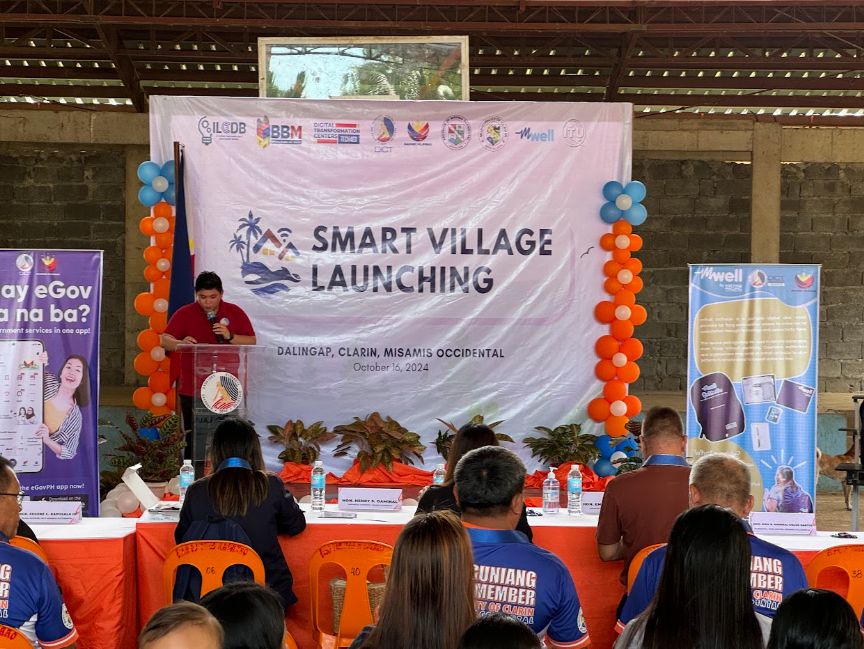
From 2024 to 2025, the initiative has been piloted in Munai, Dalingap, and Capihan.
The DICT Region 10 team provides internet access, engages multiple stakeholders to enable ICT activities, rolls out cybersecurity awareness and training programmes, leveraged ICT for public services and more.
The team clinched the “Special Mention” at the Festival of Innovation (FOI) awards this year for its efforts to scale innovation through radical collaboration.
Last mile starts with listening before delivering
While most digital inclusion programmes begin with infrastructure, the team begins by asking what the local communities actually need.
It’s an instinct partially shaped by Asuncion’s dual role, serving as both the IT officer and provincial officer.
In practice, this means moving between writing technical specifications to sitting across the table from multiple stakeholders as DICT's representative.
“This is what I like about my current role... It makes me understand both sides,” he says. The ability to hold the technical and human aspects simultaneously is what community-centred design requires.

Instead of arriving with pre-determined solutions, his team studies each community’s economic activities, literacy levels and barriers keeping them outside the economy, and then design the programmes based on grassroots’ needs.
In 2025, his team supported 127 ICT-enabled activities of partners and stakeholders.
Regional digital competitions and innovation activities also brought in a further 2,400 participants, with youths and professionals developing digital skills and creativity.
This ensures that internet coverage translates into development outcomes.
“We sometimes allow the communities to participate in the planning and consultation process,” he adds.
At one pilot site, parents flagged concerns about children's screen time during a community consultation, and the team responded by introducing a connectivity curfew by cutting free Wi-Fi at 9pm and resuming at 5am.
In June, the team will also introduced the LAKIP (Localised Accessible Knowledge and Inclusive Platform) to the province.
The online learning platform offers self-paced ICT learning modules translated entirely into the local dialect, Visayan.
From donors to co-owners
Managing a partnership with more than 30 active organisations across multiple sectors and geographically isolated communities is no easy feat.
According to Asuncion, his team works with the MAGIC framework, known as “Making academia, government and industry collaborate.”
What makes the framework work is not the breadth of partners but the clarity of roles.
Academic institutions help validate the course curriculum and act as knowledge partners during training programmes, while industry partners bring equipment and platforms that government budgets alone cannot sustain.
For example, mWell, a Philippines-based digital health and wellness app, supplies the team with eTelemedicine kits that allow residents to consult with licensed doctors remotely without leaving their communities.
In 2025, telemedicine services saved the community over US$715 (S$914 million) in travel and medical costs, which is considered a significant amount for the local community.
Local government units contribute to mobility, logistical reach, and on-the-ground resources to deliver the programmes effectively.
The same year saw the team facilitating over 58,000 eLGU (electronic local government unit) transactions in the province, leading to reduced turnaround time, improved citizen experience, and more streamlined government processes.
“We have to find partners that share the same values,” says Asuncion, adding that formal coordination mechanisms like regular reporting, technical consultations, and alignment with the central government’s DICT remain necessary.
“And we make sure that roles are distributed in an equitable manner, so that everyone feels a sense of ownership in the programme,” he notes.
The patience and time needed to build the commitment, he says, is worth it.
When partners are invested in outcomes rather than merely fulfilling a contractual obligation, the programme gains resilience.
POC to replicable model
Asuncion shares that the programme’s expansion to Lanao del Norte and Bukidnon is underway.
Additionally, his team has been involved in rolling out Child Safe Thursdays, signalling that the digital ecosystem now goes beyond access and skills to cover safety.
The team would visit local schools and communities to raise awareness to children and students on fighting online sexual abuse and exploitation.
“Isolated communities can become models of innovation, inclusion and resilience through collaborative digital transformation,” he says.
The team didn’t pick its pilot communities at random within the province.
It went looking for the hardest cases, what the country formally calls “geographically isolated and disadvantaged areas (GIDAs)”, referring to places with limited connectivity and no experience with digital tools.
“The initiative was designed to respond to the actual needs of the people and transform these communities to become more productive and have a chance to function in the bigger economy,” he says.
You can read other articles covering DICT Philippines here in our digital government directory.