
The Philippines maps its indigenous peoples' data to protect their seat at the table
The National Commission on Indigenous Peoples (NCIP) shares how the Data Repository on Indigenous Peoples (DRIP) connects numbers to policy, ultimately helping the agency deliver more impactful support to indigenous communities.
-1784625741829.jpg)
NCIP's DRIP clinched a "Special Mention" at GovInsider's Festival of Innovation (FOI) 2026 awards for the "Digital Government" category earlier this year. Image: GovInsider
What good are human rights if no one can prove they're being upheld?
Since 1997, the Philippines has had its legislation, known as the Indigenous Peoples' Rights Act (IPRA), guaranteeing its indigenous communities four bundles of rights over their ancestral domains, self-governance, social justice and cultural integrity.
-1784625794606.jpg)
Acting on that mandate depends on data collected by the National Commission on Indigenous Peoples (NCIP). But that data was scattered across community, provincial, regional, and central offices, with no single view of the whole picture.
Launched last December, the Data Repository on Indigenous Peoples (DRIP) has been built to close that gap.
Structured around the same four bundles of rights laid down in the 1997 legislation, DRIP gives NCIP a way to finally ask if the indigenous people's rights are being upheld, or are only written down?
NCIP's DRIP clinched a "Special Mention" at GovInsider's Festival of Innovation (FOI) 2026 awards for the "Digital Government" category earlier this year.
We speak to NCIP's policy and planning division chief, Alvin Benedict D. Del Castillo, and ICT division chief, Raychelou T. Valencia, to find out how DRIP is doing more than just centralise that data to surface policy gaps in indigenous representation.
Ancestral domains at the heart
When NCIP's technical team sat down to design DRIP, they started with the law itself as their blueprint.
The system currently organises data around the four rights, then breaking each one down into the specific programmes and data sources the agency already holds.
It was key for the team to get the foundations right by adopting the "indigenous peoples' lens," as Castillo calls it.
"The system would then adhere to the cultural context and reflect the different nuances of indigenous communities here in the Philippines," he says, emphasising the 1997 law, guaranteeing those rights, forming the backbone that DRIP has been built to uphold.
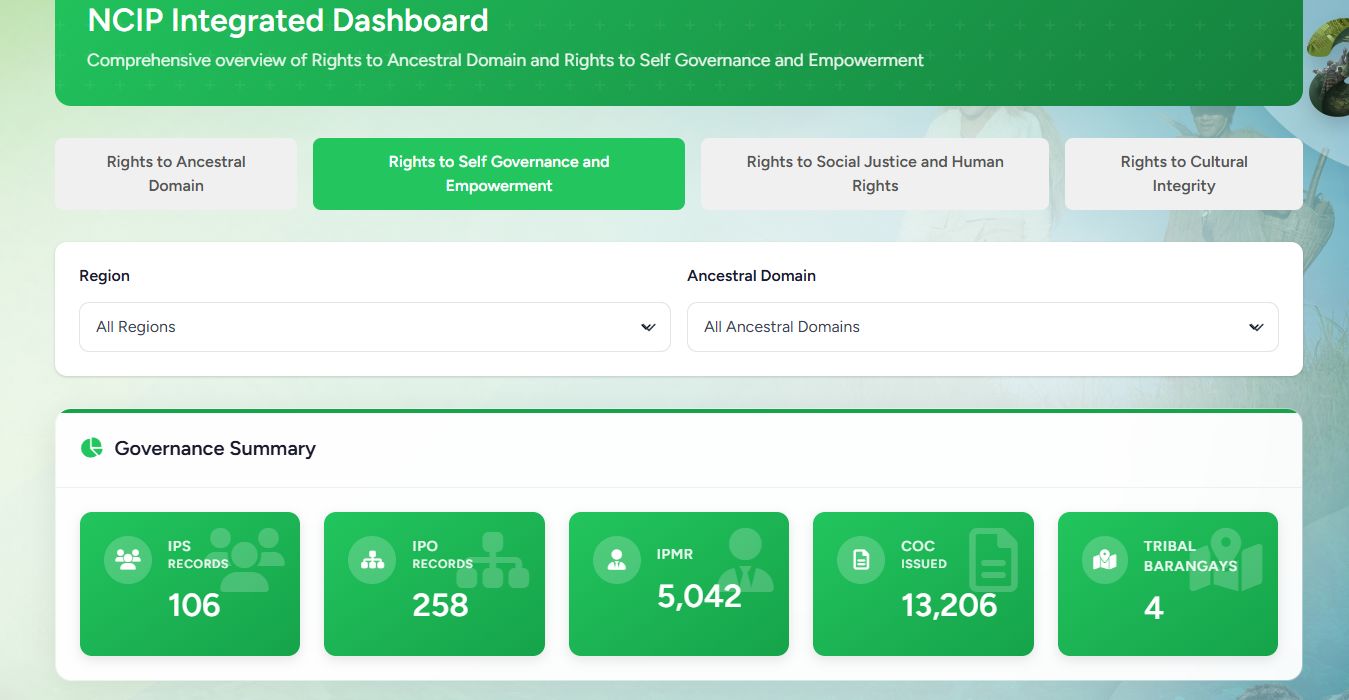
The lenses show up most clearly when the team decides to put ancestral domains as the first module in DRIP.
Unlike administrative boundaries, ancestral domains carry the identity of indigenous people, says Castillo.
"The ancestral domains become the living locus... [where] indigenous knowledge systems and practices are developed," he explains, drawing on a field visit he made with Valencia where they witnessed how attuned indigenous elders were to the knowledge of their lands.
The land is also where outside interests intersect with indigenous life, as government-backed investments like geothermal plants and mining often move into these domains.
DRIP now maps these projects against the domains, alongside data on land titles, whether the community has given its consent, whether it has received the benefits promised, and if the domains have a sustainable development plan in place.
Being able to layer other types of data on top of the ancestral domain allows the team to identify policy gaps, investigate the lapses, and advocate for policy interventions in specific domains.
Why are they not seated?
While the law requires every indigenous community to have a mandatory representative at the local government level, NCIP, prior to the DRIP system, had no reliable way to see how many of those seats were filled.
Some seats existed on paper but have no representative holding them, while others have a representative in name only without any real functions.
Now, "we could finally assess why it is so and ask the question 'why are they not seated?'", says Castillo.
"From the numbers, we could then tell the stories, relate back to the policy environments to see how the team can be more effective in serving our indigenous communities," he says.
In the case of the local representatives, it could mean intervening in how the representatives are selected, and what support they are given once in the role.
When NCIP defends its budget before Congress every July, what once required chasing regional offices one by one is now available "at one press of a button," says Castillo.
"It's an instant way of getting the numbers, which is especially needed when we need to justify budget proposals and policymaking," he adds.
Making the numbers work harder
For the team, the repository doesn't just serve as a record of what already has happened but surfaces the questions that they can answer and do something about it.
Castillo points to one correlation the team is eager to dig into, which is that areas with fewer seated indigenous representatives also tend to report higher poverty incidence.
His team plans to formalise this kind of analysis into policy briefs and research outputs.
The research ambition also comes with an open door, as his team wants to make DRIP a resource for students and academics who already approach NCIP to study indigenous communities.
Valencia notes that DRIP can leverage open application programming interfaces (APIs) to seamlessly connect with NCIP's internal systems.
The team also sees strong potential for NCIP’s data to integrate with the country's broader disaster mitigation framework, which would be a crucial step given the vulnerability of indigenous lands.
Building on this momentum, Valencia mentions ongoing discussions with other government bodies, such as the Department of Education (DepEd) and the National Economic and Development Authority (NEDA), who are interested in learning how DRIP was developed.
The human side of the technical architecture
Trained to think in programming logic and process flows, Valencia admits that building DRIP meant starting somewhere else entirely, which was the law.
"We really need to understand the IPRA law and read all the related policies here in NCIP," she says, adding that her team now understands the agency's mandate more than ever before they built the DRIP system.
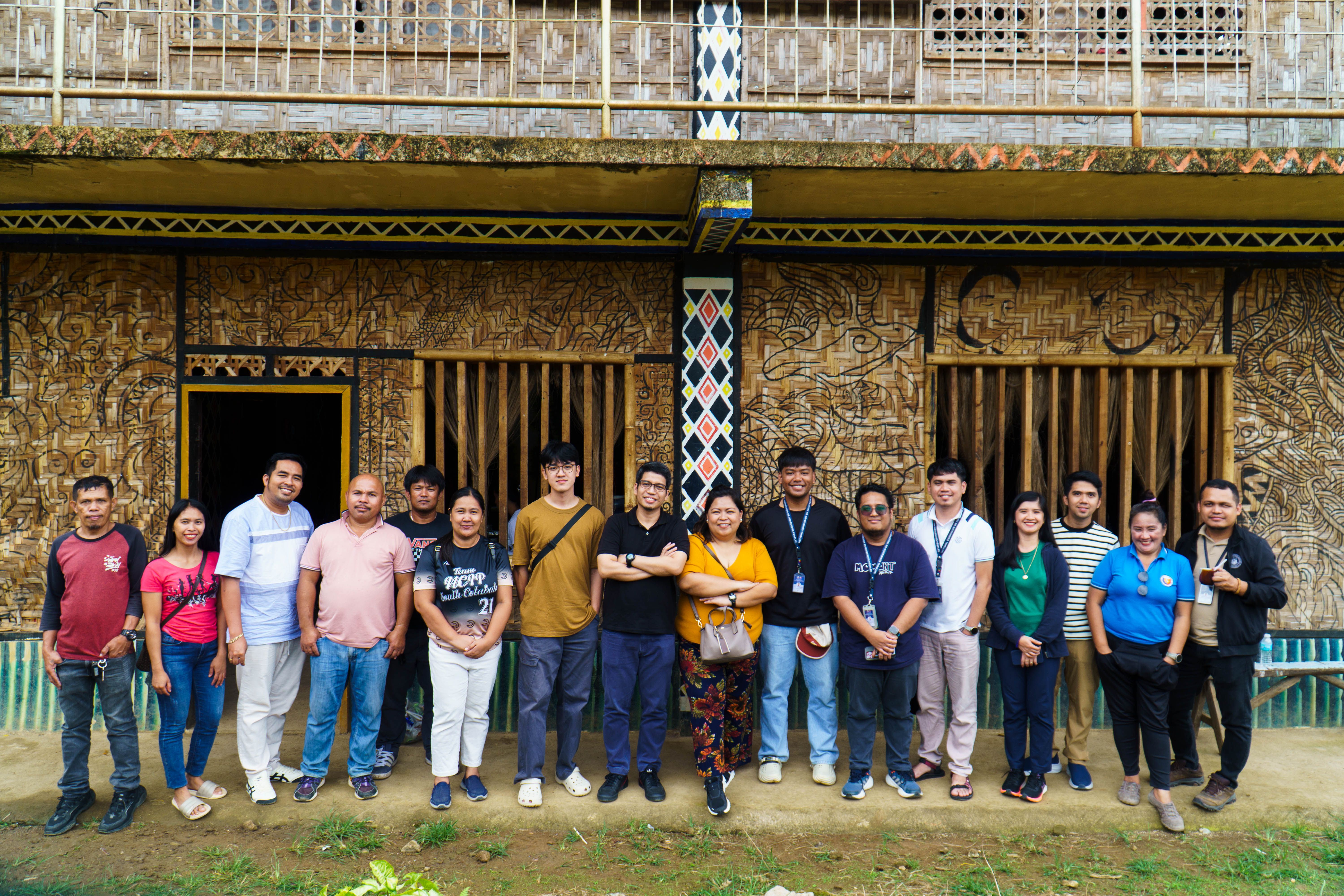
Castillo highlights a real risk for any agency when embarking on a tech project to be "confined to the logic of the system" and losing sight of "the humane side of the agency."
His advice is to design systems that tackle the needs of the people it serves, including both the indigenous people and agency staff.
Highlighting that earlier on during DRIP's rollout, the agency's staff worried that this meant extra work stacked onto their already heavy caseloads.
His team aims to make DRIP's value visible, by showing offices how DRIP could cut down on manual coordination and back their work with better evidence.
The answer to providing whether a right is being upheld may not be in the database alone, but through the public officers who took the time to understand what those rights meant and their agency's mandate to uphold these rights.