Three ways that Singapore is clearing the path for decarbonisation
By James Yau
Singapore International Energy Week 2025 (SIEW), the annual convention of energy professionals and policymakers, provided key updates around high-integrity carbon markets, cross-border cooperations, and common frameworks.
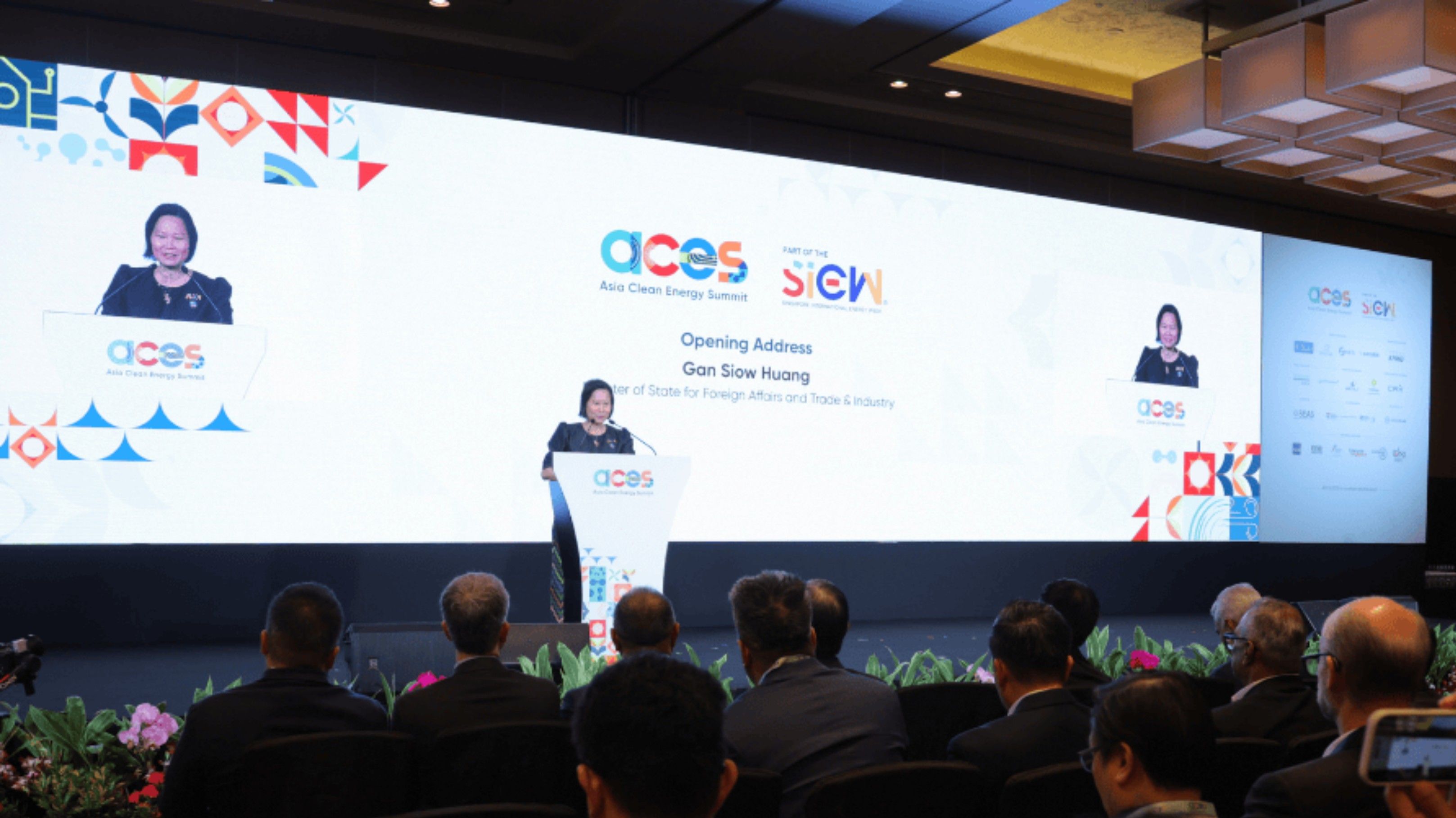
Minister of State for Foreign Affairs and Trade & Industry Gan Siow Huang called for stronger regional connectivity to accelerate ASEAN's shared clean energy transition. Image: SIEW 2025
Governments must create “facilitative environments” for companies to pursue decarbonisation pathways and achieve net-zero ambitions.
This was the key takeaway from Singapore’s Minister of State for Foreign Affairs and Trade & Industry Gan Siow Huang’s opening address at the Asia Clean Energy Summit on October 28.
With global climate ambition under pressure, Singapore's partnerships with like-minded partners are more important than ever before, she says.
She emphasised the importance of ASEAN to continue to collaborate on the regional power grid, capacity building and public-private partnerships to achieve a more resilient, sustainable and inclusive energy future for Southeast Asia.
The Asia Clean Energy Summit from October 28-30 provided a platform for regional energy leaders to collaborate on challenges and opportunities for harnessing clean energy.
The summit is held as part of the Singapore International Energy Week (SIEW) 2025 organised by the Singapore’s Energy Market Authority (EMA).
GovInsider highlights three key initiatives announced by the Singapore government to accelerate the clean energy transition.
To subscribe to the GovInsider bulletin, click here.
1. Adopt a multi-agency approach to strengthen carbon markets
Carbon markets are a critical enabler for the global transition to net-zero, by channelling capital towards climate action.
However, the growth of carbon markets has been constrained by weak demand, limited supply of high-integrity projects and underdeveloped market infrastructure.
To address these gaps, the National Climate Change Secretariat (NCCS), Ministry of Trade and Industry (MTI), Enterprise Singapore (EnterpriseSG) and Monetary Authority of Singapore (MAS) have announced respective initiatives to support the development of high-integrity carbon markets.
These include the published voluntary carbon market (VCM) guidance document and the introduction of a new Financial Sector Carbon Market Development Grant.
Developed with the Singapore Sustainable Finance Association (SSFA), the VCM provides guidance on how companies can use carbon credits as part of their decarbonisation plans.
The live document spells out key mechanisms like the use of carbon credits and will be updated as new information becomes available. More information would be shared in 2026.
MAS has set aside S$15 million over 2025-2028 for the Financial Sector Carbon Market Development Grant to support financial institutions’ participation in carbon markets.
The grant is designed to boost financial sector participation in high-integrity carbon markets by helping Singapore-based financial institutions develop the necessary skills, expertise and solutions.
The scheme comprises two tracks of support: “Building carbon market capabilities” and “catalysing innovative financing solutions and platforms”, with specified focus areas and support.
Applications for the grant will open on November 1 and the eligibility requirements can be found here.
2. Standardise tracking for cross-border renewable energy certificates
MTI and EMA would team up with International Tracking Standard Foundation (I-TRACK Foundation), a non-profit organisation that sets standards for attribute tracking systems, to create a framework for Cross-Border Renewable Energy Certificates (RECs) that is tailored to Southeast Asia.
RECs are used to track renewable energy and their environmental attributes across borders but faces complexity due to different government regulations in Southeast Asia.
The framework standardises the mechanisms for tracking and accounting cross-border RECs in three ways: by specifying how to track the physical electricity flow and the RECs; by identifying permitted REC registries and instruments for trading; and by setting the approach for calculating the residual mix.
When completed, the Framework will provide a template for user countries to account for the RECs associated with cross-border electricity trading.
This framework also complemented ongoing efforts by the ASEAN Centre of Energy to develop an ASEAN regional REC framework by 2027.
“The Initiation of the ASEAN Renewable Energy Certificate Framework was part of the Annual Priority on Energy under Malaysia’s ASEAN Chairmanship 2025.
“The initiation aims to establish a harmonised and credible regional system to advance renewable energy deployment and facilitates cross-border exchange of renewable electricity under the ASEAN Power Grid,” said ASEAN Centre of Energy’s Executive Director, Dato’ Ir. Ts. Razib Dawood.
3. Strengthen global cooperations to boost energy security
The SIEW 2025 agenda also included the historic moment of the International Energy Agency (IEA) Governing Board holding its meeting in Asia for the very first time.
The IEA, which provides authoritative analysis, data, policy recommendations and solutions, used the occasion to reinforce its partnership with Singapore. IEA specifically reaffirmed the need to strengthen cooperation on regional energy interconnectivity and its crucial links to energy security.
Last year, IEA launched the Singapore-IEA Regional Cooperation in Singapore, which was its office outside its Paris headquarters.
Minister-in-Charge of Science and Energy & Technology Dr Tan See Leng in his opening remarks at the Singapore-IEA Forum pointed to the clear “win-win” benefits of cross-border electricity trade.
He noted that the IEA expects electricity costs in Southeast Asia to drop significantly, from US$120/MWh (S$155/MWh) today to about US$80/MWh by 2050. This major saving is made possible because countries will be using more affordable renewable energy sources.
He highlighted that the ASEAN Power Grid (APG) is the key to this, enabling countries to trade energy, build capacity, and make electricity more affordable regionally.
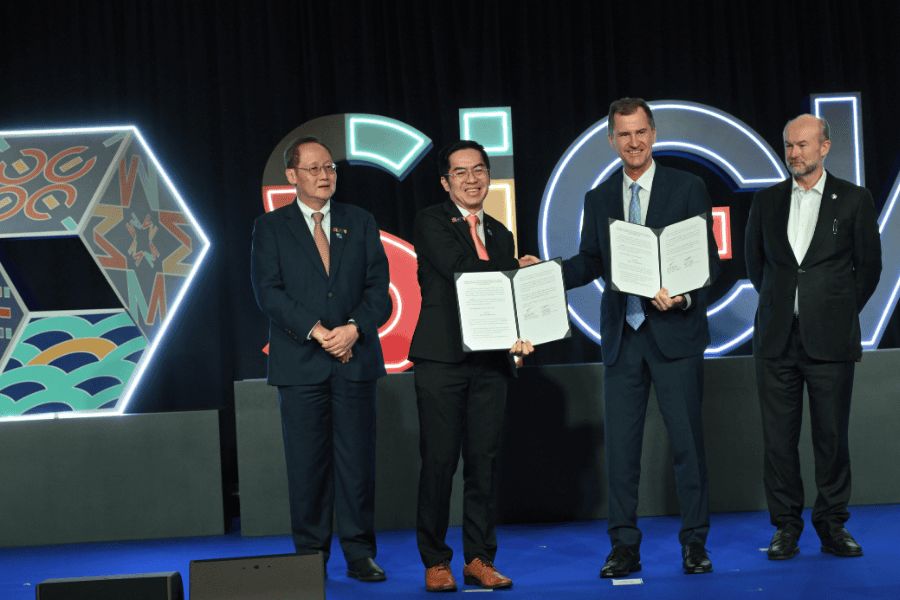
The forum also witnessed a Memorandum of Understanding (MoU) signing between EMA and the Australian Energy Regulator.
The MoU establishes a structure for EMA and AER to cooperate and share best practices regarding gas and electricity market regulation.
This cooperation will involve sharing knowledge and experience, offering training and exchange programmes, and conducting regular dialogues between the two agencies.
IEA Executive Director Fatih Birol also reinforced the region’s importance, stating that Southeast Asia is vital to the world's energy future.
Because of current policies, the region's energy demand, which has already shot up by 80 per cent, is predicted to drive one-quarter of the world's new energy demand growth through 2050, second to India.