
Titikorn Tantawutho, Unmanned Aerial Vehicle Pilot, Defense Technology Institute (DTI), Thailand
By Sol Gonzalez
Meet the young public sector officials in the inaugural Young & Official Report 2026.
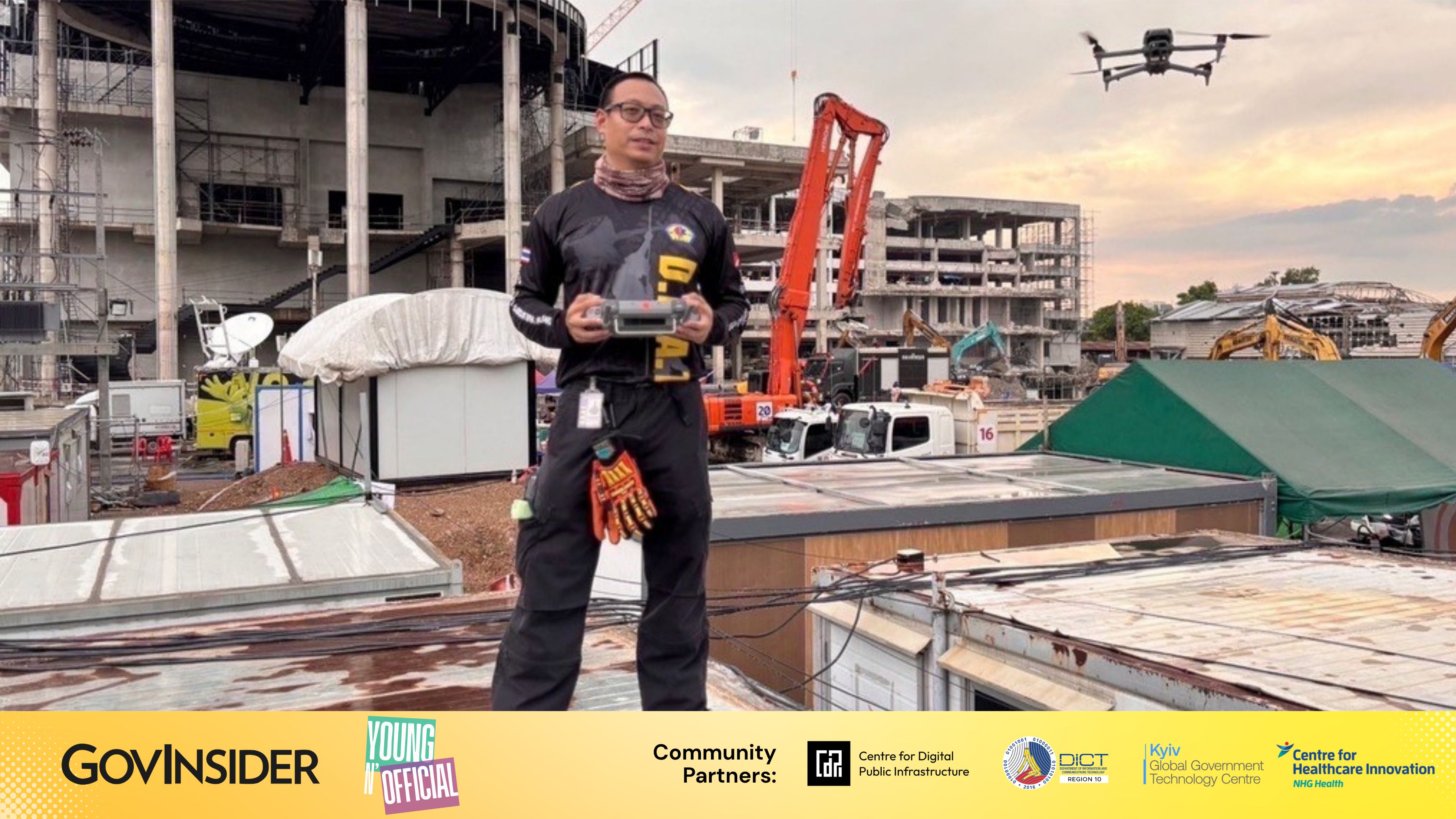
Titikorn Tantawutho, Unmanned Aerial Vehicle Pilot, Defense Technology Institute (DTI), Thailand. Image: Titikorn Tantawutho
1) What does public service mean to you? Can you share more about your role in the public sector?
The meaning of public service for me is using specialised skills in a way that strengthens the state’s ability to protect the people, to respond and to serve the national sovereignty.
I work at the intertwined unmanned aircraft systems (UAS), research and development, and training domain.
My role is not only to operate training courses and instruct trainees but also to build readiness of drone safety standard so that these capabilities can be relied upon when missions become complex, urgent or at high stakes.
Accordingly, public service holds my responsibility to stay prepared, act with discipline and use my skills to create real values for the Thai people, to hold on to mission outcomes, and to attain public confidence.
2) Tell us about a project you championed. What impact did it have on the community?
One area I have consistently championed is transforming unmanned aircraft systems from a training capability into a real public mission tool.
My involvement has extended to critical situations such as search and rescue operation at the earthquake-collapsed site in Bangkok, delivering survival kits to flood-affected in Southern Thailand, assessing fire-damaged structure and inspecting oiled pipeline leaks in Eastern Thailand.
By focusing on instructions, safety disciplines and operational readiness, I have played a role in ensuring that drone capabilities effectively support emergency responses and operations where timely aerial awareness is critical.
During crises, this preparedness has empowered teams to assess conditions more safely, reduce uncertainties and make faster, better-informed decisions. For me, the true significance of technology does not lie in the machinery itself but in its capacity to enable people to act with greater clarity, safety and purposes.
3) As a young professional, how has your unique background or perspective allowed you to identify a solution that others in your organisations might have overlooked?
My background is a mixed engineering, art, and information technology one. For that reason, I do not see drones as just aircraft. I see within them the system of people, communications, data, disciplines and trust.
The attention goes to equipment in many organisations naturally while the human and procedural sides are underestimated. I have often tried to bridge the gap by focusing on solutions that are not only technically feasible but also trainable, dependable and safe under real operational pressure.
In public service, technology is only meaningful when people can rely on it in time of high stakes.
4) What is your personal strategy for maintaining your creative energy when faced with bureaucracy?
I maintain my creative energy by staying close to the mission. Bureaucracy becomes easier to handle when I stop asking why a change is slow and start asking what can still be improved today within the system.
I focus on practical progress whether by improving a training step, clarifying a safety process or helping teams to coordinate more effectively.
Also, I keep reminding myself that the long-lasting change in public service often comes through persistence rather than speed.
Creativity in government is not only about having new ideas. It is about moving good ideas forward responsibly without losing trust, disciplines or accountability.
5) If you had just one area to invest in to accelerate transformation in the public sector (regulation, technology, talent, etc.), which one would you choose and why?
I would invest in talents. Although technologies are powerful and important matters, they do not transform organisations by their own. Human beings do and drive them. The real difference comes from whether teams have the judgment, ethics, discipline and confidence to use technologies responsibly and effectively.
Strong talents create a multiplying effect where capable people improve processes, adapt to change, strengthen collaboration and turn ideas into sustainable outcomes.
Especially in safety related work, human capability matters even far more than hardware.
When you invest in people who can keep learning and serving with integrity, transformation becomes more resilient and more meaningful.
6) What is your greatest ambition as you grow in your public service career?
My greatest ambition is to support building a public sector that becomes more prepared, more resilient and more trusted so that its public service can involve modern tools responsibly.
I aim to contribute not only through operations but also helping to shape people and systems that will outlast any one individual. If I can help the public through strengthening readiness, improving safe cultures and supporting missions that protect lives and serve societies, I will consider that a meaningful career.
I aspire to be recognised not just for my technical expertise but also for judgment, composure and unwavering especially when the stakes are at the highest.
7) What is a “universal value” that connects everyone in your department – from interns to directors – and how do you use that to drive collaboration?
A universal value that connects everyone in our work is responsibility. Regardless of our roles or experiences, we all understand that our decisions have a direct impact on safety, trust and mission success.
A shared sense of responsibility encourages individuals to look beyond hierarchy and to focus on the task. I try to reinforce that by helping to remind teams that every role is indispensable whether in planning, training, operating or supporting.
When individuals understand that their efforts contribute to a purpose greater than themselves, collaboration becomes more natural.
Responsibility creates common ground which enhances collaboration and coordination.
8) What is the best piece of advice you’ve got for the next generation of public servants?
The best advice for the next generation of public servants is to prioritise being useful over trying to appear impressive and to respond to the needs of community, social, nation and the world over an individual.
Public service is not defined by having the most prominent voice or the most noticeable position, it is rather focused on becoming the kind of person who can be relied on when tasks are challenging, highly technical, time-sensitive or unpredictable.
Learn deeply, stay humble and follow disciplines behind the mission. Credibility is established over time through consistent actions and behaviours. When people trust you to perform under pressure, your influence will resonate far more than any title ever could.
9) What is a myth you wish to debunk about young public servants?
The one myth is that young public servants prioritise speed and technologies while neglecting the importance of organisational disciplines and transparency.
Many young officers respect structures deeply. We should also aim for systems to be more practical, responsive and aligned with real-world needs.
Our intention is not to undermine the core values of public service. Our goal is to make those values more effective in a fast-changing world.
Young professionals should contribute urgency, adaptability and new ideas to public service while still honouring responsibility and collaboration in the service.
10) Write a letter to your future self in 2035.
Dear future me,
I hope that by 2035, you have not become too comfortable to listen, too senior to learn or too distant from the field to remember why you started.
I hope you still believe that public service is not measured by rank but by responsibility and impact on individuals and communities.
If you have gained more experience, use it to help others. If you have earned trust, protect it with humility. If you are leading teams, never forget the pressure, uncertainties and efforts weighing on people in the front lines.
Stay close to real work, real risks and real communities. Do not let technologies become an end in themselves. Keep using them as a tool to improve safety, readiness, and service.
Continue to value disciplines but never lose compassion. Continue to pursue excellence but never lose your sense of duties.
Most importantly, remain the kind of public servant who is still willing to step forward when the work is difficult and the outcome matters.
Keep serving with courage, purposes and transparency.