
To digitalise government services, flexibility and agile teams are a must
Nusantara Capital Authority’s Senior Advisor, Daniel Oscar Baskoro, shares how to combine cutting-edge technology with agile teams to develop Indonesia’s digital public services.
-1757473586709.jpg)
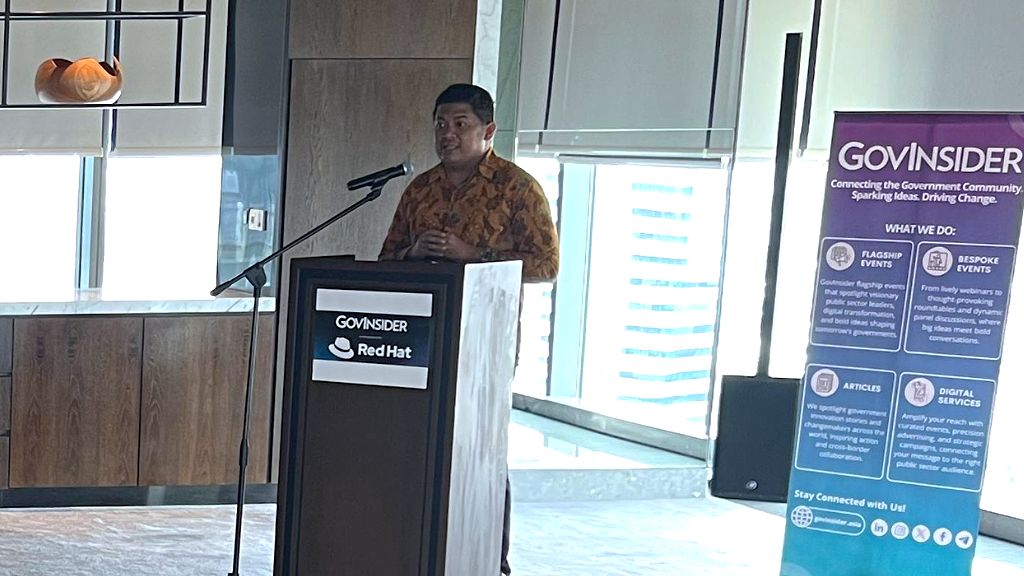
Indonesia Nusantara Capital Authority's Senior Advisor, Oscar Baskoro, shared his experiences in developing government digital services. Image: GovInsider
Nusantara Capital Authority’s (IKN) Senior Advisor, Oscar Baskoro, has a colourful way of describing his role in developing digital government services: “If someone builds the physical structure, I build in the skies”. [By “skies” Baskoro meant in the cloud.]
Baskoro notes that government agencies often get caught up in targets, such as the number of users or the type of technology being used, when building out digital services.
In reality, the challenge is far more complex, he said, adding: “Iterative processes and bureaucratic flexibility are essential yet often overlooked”.
Speaking on August 28 during the government keynote session at the Red Hat and GovInsider Public Sector Leader Roundtable event titled Realising Golden Indonesia Vision 2045 with Hybrid Cloud in Jakarta, Baskoro shared his experiences with fellow civil servants on how to manage nationwide apps and build digital infrastructure for the new capital of Indonesia.
Scalable public services
According to him, combining on-premises infrastructure with hybrid cloud was one of the most critical elements in government.
Before joining IKN, Baskoro was part of the development team for the PeduliLindungi app at the Ministry of Health. The app has since been incorporated into SATUSEHAT app.
PeduliLindungi was the contact-tracing app that became the backbone of Indonesia’s digital health response during the Covid-19 pandemic.
Talking about the app Baskoro noted that once PeduliLindungi reached millions of users, a scalability challenge became inevitable. That challenge could not be resolved simply by relying on on-prem infrastructure.
“When the app was used by five million users, it was still stable. When it reached 10 million, we felt proud, although the system began slowing down. By the time it hit 50 million, the system could not handle it,” he recalled.
The solution was to move to a hybrid cloud, with sensitive data still managed on-prem, while mass services were fully migrated to the cloud.
“PeduliLindungi once handled up to 10 million transactions a day. That was likely the largest transaction volume of any centralised government service in Indonesia,” said Oscar, adding that the team started with just 20 members before expanding to 250 in line with the strong push for digitalisation in the healthcare sector.
To subscribe to the GovInsider bulletin, click here.
Leading smart city implementation
At IKN, Baskoro now leads a 150-person team in developing the smart city concept for Nusantara, which included sensor-based surveillance and monitoring systems, CCTV, and an integrated app for residents and visitors called IKNOW.
He noted that his team used hybrid cloud for data analytics powered by artificial intelligence (AI). IKN also used edge computing, which enabled real-time analysis of data without sending it to the cloud. As a result, system responses were faster and more efficient.
Highlighting AI implementation as a buzzword in government, he stated that AI must not stop at gimmicks or short demos but truly deliver tangible benefits for citizens.
“AI can indeed answer our questions. But are those answers accurate, and how fast are they delivered? How can AI performance truly satisfy users?” He asked.
Baskoro gave an example: “If AI is asked about the weather in a specific district but responds with general city-level data and it takes more than one minute; users will be disappointed.”
Before developing an AI model, it was important to consider what benefits it would bring, how it would perform, and what kind of user experience would be delivered, he added.
Open-source flexibility
Baskoro acknowledged that Indonesia’s digital landscape was heavily influenced by budgetary policies set by the central government. This impacted how digital government projects were planned and developed, often resulting in limited flexibility.
In situations where government spending was constrained, service sustainability became uncertain and would ultimately leave users at risk, he added.
He believed that adopting open-source platforms could be an option to bridge the demands of digitalisation while ensuring the sustainability of government digital projects.
In addition to being flexible and customisable, open platforms also protect governments from vendor lock-in, he added.
“Platforms like OpenShift, or solutions from other providers, could ensure smooth transitions from on-prem to cloud without sacrificing user experience,” he said, while adding that he was not endorsing any particular product.
Human resources as the foundation
While technology is vital to digital transformation, Baskoro believed the true foundation lay in developing human resources.
To this end, he applied the agile squad model so that tech staff could focus on core competencies rather than being bogged down in bureaucracy. These teams were specifically tasked with designing concepts, experimenting, and developing products that citizens need.
“Too often, government IT staff end up busy drafting paperwork, when in fact they should be focusing on digitalisation,” he said.
For Baskoro, human resource development was not only about technical skills but also about organisational strategy. He likened it to a football team: even with 11 talented players and an excellent coach, the team would not win, without a solid strategy.