
Two months of prototyping turned good intentions into inclusive services
GovTech Singapore’s first inclusive challenge saw 17 prototypes built by public officers and students to tackle common accessibility challenges faced by people with disabilities, seniors and caregivers.
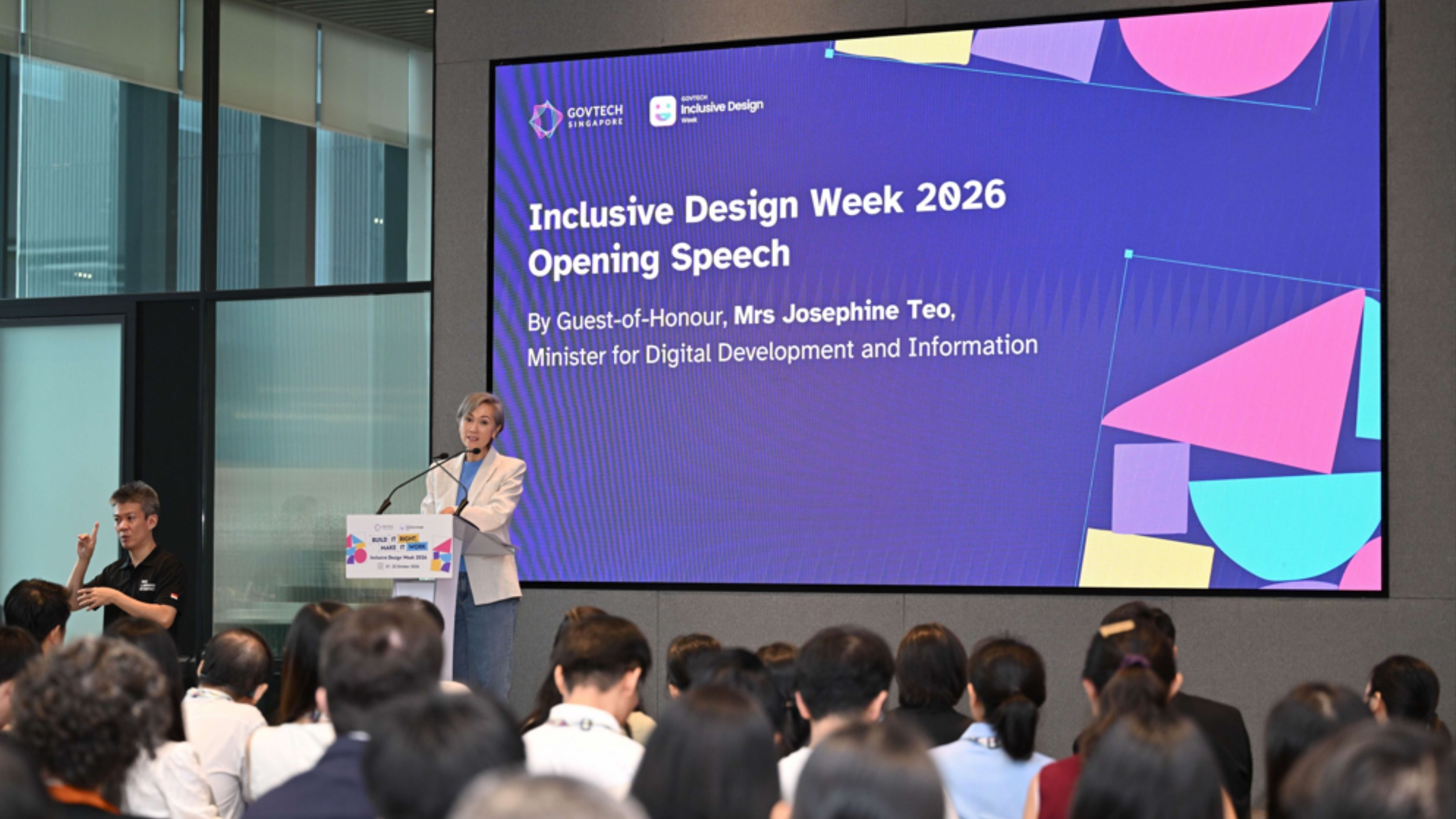
Minister for Digital Development and Information Josephine Teo delivering the Welcome Address at GovTech Singapore's Inclusive Design Week. Image: GovTech Singapore
For most Singaporeans, eating at the hawker centre is simple enough.
But for visually-impaired diners, this is done in about 12 steps, a finding that was shared by a team of Singapore public officers.
So, many of these diners end up not going on their own.
Genevieve Yip, Product Designer, Skills and Workforce Development Agency (SWDA), notes this finding from her team's interviews with and observations of visually impaired users.
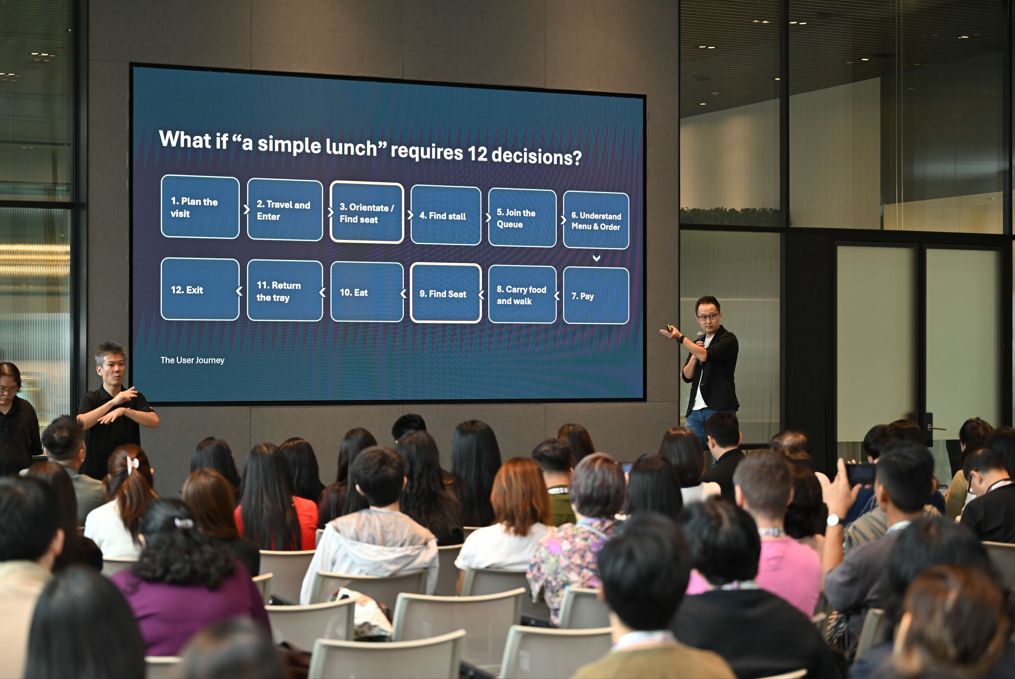
Week 2026. Image: GovTech Singapore
Her team, LetsGo, prototyped a mobile app that guides visually impaired diners to an available table at hawker centres through audio connected with Bluetooth technology.
LetsGo was one of the 17 prototypes built at GovTech Singapore's first Inclusive Design Challenge showcased at the Inclusive Design Week (IDW) that started on October 21.
Yip, alongside four other public officers coming from the workforce, urban redevelopment and social and family development agencies, chose to tackle this accessibility challenge.
Good intentions don’t guarantee inclusive services, so the challenge gave public officers and tertiary students a hands-on experience designing solutions alongside users of different needs.
Across two months, 17 teams made up of more than 60 participants worked alongside GovTech's mentors and industry experts to design and test prototypes that tackle everyday accessibility challenges.
These common challenges were scoped around digital services and public infrastructure identified by persons with disabilities (PwDs), community advocates, accessibility experts, and government agencies.
Speaking to GovInsider, Joy Ng, Head of the Chief Digital Experience Office at GovTech, highlights three points for organisations to move from good intentions to inclusive services.
These include bringing users into the room early, building on existing accessibility standards, and keep tracking where people still struggle.
The challenge aimed to kickstart a culture about designing inclusively from the start of a product or service development, says Ng.
We also speak with three teams to find out how Ng's points played out in practice, from LetsGo, more accessible medical kiosks and digital payment platforms.
Put users in the room, then prioritise
Step one, according to Ng, is ensuring that the people you're designing services for are physically in the room and testing the services.
The users need to include PwDs, seniors and even people who are not confident with using technology.
“The moment the product team sees them struggle, they will change their prioritisation,” she notes.
That was what happened to the team prototyping accessible medical kiosks.
Accessible medical kiosks tackled the challenges of small touch targets and limited audio guidance, which make it difficult for PwDs to complete transactions independently.
The team was made up of officers from Enterprise Singapore (ESG) and the Ministry of Energy, Trade, and Industry (METI).
It started with a survey of slightly under 50 people and recruited five across visually impaired users, wheelchair users and seniors for usability testing.
Observing how the users use the kiosk showed problems the team had not anticipated.
“For us it’s just like one second,” says METI's senior designer, Seow Zhi Hao, to GovInsider, on scanning an identity card at the kiosk.
For wheelchair users, the card scanner can shine straight into their faces, he notices.
The team also learnt why older users often look for help instead of trying to use the kiosk themselves.
ESG's senior business partner, Syed Sharaf Ibrahim, says the kiosk needed to look simple to use, so that seniors feel they can "just scan and get going."
Watching users also showed divergence in what they said and what they actually did, adds Sharaf.
The importance of watching users was also highlighted by the LetsGo team.
Watching how their GovTech mentor made his way to meet the visually impaired users at the hawker centre, they found that white tables against white floors were hard to see, and that decals stuck on tables can be mistaken for someone’s belongings which can make a free seat look reserved in the Singapore's context.
Use the standards that already exist
Ng's second step is to avoid reinventing the wheel and take reference from the existing accessibility standards and tools.
In her opening address, Minister for Digital Development and Information, Josephine Teo, noted that standards were just the starting line, adding that Singapore refreshed its Digital Service Standards just last year.
"A service may tick all the right boxes and still be confusing or difficult to use,” she cautioned.
As a result, GovTech begun piloting a new approach to its Mystery Shopper Programme in which real users, including those with accessibility needs, complete government service journeys as they would in everyday life.
On not reinventing the wheel, students at Temasek Polytechnic decided to relook existing accessibility guidelines around digital payment platforms and developed a framework of best practices that any bank could adopt.
Asking seniors to learn a new app would break their muscle memory, say Vu Phuong Quyen and Razon Jana Jireh De Leon, students from the School of Informatics & IT at Temasek Polytechnic, to GovInsider.
While many seniors use digital payments, that is different from feeling confident doing so, they highlight.
These best practices include announcing which screen a user is on, putting important information first, clearly labelling buttons based on what they do (e.g. "confirm payment" instead of just "proceed"), announcing if a payment has succeeded or failed, offering next steps after failure and clearing irrelevant content from the screen.
A GovTech mentor’s advice had shaped the second behaviour: “Just because you can see it doesn’t mean you need to see it.”
For example, details such as an account number can sit behind a “more details” button.
Track where people fail, and keep going
Once a product is made accessible, continue track your accessibility efforts and see where people still fail, says Ng.
METI's Seow says that "design [for inclusivity] is never ending… accessibility is really not one-size-fits-all.”
The measure of success is also determined when a service gets used.
“It’s when visually impaired users do actually download it and use it in their day-to-day life,” says the SWDA's product designer, Tay Yu Qing, who was part of the LetsGo team.
"All the apps we use are getting better and public service apps need to keep up. What felt like a good experience may no longer feel so in a matter of months, if not weeks," said Minister Teo.
Inclusion isn’t only a designer’s job
“The tech solution was only the tip of the iceberg,” says SWDA's Tay, with Yip adding that the physical environment and policy need to be considered for inclusion.
The LetsGo team also included an architect who, after the team's research, proposed physical improvements to a hawker centre which could include high-contrast tables and chairs against the floor, no decals on tables, and quieter zones.
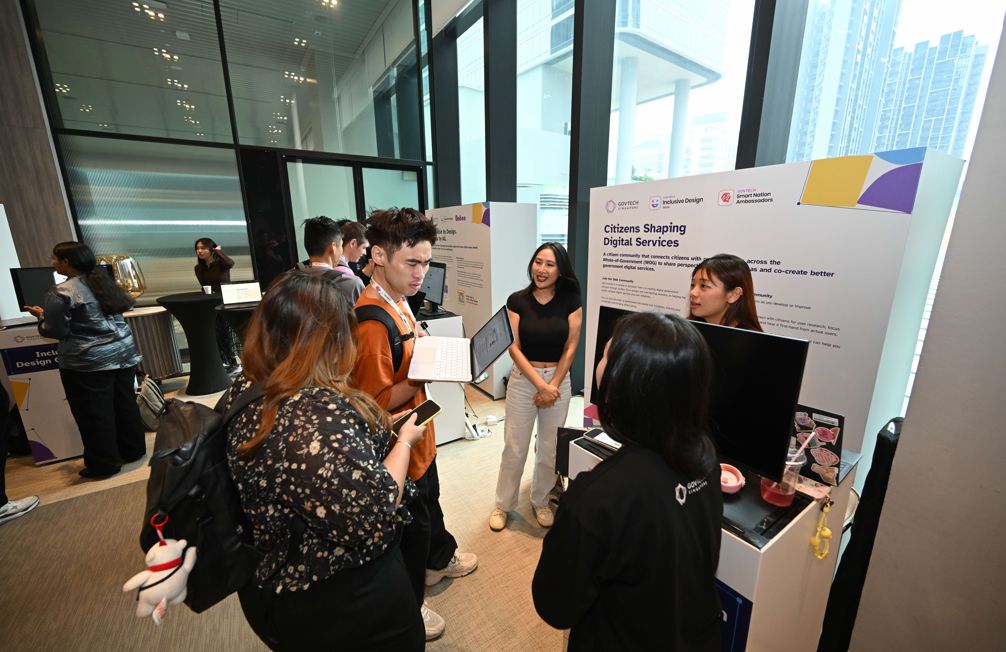
booths showcasing inclusive
design initiatives and solutions at
Inclusive Design Week 2026. Image: GovTech Singapore
Involving students in the challenge was also intentional as they are “not constrained by the practicality,” says Ng, adding that students bring fresh ideas to problems officers have seen year after year.
On the other hand, public officers understood the constraints of government, which keeps these ideas grounded.
The shift in mindset was what the challenge set out to spark.
ESG's Sharaf, who works in procurement and project management, shares how he became more mindful of exclusion practices after a wheelchair user whom he wanted to interview asked if his office had a ramp.
Working out the answer showed him that reaching the building without steps was harder than he had assumed, and left him feeling unjustified.
As for next steps, while Ng says that it's still too early to commit to taking any prototype forward, GovTech will continue to work with sectoral agencies to explore use cases for promising ideas.
The agency will also publish lessons from the challenges for the wider public sector.