
UiPath bets on business orchestration, not just automation, to scale enterprise AI
By UiPath
Discussions at UiPath FUSION Singapore revealed a clear gap between adopting AI and successfully scaling it across enterprise operations.
-1784081049814.jpg)
Discussions at UiPath FUSION Singapore revealed a clear gap between adopting AI and successfully scaling it across enterprise operations. Image: UiPath
It is one thing to experiment with artificial intelligence (AI); it is entirely another to have it deeply embedded into everyday business operations that actually drives significant impact.
That tension was addressed at UiPath FUSION Singapore event on May 5, where the business orchestration and automation company made its case for why orchestration, and not just AI tools alone, is necessary to scale enterprise AI adoption.
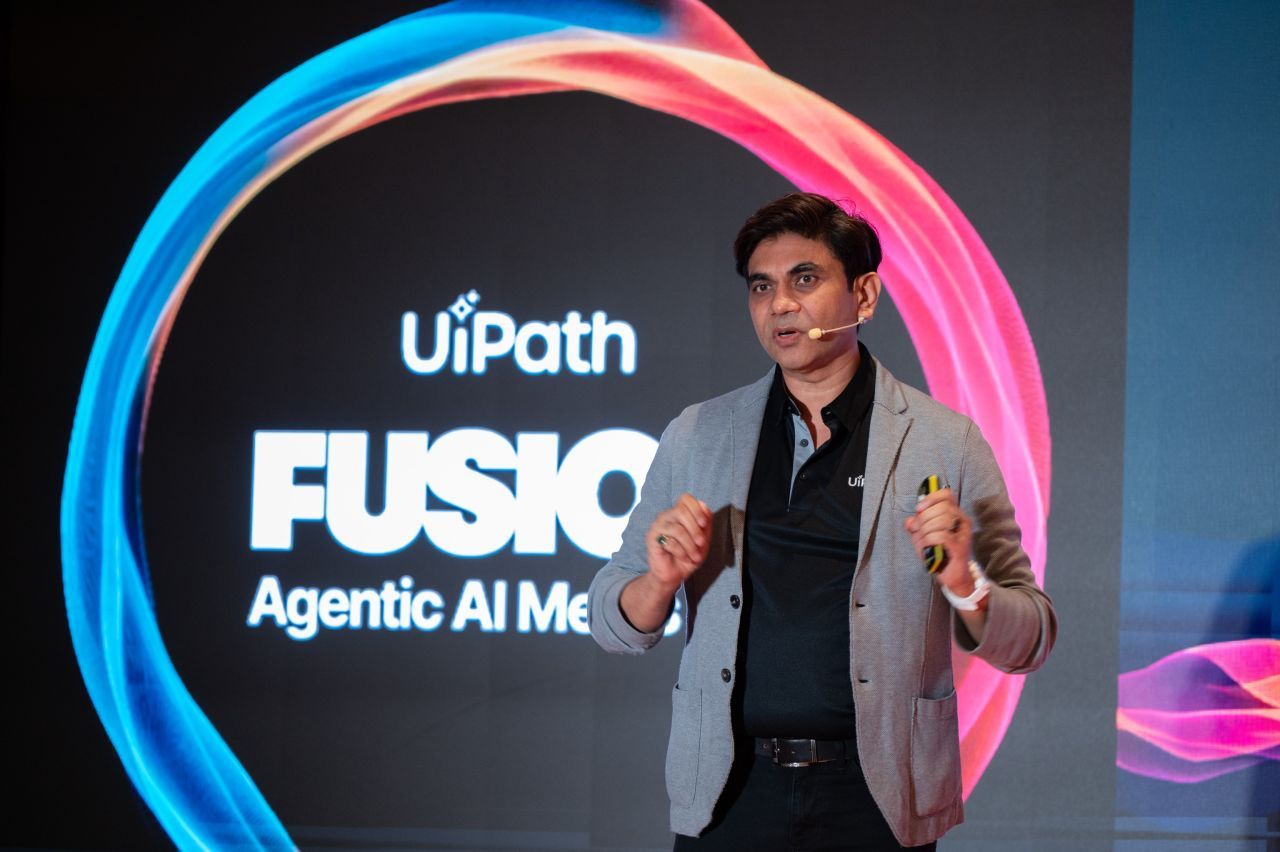
UiPath’s Regional Vice President and Managing Director for Southeast Asia, Amit Khandelwal, highlighted that while organisations have layered AI tools across their operations, many are still running the same underlying processes.
He cited that finance departments are still manually reconciling data at the end of the month or quarter to ensure numbers are correct.
"Earlier this year, Singapore launched its first National AI Council with a clear directive from the Prime Minister. Organisations must stop experimenting in silos and start deploying AI with agility to realise true business value," Khandelwal told the audience.
"The defining question for leaders today is: ‘Are you using AI, or do you want to run AI on your enterprise?’”
From bots to agents
Making that leap requires a fundamental shift in how automation is deployed.
For early adopters in the financial services and insurance sectors, this means moving away from basic robotic process automation (RPA) and embracing agentic AI.
While the broader industry has recently been fixated on rapid generative AI experiments, true transformation requires far deeper groundwork.
Many insurers and banks actually began their automation journeys years ago, deploying hundreds of RPA bots to gather raw text from PDFs, emails, and backend systems across core workflows like claims management and policy administration.
Yet, for all the wins of traditional RPA, it has limitations. Because it relies on strict rules and structured inputs, basic bots often hit a wall when faced with unstructured data, nuanced business logic, or sudden exceptions.
Overcoming those limits requires a new approach to automation altogether. Leveraging platforms like UiPath, financial services institutions are shifting to a new model where agents think, robots do, and people lead.
While traditional RPA is stuck following a rigid script, agentic automation brings flexibility to the process. These systems can look at an overall goal, interpret messy or unstructured information, and figure out the best combination of tools and steps to get the job done.
By building this intelligence directly onto an established foundation, financial institutions can completely redesign core operations like loan origination and compliance workflows from end to end.
In lending, AI agents work seamlessly with existing loan origination systems, core banking platforms, and data sources to streamline the manual loan setup and quality control processes.
In fraud detection, specialised AI agents can independently analyse watchlist alerts and cross-reference contextual information across internal and external data sources to isolate and elevate genuine risks to human investigators.
Additionally, dedicated adverse media agents continuously scan multiple news and information sources to flag negative mentions early on.
This cuts down hours of manual research time and provides an early warning for fraudulent or high-risk client relationships, while vastly improving review consistency and expanding risk coverage.
Moving from basic bots to agents, however, requires deep organisational change.
To truly optimise agentic AI adoption, business units must actively re-orchestrate their workflows, establishing a unified ecosystem where autonomous agents, dependable robots, and human expertise work in seamless harmony.
Orchestration as the missing layer
To bridge the gap between AI potential and operational reality, UiPath highlighted its four-pillar platform vision: agentic automation, business orchestration, industry solutions and AI-augmented testing.
This vision is anchored by UiPath Maestro™, an orchestration layer that connects agents, robots, humans, and data into managed workflows.
While traditional RPA is deterministic and rules-based, the current generation of agentic systems can reason through documents, handle complex exceptions, and escalate decisions to humans when needed.
Bringing this vision to life, UiPath shared how it has co-developed purpose-built solutions for finance and accounting, retail, healthcare, and supply chain.
Because these solutions are pre-configured with industry-specific business logic, they are designed to go live in weeks rather than quarters.
This outcome-driven approach is backed by industry data.
Speaking at the event, Deepika Giri, Associate Vice President at IDC Asia/Pacific, pointed out that the region has reached a decisive turning point where boards are aggressively demanding measurable return on investment (ROI) from AI.
"Agentic business orchestration provides the essential control layer to operationalise AI at scale, enforce governance, and connect automation directly to measurable business value," Giri explained.
"Orchestration is the bridge that binds fragmented AI investments, translating them from impressive standalone demos into enterprise-wide outcomes."
Crucially for public sector agencies and highly regulated enterprises, UiPath Platform now offers flexible deployment options across cloud-hosted or self-hosted environments—running natively across AWS, Microsoft Azure, and OpenShift.
The enhancement provides UiPath customers globally with the option to deploy agentic AI within their own infrastructure via cloud-hosted or self-hosted large-language models, giving customers control over domestic data residency without sacrificing enterprise-grade automation capabilities.
Automation is not an IT project
The deeper takeaway from UiPath FUSION Singapore centred around ownership. Enterprises must think of robots and agents as employees of the organisation.
In practice, this means that technology is only part of the equation. Process ownership must sit with the business, change management cannot be left solely to IT, and success must be judged by business impact rather than deployment numbers.
Another critical factor for enterprise success is maintaining trust through visibility and transparency. Maestro addresses this by serving as a centralised control plane that offers real-time visibility into agentic workflows while enforcing unified governance controls.
The conversations at UiPath FUSION Singapore also suggested that the organisations that are poised to gain the most from agentic AI are not necessarily those with the most sophisticated technology stacks.
They are the ones who have made the harder organisational commitment: treating agentic automation as a core business transformation, building governance into the foundation, and moving decisively from experimentation to enterprise execution.
That, more than any individual platform feature, is what separates those who are merely using AI from the enterprises winning in the AI era.
Take control of your AI infrastructure and leverage the power of advanced AI agents. Explore how UiPath helps public agencies gain the visibility, governance, and control required to run mission-critical workflows securely.